
Nvidia’s $2 Billion CoreWeave Deal Redefines the AI Copper Narrative
Gridlock Over Gold Rush: Unpacking the Hidden Commodities Play Behind the AI Super-Cycle.
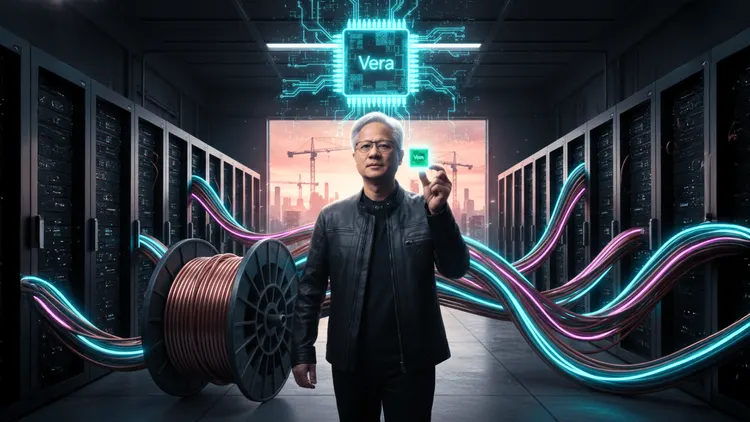
Nvidia Corp. (Nasdaq: NVDA) CEO Jensen Huang is once again writing checks to his own customers, but this morning’s $2 billion investment in CoreWeave (NASDAQ: CRWV) isn’t just another headline about the circular economy of AI financing. While Wall Street obsesses over the valuation at $87.20 a share, commodity traders should be looking at the fine print. The announcement of the new "Vera" standalone CPU and a massive 5-gigawatt infrastructure target effectively rewrites the playbook for the critical minerals supply chain, delivering a sobering reality check to the copper super-cycle hype.
For the past year, copper bulls have been fueled by a now-infamous clerical error that suggested AI data centers would consume half the world's copper supply. When Nvidia inadvertently published data suggesting a single gigawatt of compute would require half a million tons of copper, prices surged. It turned out to be a unit conversion error, likely confusing tons with pounds, and the real figure was subsequently corrected to a modest 200 to 500 tons per gigawatt.
Today's deal with CoreWeave drives this point home. CoreWeave is racing to build 5 gigawatts of capacity by 2030, a scale that would require a mountain of metal rivaling the output of a major mining nation if the old math were true. In reality, the copper required for the servers themselves is negligible compared to global production. The "Vera" CPU and the broader Rubin architecture are designed for density and efficiency, not for hoarding red metal, meaning investors betting on a copper shortage based solely on chip demand are trading on a fantasy that has already been debunked.
However, the bears shouldn't get too comfortable because the "bottleneck" executives at Nvidia keep citing isn't silicon; it's voltage. While the servers might be lean, the 5-gigawatt power target is a monster, roughly enough to light up nearly 4 million homes. Connecting these AI factories to the grid requires thousands of miles of high-voltage transmission lines, massive substation upgrades, and transformers the size of school buses. These components are non-negotiably copper-intensive, proving the demand hasn't disappeared, it has just migrated from the sexy, high-tech server racks to the boring, unglamorous utility poles outside.
The debut of the Vera CPU as a standalone product also signals the death knell for air cooling, ushering in an era of liquid-cooled systems that trade aluminum heatsinks for complex plumbing. This shift creates a new, quieter pressure on the supply chain: rare earth elements. Liquid cooling systems rely on high-performance pumps to circulate fluid through the racks, and these industrial pumps depend on powerful permanent magnets made from Neodymium and Dysprosium. As CoreWeave scales up its liquid-cooled infrastructure, the reliance on these Chinese-dominated supply chains intensifies, trading a perceived copper crisis for a very real geopolitical vulnerability in rare earth magnets.
This latest investment ultimately validates that the AI build-out is moving from a sprint to a marathon. For the minerals market, it’s a signal to stop looking at the microchips and start looking at the macro-infrastructure. The copper play isn't dead, but it’s no longer about the wiring inside the data center, it’s about the massive, copper-hungry grid required to turn the lights on.