
Brian Belski’s Mic-Drop: “This Isn’t a Bubble, It’s a VIP Room”
Wall Street Veteran Schools the Doomsayers: Why the “AI Bubble” Panic Is Premature and What Actually Signals the Endgame
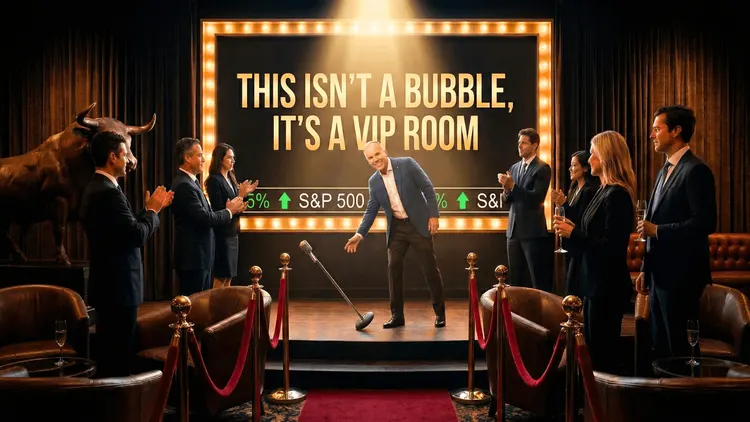
While half the internet is busy declaring the AI trade dead for the third time this year, Brian Belski, CEO and Chief Investment Officer of Humilis Investment Strategies, strolled onto Yahoo Finance this morning and delivered one of the most refreshingly blunt takes of the quarter: calling the current AI bubble narrative “ridiculous.”
And no, he didn’t whisper it. He shouted it, then doubled down for fourteen glorious minutes.
“Just because prices go up doesn’t mean it’s a bubble,” Belski told host Julie Hyman. “Bubble is one of the most overused words in the financial industry.” Translation: calm down, keyboard Cassandras.
His definition of a real bubble is simple and devastatingly accurate: universal froth. A moment when literally everyone—investment banks, brokers, CEOs, your Uber driver, the guy who sold pets.com socks—is getting stupidly rich at the same time. Think late-1999, when private-client accounts were 90 percent tech stocks and companies were buying each other with Monopoly money printed on Napster CDs. Or 2007, when every mortgage originator from Miami to Fresno was buying a second yacht.
That, Belski says, is not what we have in December 2025.
What we have instead is a handful of genuinely profitable, cash-gushing giants—<a class="tvreplink" target="_blank" href="https://www.tradingview.com/chart/?symbol=Nasdaq%3AMSFT">Microsoft, Google, Amazon, Nvidia, Apple—making actual money from actual AI workloads while the rest of the market argues about whether the party is over. Investment banks are not yet swimming in garbage-tier AI IPO fees. Retail investors are not margined to the eyeballs buying three-letter tickers with no earnings. Margin debt sits at roughly 1.1 percent of GDP, a far cry from the 2.8 percent peak of the dot-com mania.
In other words, the orgy phase hasn’t started. We’re still in the VIP-room only.
Belski’s most provocative prediction? The Magnificent Seven as we know it will look completely different twelve months from now. “I’m going to be brash,” he grinned. “A year from now those seven companies will be different companies.” He’s already watching the dispersion happen in real time: Meta and Google crushing it on fundamentals, Tesla behaving like the consumer-discretionary car stock it actually is, and Nvidia so gargantuan (8 percent of the entire S&P 500) that being meaningfully overweight is mathematically painful.
His shopping list for the next decade remains unapologetically concentrated in American mega-cap tech, with particular love for Google (“YouTube alone is bigger than Netflix”), Microsoft (“best management team in tech”), Amazon’s AWS cash machine, and Apple’s absurd fortress balance sheet. Nvidia? Still owns it, still respects Jensen Huang’s visionary status, but has stayed neutral to underweight purely because of index weight constraints—refreshingly honest in an era when most strategists feel compelled to genuflect at the altar of the chip king.
Perhaps the most bullish undertone of the entire interview: Belski believes we remain in a 25-year secular U.S. equity bull market that began in 2009 and still has another decade to run. The next ten years, however, will reward stock-pickers far more than the passive index huggers who feasted in the previous decade.
So the next time someone breathlessly tells you the AI bubble is about to pop, you can smile and channel Brian Belski: “Show me the universal froth first. Until the dog-walker is flipping AI micro-caps and Goldman is underwriting a company that sells AI-powered toothbrushes at 200 times revenue, spare me the obituary.”
The party isn’t over. It hasn’t even sent the open-bar invite to the general public yet.
Source: Yahoo Finance Market Catalysts interview with Brian Belski, CEO & CIO of Humilis Investment Strategies, hosted by Julie Hyman, published December 10, 2025, full video and transcript available on Yahoo Finance. All quotes and market observations in this article are drawn directly from that appearance and contemporaneous market data as of December 10, 2025 close.