
The US Rush to Secure AI’s Raw Materials Enters Overdrive
Washington rallies key allies to rebuild the minerals, semiconductor, and energy systems underpinning the global AI race.
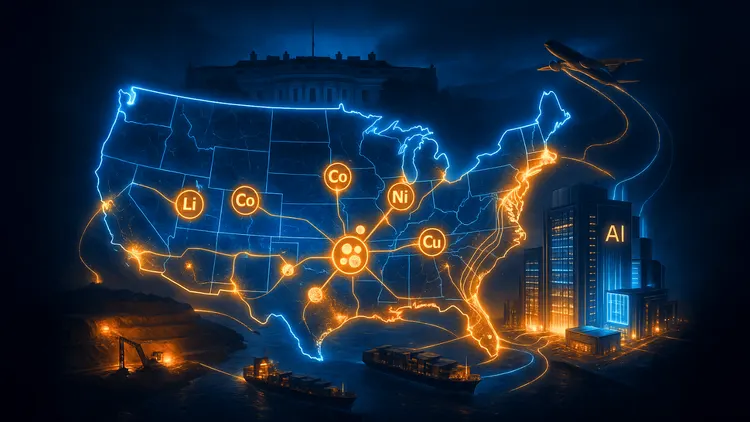
The United States is accelerating efforts to secure the minerals, materials, and high-end manufacturing capacity that power modern artificial intelligence, launching a new initiative that places supply chains at the center of geopolitical competition with China. This shift isn’t subtle. It’s strategic, it’s urgent, and it’s being orchestrated directly from the White House.
On December 12, US officials will meet with representatives from eight key allies — Japan, South Korea, Singapore, the Netherlands, the UK, Israel, the UAE, and Australia — in a high-level summit designed to lock in new agreements across critical minerals, semiconductors, energy, transportation logistics, and AI infrastructure. The message is unmistakable. AI dominance won’t be decided solely by breakthroughs in code. It will be decided by who controls the minerals that power the chips that run the models.
A Two-Horse Race: The US and China
Jacob Helberg, the State Department’s undersecretary for economic affairs and a former Palantir adviser, describes the moment bluntly: “Right now in AI, it’s a two-horse race — it’s the US and China.” His goal is to ensure the US stays ahead by eliminating the “coercive dependencies” that have allowed Beijing to weaponize control over minerals and manufacturing.
The US has spent years trying to weaken China’s dominance in critical minerals. The Trump administration launched the Energy Resource Governance Initiative, targeting lithium and cobalt supply chains. The Biden administration expanded the approach through the Minerals Security Partnership, steering Western capital into strategic mining jurisdictions. Yet China still controls more than 90% of global rare earths and permanent magnet refining — a leverage point Beijing has already used through export controls and political pressure.
Why This New Initiative Is Different
Helberg’s plan is narrower, more aggressive, and more rooted in national security. Instead of building a sprawling coalition, it focuses on nations that either produce critical minerals, build semiconductors, or anchor advanced AI ecosystems. Each ally plays a specific role.
Japan and South Korea hold indispensable semiconductor expertise. The Netherlands controls the chipmaking tools that constrain global supply. Israel and Singapore bring AI infrastructure and cyber-capability. Australia and the UAE provide mineral wealth, capital, and energy security. The UK contributes diplomatic weight and regulatory alignment.
This alignment is intentional. The White House wants coordination among partners that can actually move the needle — not symbolic signatures on generic communiqués.
Breaking China’s Grip on Rare Earths
Washington remains acutely aware of its vulnerability. China’s 90% share of rare earth refining is not just an economic advantage — it’s a geopolitical weapon. The tightening of export controls in October, followed by a temporary suspension after a Trump–Xi meeting, underscored the fragility of global supply.
Helberg’s initiative attempts to build parallel processing routes, diversify upstream mining, and anchor midstream manufacturing in allied jurisdictions. But it also recognizes that the AI competition spans far beyond minerals alone.
AI Infrastructure Requires a Total Supply Chain Rethink
Building and running AI systems requires massive amounts of energy, copper, steel, high-grade silicon, and power-dense chips. Data centers behave like industrial facilities. Transmission lines, ports, fabrication plants, and shipping lanes matter just as much as algorithms.
This is why the December summit includes discussions not only on minerals and chips, but on advanced manufacturing, logistics corridors, transportation routes, and resilient energy grids. The AI race now runs through everything from lithium deposits in Australia to ports in Singapore to advanced chip fabs in Japan and South Korea.
An America-Centric Framework With Global Ambition
Helberg frames the initiative as “America-centric,” not anti-China. The distinction matters. Rather than reacting to Beijing’s moves, the US is trying to architect a system that supports its own growth — and the growth of allies who see AI as an economic and military multiplier.
Countries joining the summit understand the stakes. AI will shape GDP growth, defensive capabilities, and technological sovereignty. They want to be part of the AI boom rather than dependent on Beijing-centric supply chains.
The Next Phase of the US–China Rivalry
The Biden and Trump administrations both recognized the mineral bottleneck years ago. But the explosion of generative AI has pushed the issue from a niche industrial concern to a central national-security priority. The US isn’t just trying to secure minerals anymore — it’s redesigning the architecture of AI itself.
If this initiative succeeds, it could create the first credible alternative to China’s mineral-to-manufacturing dominance in more than three decades. If it fails, the US risks building its digital future atop supply chains it doesn’t control.
Conclusion
The global AI race is no longer just about chips, models, or compute. It’s about minerals, grids, refineries, ports, and the alliances that bind them. The White House’s new initiative marks a decisive shift: AI supremacy starts beneath the ground, long before a line of code is ever written. And in a world where China still controls the choke points, the US is moving fast to rebuild the foundations of technological power.