
Jensen Huang Trades His Leather Jacket for a Lab Coat
The tech and pharma titans are building a billion-dollar "AI Factory" in the Bay Area, signaling a massive shift from experimental biology to computational brute force.
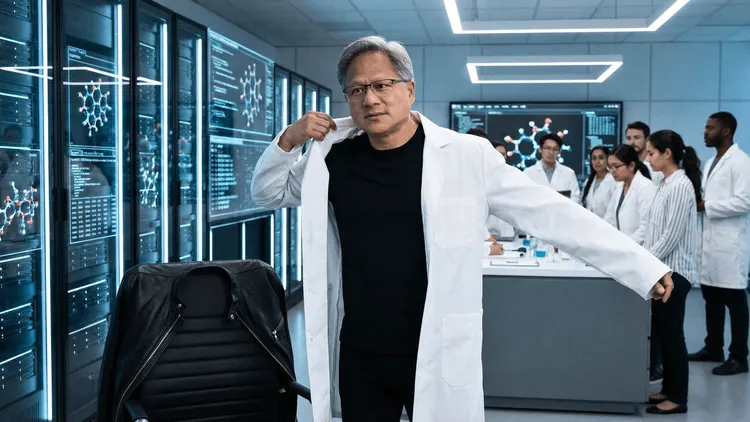
If you thought the AI revolution was just about chatbots writing poetry or generating surreal videos of cats in space, you might want to sit down. The world’s most valuable chipmaker and the pharmaceutical titan that redefined weight loss have decided to move in together, and their new address is a $1 billion laboratory in the San Francisco Bay Area.
Nvidia and Eli Lilly announced on Monday a massive joint venture that effectively blurs the line between silicon and biology. The two giants are pouring a combined $1 billion over the next five years into a facility designed to do one thing: teach computers how to invent medicine. This isn't just a partnership; it’s a signal that the future of drug discovery is no longer about pipettes and luck, it’s about sheer computational brute force.
Silicon Valley Meets "Wet Lab" Reality
The headline numbers are eye-watering, but the mechanics are where things get interesting. The new lab will feature what the companies call "agentic wet labs", a fancy way of saying robotic laboratories controlled by AI agents. These systems will autonomously design experiments, synthesize chemical compounds, run tests, and then feed that data back into the model to learn from the results. It is a closed loop of trial and error, running 24/7 without a coffee break.
Fueling this machine is Nvidia’s latest hardware. The lab will be powered by the much-anticipated "Vera Rubin" architecture, the next-generation chips succeeding the Blackwell series. This confirms that Nvidia sees biology not as a side project, but as a computational problem on the scale of training a large language model. For Lilly, it’s a chance to skip the decade-long slog of traditional drug development. CEO David Ricks didn't mince words, suggesting the collaboration could "reinvent drug discovery as we know it" by exploring vast chemical spaces in the digital realm before ever mixing a solution in the real world.
The "Data Scarcity" War Begins
For investors and industry watchers, the subtext of this deal is screamingly loud. The low-hanging fruit in AI drug discovery has been picked. The challenge now isn’t just having a smart algorithm; it’s having the data to teach it. By physically co-locating Nvidia’s engineers with Lilly’s biologists, the companies are admitting that the next breakthrough requires a merger of cultures. The tech guys need the biological "ground truth" that only a 150-year-old pharma company can provide, and the pharma guys need the compute power to make sense of it.
This creates a fascinating ripple effect for the rest of the market. Small-cap biotechs and junior players are now staring at a new reality where the barrier to entry is a billion-dollar supercomputer. The days of pitching a "proprietary algorithm" are likely over. The new currency is proprietary data, unique biological libraries that the giants can’t just simulate.
A New Era for Medicine?
While Wall Street debates whether this is another sign of an AI bubble or the start of a healthcare golden age, the intent is clear. Jensen Huang, Nvidia’s leather-jacket-clad CEO, has long predicted that digital biology would be the "next amazing revolution" for AI. With this lab, he’s putting a billion dollars of skin in the game.
If this experiment works, we might look back at 2026 as the year the pharmaceutical industry stopped guessing and started computing. If it fails, well, it’s going to be a very expensive science fair project. But given the track records of the two companies involved, betting against them feels like a risky prescription.