
Trump Pushes Emergency Auction to Curb AI Energy Costs
A bipartisan push to make data centers pay for their own electricity hits a snag: nobody told the grid operator.
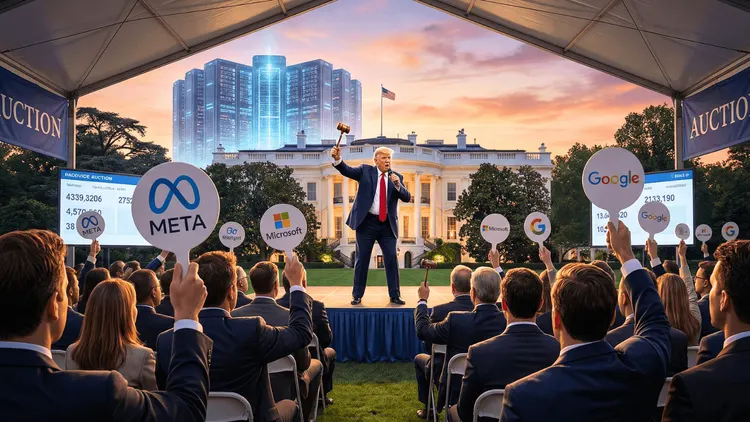
President Trump has a plan to keep your lights on while ChatGPT learns to write poetry, and it involves a heavy dose of “pay-to-play” for Silicon Valley. In a strategy session slated for today at the White House, the administration is set to unveil an "emergency wholesale electricity auction" designed to force tech giants into funding their own energy gluttony.
The logic is simple: if Big Tech wants to drink from the firehose of the American power grid, they need to pay for the plumbing. But in a twist that would make a sit-com writer blush, the entity actually responsible for that plumbing, PJM Interconnection, the nation’s largest grid operator, was reportedly not invited to the party.
The "You Break It, You Buy It" Doctrine
The White House’s proposal, drafted with input from a bipartisan clutch of governors, aims to compel PJM to hold a special auction. The goal? Lock companies like <a class="tvreplink" target="_blank" href="https://www.tradingview.com/chart/?symbol=Nasdaq%3AMSFT">Microsoft, Amazon, and Google into 15-year "take-or-pay" contracts. This means tech firms would be on the hook for a set amount of power whether they use it or not, providing a guaranteed revenue stream to finance an estimated $15 billion in new power generation.
The administration’s messaging is clear: regular Americans shouldn't see their utility bills spike just because a data center moved in next door. It’s a classic populist play, framing the narrative as Main Street vs. The Server Farm.
Strange Bedfellows and Missing Guests
The guest list for today’s meeting is a bipartisan fever dream. You have Pennsylvania Governor Josh Shapiro (D) and Virginia Governor Glenn Youngkin (R) expected to attend, united by the terrifying reality that their states are ground zero for data center expansion. Virginia’s "Data Center Alley" is already thirsty, and Pennsylvania is eyeing Three Mile Island’s restart to feed the beast.
Notably absent is PJM Interconnection, the organization that manages the grid for 65 million people across 13 states. Their exclusion is akin to planning a wedding without telling the officiant. A PJM spokesperson confirmed they were unaware of the event, raising awkward questions about how exactly the White House plans to "compel" an independent operator to sell contracts it hasn't agreed to design.
The Sticker Shock Politics
Behind the policy maneuver is a raw political nerve. On the campaign trail, Trump promised to cut energy bills in half. Instead, the Bureau of Labor Statistics reports that electricity prices have jumped over 5% since he took office in January 2025.
For a president who prides himself on being the "CEO of America," rising utility costs are a bad quarterly report. The auction is arguably less about grid physics and more about political insulation, creating a mechanism to blame Big Tech for future hikes while claiming credit for any stabilization.
Silicon Valley’s Counter-Programming
Tech CEOs, anticipating the crosshairs, are scrambling to prove they are good neighbors.
<a class="tvreplink" target="_blank" href="https://www.tradingview.com/chart/?symbol=Nasdaq%3AMSFT">Microsoft: President Brad Smith launched a pre-emptive PR strike this week with a "Community-First" infrastructure plan, pledging to pay for transmission upgrades so local ratepayers don't get stuck with the bill.
Meta: Mark Zuckerberg’s empire is bypassing the grid arguments entirely by going nuclear. The company announced partnerships with Vistra and others to bring new nuclear capacity online, effectively trying to build their own private power plants.
The Trump Disconnect: While the White House pushes this auction, Trump himself has suggested tech companies should simply "own their own electric" and become producers. It’s a slightly different vision, one of tech autarky versus the grid-integrated model the auction proposes.
The Federal Fracture
Not everyone is buying the "federal emergency" framing. Florida Governor Ron DeSantis has emerged as a critic from the right, framing federal AI mandates as overreach. His stance, that states should police "data center intrusions on power/water resources", highlights a growing fissure in the GOP between national populism and states' rights. Meanwhile, New York Governor Kathy Hochul is running her own play with the "Energize NY" initiative, effectively threatening to charge data centers a premium if they don't generate their own juice.
As the White House moves to sign this non-binding statement of principles, the friction between physics, politics, and profit margins is generating enough heat to power a small city. Whether it generates any actual light remains to be seen.