
Sam Altman Pours Cold Water on the Myth of the Thirsty AI
OpenAI’s chief executive dismisses data center drought rumors and argues human brains are the real energy hogs in a heated defense of AI's environmental footprint.
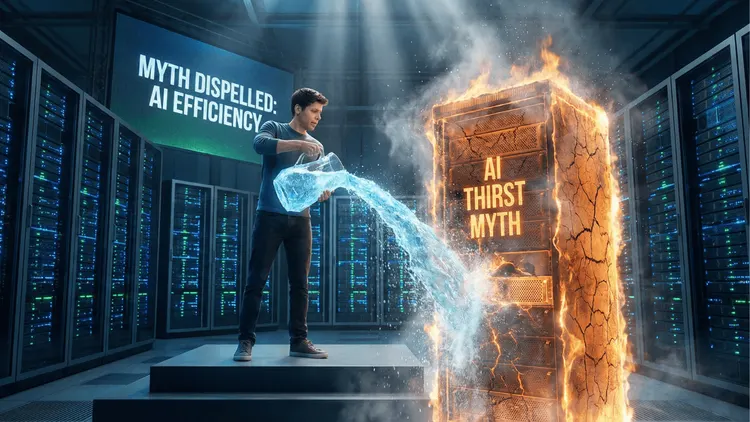
Forget the image of tech giants drinking towns dry, at least, if you ask Sam Altman. The chief executive officer of OpenAI Inc. recently took center stage at the India AI Impact Summit in New Delhi, dropping a few conversational hand grenades regarding the environmental footprint of artificial intelligence. Addressing the growing chorus of climate anxieties surrounding the AI boom, Altman didn't just walk the industry line; he completely dismissed some of the heaviest criticisms, calling them entirely out of touch with reality.
Debunking the Data Center Drought Myth
In a candid interview with The Indian Express on the summit's sidelines, Altman took direct aim at viral claims suggesting ChatGPT guzzles gallons of water for every single query. His verdict? The rumors are completely untrue, totally insane, and have zero connection to reality.
While traditional data centers have historically relied on massive amounts of water to cool their overheating electrical components, Altman firmly rejected the apocalyptic water narratives currently circulating online. The reality is that data center cooling technologies are rapidly evolving, with some newer facilities bypassing water reliance entirely. However, the debate is far from settled. Despite Altman's dismissive stance on water usage, a recent report from water technology company Xylem (NYSE: XYL) and Global Water Intelligence projects that water drawn for computing cooling could still more than triple over the next 25 years.
The Human vs. Machine Energy Debate
The narrative shifts slightly when it comes to the power grid. Altman willingly conceded that total AI energy consumption is a legitimate and pressing issue. With the world rapidly adopting AI technologies, he emphasized a desperate need to pivot toward nuclear, wind, and solar power. Yet, even while conceding the energy point, Altman couldn't resist flipping the script on critics. Specifically, he pushed back against previous remarks from <a class="tvreplink" target="_blank" href="https://www.tradingview.com/chart/?symbol=Nasdaq%3AMSFT">Microsoft (NASDAQ: MSFT) founder Bill Gates, who has often praised the energy efficiency of the human brain as the ultimate benchmark for AI.
Altman argued that comparing the energy required to train a freshly minted AI model to a human brain is a fundamentally rigged game. He pointed out that training a human takes roughly two decades of continuous life, resource consumption, and food just to get them "smart." The fair fight, according to Altman, is strictly in the inference phase, the moment an already-trained model creates new outputs. Once an AI model is fully trained, asking ChatGPT a question takes comparatively little power. Measured against a human executing that exact same task, Altman believes AI has probably already caught up on the energy efficiency scoreboard.
Pushback from Peers and the Public
Naturally, equating the human experience to a machine's lifecycle didn't land perfectly with everyone in the room. Sridhar Vembu, co-founder and chief scientist of Indian software giant Zoho Corporation, publicly bristled at the human-to-AI equivalence, firmly stating his opposition to a world where a piece of technology is equated to a human being.
This philosophical clash arrives at a boiling point for global infrastructure. According to a May report by the International Monetary Fund, the electricity devoured by global data centers in 2023 was already rivaling the national consumption of entire countries like Germany or France. Local communities are already fighting back against the physical footprint of this computing revolution. Just last week, the City Council in San Marcos, Texas, dramatically voted down a proposed $1.5 billion data center project following months of intense public opposition over potential power grid strain and spiking electricity costs.
As governments fast-track new energy approvals and environmentalists raise red flags about global net-zero goals, the tech industry is finding itself in a high-stakes balancing act. If Altman’s latest commentary is any indication, the titans of AI are no longer quietly absorbing environmental criticism. They are going on the offensive, betting big on a future powered by clean energy, and firmly asserting that artificial intelligence is well worth the wattage.