
What is the price of 60 days’ worth of mineral security for General Motors and Google?
How a $12 billion public-private gamble aims to insure the US economy against critical mineral shockwaves.
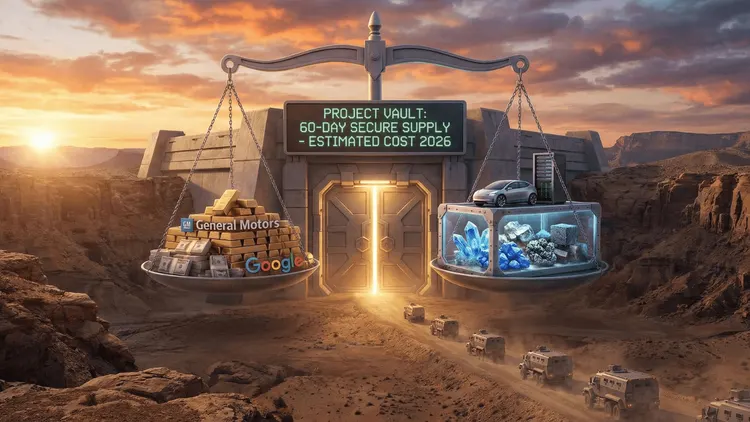
The United States has long kept a rainy-day fund for crude oil, tucked away in salt caverns to ward off the ghost of 1970s gas lines. Now, the Trump Administration is applying that same logic to the lithium and cobalt powering your iPhone and electric vehicle. Enter Project Vault, a $12 billion initiative that effectively builds a "Fort Knox" for critical minerals, minus the gold bars.
Announced this February with the ink barely dry on a $10 billion loan from the U.S. Export-Import Bank (EXIM), Project Vault is Washington’s answer to a supply chain that has become uncomfortably dependent on foreign adversaries. But unlike the taxpayer-funded oil reserve, this stockpile comes with a twist: it’s bankrolled largely by the industries that need it most.
The Billion-Dollar Buffer
At its core, Project Vault is an insurance policy for the American industrial base. The math behind it is surprisingly lean given the stakes. To secure a strategic stock equivalent to 60 days of US demand for key battery minerals in 2026, the price tag sits at just $991 million. That sub-billion-dollar figure buys a two-month safety net of lithium, cobalt, nickel, manganese, graphite, and coke, the elemental slurry required to keep gigafactories humming if global trade routes suddenly freeze.
If you widen the lens beyond batteries, the bill gets steeper. Securing a similar 60-day buffer for refined copper would add another $3.7 billion, while rare earth elements for permanent magnets, critical for everything from wind turbines to fighter jets, would cost an additional $235 million.
The "Option" to survive
The genius of Project Vault, or perhaps its gamble, lies in its funding model. Rather than the government simply buying piles of metal and sitting on them, the project has attracted $1.67 billion in private capital. Heavy hitters like General Motors, Stellantis, Boeing, Google, and GE Vernova have signed on not just as supporters, but as paying customers.
These companies pay a fee for the "option" to tap into the reserve during defined emergencies. It is a premium paid for peace of mind, ensuring that if the open market goes dark, they have a domestic hotline to physical materials. Trading houses including Hartree Partners, Mercuria, and Traxys will handle the gritty work of actually procuring the minerals, acting as the logistical muscle behind the strategic brain.
A Geopolitical chess move
The timing is hardly accidental. With China controlling the lion's share of global processing for rare earths and battery metals, Project Vault is designed to insulate the US economy from the kind of leverage Beijing has wielded in past trade disputes. It echoes the creation of the Strategic Petroleum Reserve after the 1973 Arab oil embargo, but adapted for a century where silicon and lithium matter as much as crude.
However, a stockpile is only a bandage, not a cure. Industry insiders note that while 60 days of supply can weather a storm, it doesn't solve the underlying problem: the upstream concentration of mining and refining outside US borders. Without domestic projects coming online, there is a risk that the US reserve itself could end up filled with Chinese material, a true irony for a project meant to curb that very dependence.
As the administration rolls out this metallic safety net, the question remains whether a two-month buffer is enough to calm the nerves of a jittery market. For now, though, American industry has bought itself a little time, and for under a billion dollars in battery metals, the price is right.
Sources:
- Benchmark Mineral Intelligence, "Project Vault: The cost of a US critical mineral reserve," February 2026.
- U.S. Export-Import Bank (EXIM) press releases regarding Project Vault funding.