
What Happens to Uranium in 17 Months When America Formally Cuts Off Imports from Moscow?
As the 17-month window on Russian enrichment waivers closes, a structural supply bottleneck is forcing U.S. utilities into the Athabasca Basin.
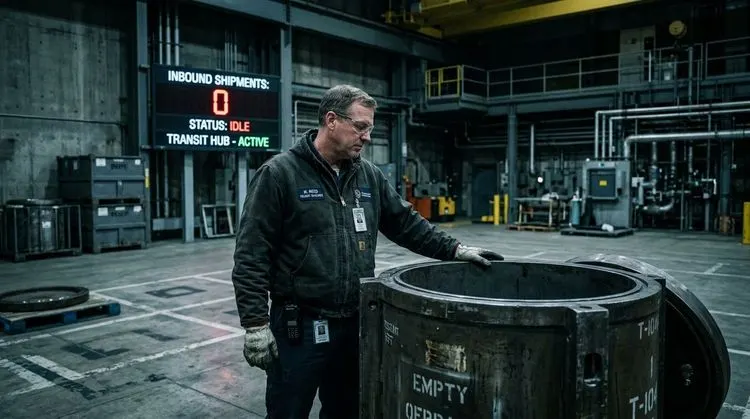
Washington's grand ambitions for a zero-carbon power renaissance face an uncomfortably ironic bottleneck: the atomic grid powering America’s artificial intelligence revolution remains quietly hitched to the Kremlin.
As energy-hungry data centers and nationwide electrification push U.S. power demand to record highs, nuclear power plant operators are grappling with a relentless clock.
Only 17 months remain on the temporary Department of Energy waivers that allow American utilities to import Russian-enriched nuclear fuel before a strict statutory embargo shuts the door entirely until 2040.
Data from the U.S. Energy Information Administration (EIA) highlights the sheer scale of America's reliance on Russian nuclear processing. U.S. reactor operators bought roughly 3.28 million Separative Work Units (SWUs), the standard physical unit measuring uranium enrichment, from Russian entities in 2025. That accounted for nearly 26 percent of all enrichment services purchased by U.S. commercial plants, up from 17 percent a decade ago.
Across the entire nuclear fuel cycle, foreign suppliers provided 77 percent of the enrichment services purchased by American utilities in 2025, with Russia reigning as the largest single seller. While Congress passed the Prohibiting Russian Uranium Imports Act in May 2024 to curb this dependence, the legislation included a temporary safety valve: conditional waivers issued by the Department of Energy when alternative supplies are unavailable. That waiver authority expires no later than January 1, 2028, leaving utility executives with a tightening window to replace a quarter of their reactor fuel.
The fundamental crisis facing utility procurement officers is not simply geopolitical; it is physical. Nuclear supply chains operate on multi-year lead times, whereas political mandates change at the speed of a pen stroke. Building high-precision gas centrifuge enrichment facilities requires billions of dollars, specialized precision engineering, and years of regulatory licensing.
Consortium-owned Urenco USA is executing an expansion at its Eunice, New Mexico facility to add roughly 700,000 SWUs of annual capacity by early 2027. However, larger domestic and allied infrastructure projects led by Centrus Energy Corp. (NYSE American: LEU) and France's state-backed Orano are not slated to deliver commercial volumes until 2029 and beyond. Facing this multi-year gap, forward-thinking U.S. utilities have begun taking the extraordinary step of contracting enrichment deliveries for post-2040—locking in operational security long after the statutory ban technically expires.
This severe bottleneck in enrichment capacity creates a direct, lucrative domino effect for primary uranium miners through a process known as overfeeding. When commercial enrichment capacity is scarce and expensive, processing facilities adjust their operations: they run centrifuges less intensively per batch of fuel and compensate by feeding significantly higher quantities of raw mined yellowcake into the machines.
Overfeeding effectively converts an enrichment facility shortage into an immediate surge in demand for raw mined uranium. Because bringing a new greenfield uranium mine from discovery to production typically takes between eight and fifteen years, utilities cannot wait for unpermitted projects to materialize. Instead, they are forced to bid up primary production from established, reliable miners in safe jurisdictions.
That flight to supply-chain security leads directly to Canada’s Athabasca Basin in northern Saskatchewan, home to the richest uranium deposits on the planet. As Western utilities systematically purge Russian political risk from their fuel pipelines, Athabasca producers are capturing a substantial jurisdictional premium.
Tier-one producer Cameco Corporation (NYSE: CCJ | TSX: CCO), alongside high-grade asset developers like NexGen Energy Ltd. (NYSE: NXE | TSX: NXE) and Denison Mines Corp. (NYSE American: DNN | TSX: DML), occupy the sweet spot of this structural shift. By offering high ore grades in a stable North American jurisdiction, Athabasca operators provide Western utilities with the one thing money cannot buy overnight: guaranteed primary uranium supply in a constrained market.
Sources
- U.S. Energy Information Administration (EIA), Uranium Marketing Report (Data compiled by Bloomberg, July 2026)
- U.S. Public Law 118-58, Prohibiting Russian Uranium Imports Act (Enacted May 2024)