
US and Saudi Arabia Sign Landmark Civil Nuclear Agreement
From crude oil to atomic power: How the newly signed 123 Agreement opens a multi-billion-dollar market for US nuclear leaders while igniting a high-stakes debate over Middle East non-proliferation.
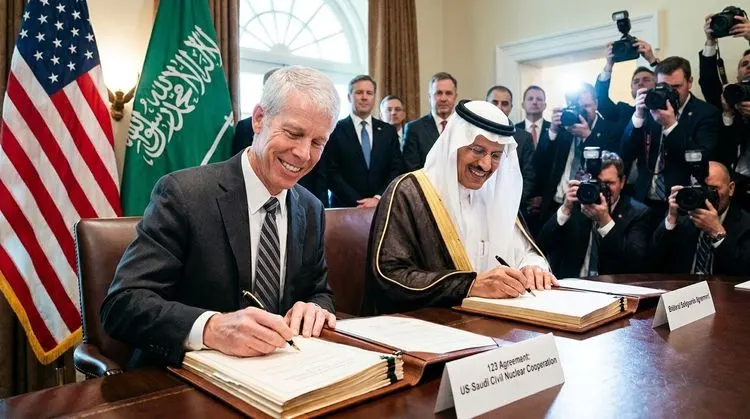
Riyadh’s long-standing ambition to trade crude oil for atomic power just took a monumental leap forward, leaving geopoliticians taking notes and nuclear engineers updating their resumes. US Secretary of Energy Chris Wright and Saudi Minister of Energy Prince Abdulaziz bin Salman signed a landmark civil nuclear cooperation agreement, commonly known as a 123 Agreement, alongside a bilateral safeguards framework.
Grounding the deal in economic and strategic terms, Wright emphasized that "these agreements reflect our two nations' shared commitment to strengthening US-Saudi commercial relations, delivering prosperity at home and security to our allies abroad," while reassuring observers that the framework upholds "the highest standards of nuclear safety and nonproliferation."
Beyond the high-stakes diplomacy, the deal acts as a direct green light for American industrial titans eager to capture a market previously eyed by global competition. Commercial contenders such as Westinghouse Electric Company, jointly owned by Brookfield Renewable Partners (NYSE: BEP) and Cameco Corporation (NYSE: CCJ), alongside small modular reactor pioneer NuScale Power (NYSE: SMR) and nuclear equipment maker BWX Technologies (NYSE: BWXT) stand to gain significant market access. Washington's diplomatic maneuver effectively edges out competing bids from state-backed international giants, including South Korea’s Korea Electric Power Corporation (KRX: 015760), China’s China National Nuclear Corporation (SHA: 601985), and Russia’s Rosatom.
Framing the commercial alignment as a vital strategic move, Jennifer T. Gordon, Director of the Nuclear Energy Policy Initiative at the Atlantic Council, observed that "a 123 agreement between the United States and Saudi Arabia is not only a win for the US nuclear energy industry. It is also a victory for the US-led global nonproliferation regime." She noted that "Saudi Arabia has made it clear that it will purchase nuclear energy technologies and begin a civil nuclear program; the only question has been whether the kingdom would choose to work with the US and its allies, or whether it would turn to Russia or China."
Naturally, no major nuclear accord arrives without a healthy dose of geopolitical friction. Unlike the 2009 US-UAE agreement, which set the non-proliferation "gold standard" by explicitly prohibiting domestic fuel enrichment, reports indicate this new framework leaves room for joint studies into domestic uranium enrichment under US-backed safeguards. Because centrifuge technology used for civil reactor fuel can theoretically be adapted to produce weapons-grade material, non-proliferation analysts are sounding the alarm. Matthew Kroenig, Vice President at the Atlantic Council’s Scowcroft Center, argued that "it would be a mistake to allow Saudi Arabia the capability for enrichment," cautioning that Washington "should not do so at the expense of its effective nuclear weapons nonproliferation standards." Rosemary Kelanic, Head of the Middle East Program at Defense Priorities, echoed those concerns even more sharply, asserting that "giving Saudi Arabia uranium enrichment technology is a terrible idea" that would "put immense pressure on Iran to get the bomb."
The debate inside Capitol Hill promises to be equally fierce as the pact heads to Congress for mandatory review under Section 123 of the Atomic Energy Act of 1954. Senator Edward Markey (D-MA) voiced severe opposition, stating that officials "are allowing Saudi Arabia, a belligerent and authoritarian nation, to develop nuclear weapons technologies... This deal would make us all less safe." Conversely, key supporters like Senator Jim Risch (R-ID) backed the alignment, affirming that "the deal stands to benefit both countries."
Ultimately, integrating atomic energy serves Saudi Arabia's core goal of shifting fossil fuel generation toward domestic export and powering water desalination facilities. But as lawmakers prepare to scrutinize every clause, the global civil nuclear race has unequivocally entered a high-powered new era.
Sources
- US Department of Energy Official Statement: "United States and Saudi Arabia Reach Historic Nuclear Cooperation Agreement" (July 22, 2026).
- Saudi Press Agency (SPA): Official Announcement on US-Saudi Intergovernmental Nuclear Agreement and Safeguards Framework (July 23, 2026).
- The Guardian: "Saudi Arabia and US strike deal for kingdom to enrich uranium" (July 22, 2026).
- Atlantic Council Policy Analysis: Expert Commentary on US-Saudi Civil Nuclear Negotiations.
- World Nuclear Association: Information Paper on Saudi Arabia Civil Nuclear Power Program.