
Inside Washington’s Multi-Billion-Dollar Plan to Nuclear-Power the Cloud
How the Trump administration’s $17.5 billion atomic gamble aims to fuel the insatiable power demands of Silicon Valley’s AI revolution.
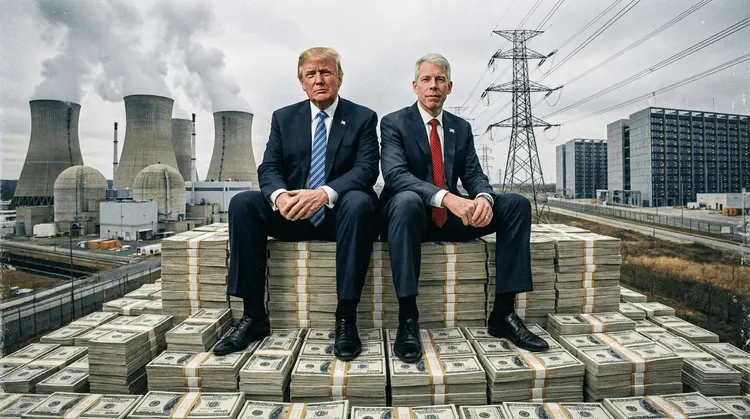
Silicon Valley’s insatiable appetite for artificial intelligence just triggered a multi-billion-dollar atomic chain reaction in Washington.
As massive data centers threaten to push regional power grids to their absolute limits, the federal government is stepping in with a heavy-metal financial firewall. On June 23, 2026, U.S. Energy Secretary Chris Wright unveiled a colossal $17.5 billion conditional loan program specifically engineered to fast-track the construction of 10 large-scale commercial nuclear reactors across the country.
Dubbed the American Nuclear Supply Chain Loans, this ambitious initiative stems from a concerted push by the Trump administration to completely revitalize the domestic nuclear industrial base and secure what the White House calls an energy addition agenda. Administered by the newly branded Office of Energy Dominance Financing (EDF), the multi-billion-dollar capital injection aims to shave up to three years off traditional nuclear development timelines. The strategic pivot focuses explicitly on one of the industry's most notorious bottlenecks: long-lead-time component procurement, which includes critical infrastructure like reactor pressure vessels, steam generators, prefabricated structural modules, and reactor coolant pumps.
Instead of acting as a standard, open-ended construction loan, this federal funding functions as a strategic bulk-purchasing order for the massive, complex components that take years to manufacture across over 100 domestic companies in 40 states. The entire $17.5 billion envelope is anchored to a single, battle-tested technology: the AP1000 pressurized water reactor designed by Westinghouse Electric Company. Because it stands as the only advanced large-scale reactor design currently licensed and operating in the United States, the federal government is effectively centering its entire next-generation grid strategy around it.
The structural mechanics of this initiative provide an immediate financial catalyst for the corporate parents behind the nuclear pioneer. Westinghouse Electric Company operates as a high-profile joint venture co-owned by Canadian uranium titan Cameco (TSX: CCO | NYSE: CCJ) and green energy giant Brookfield Renewable Partners (NYSE: BEP | TSX: BEPC). Analyzing the market implications of the massive credit facility, Craig Hutchison, a mining analyst at TD Securities, the investment banking arm of Toronto-Dominion Bank (TSX: TD | NYSE: TD), noted that the structured financing significantly improves near-term visibility and pulls forward higher-margin revenue for the venture. Celebrating the policy update, Cameco (TSX: CCO | NYSE: CCJ) Chief Executive Officer Tim Gitzel publicly stated that the right incentives are finally being created to advance the rapid deployment of AP1000 reactors on American soil.
Uncle Sam is not writing blank checks, however. According to EDF Director Gregory A. Beard, the program is a highly calculated endeavor for American taxpayers because it targets well-capitalized players with locked-in electricity buyers. To actually touch the federal loan money, Westinghouse Electric Company and its chosen utility partners must form special-purpose corporate vehicles and fully commit up to $500 million each in upfront equity per site, totaling a $5 billion equity commitment across the five chosen locations. That means a cool $1 billion in private capital must be sitting on the table per site before a single cent of federal debt is deployed.
The ultimate goal of the program is to have all 10 reactors under active construction by 2030, with full commercial operations targeted for the mid-2030s. Each individual AP1000 unit is rated to pump out 1.1 gigawatts of continuous, zero-carbon baseload electricity. Combined, the 11-gigawatt fleet will generate enough power to light up roughly 10 million traditional American homes, or keep a staggering network of advanced AI training clusters humming around the clock. Senior housing policy reporter Tristan Navera highlighted that this push comes directly amid a national explosion of power-hungry digital infrastructure, with more than 4,000 data centers currently dotting the country.
While the Department of Energy is keeping the definitive list of winners close to its chest, Westinghouse Electric Company confirmed it has already secured letters of intent with seven potential utility partners that have specific geographic sites in mind. The federal government will eventually whittle that list down to five final projects, with each location hosting a twin pair of reactors. Though government officials claim it is premature to name the seven interested companies, industry insiders and Wall Street analysts are already placing heavy bets on a familiar roster of utility giants. These corporations are currently facing an unprecedented explosion of data center demand, particularly in digital battlegrounds like Virginia and Texas, which collectively host nearly a thousand data facilities.
Among the logical frontrunners is Dominion Energy (NYSE: D), a utility wrestling directly with the immense power constraints of Northern Virginia’s Data Center Alley. Analysts are also keeping a close eye on Southern Company (NYSE: SO), which recently benefited from a separate, historic $26.5 billion EDF loan package to stabilize regional electricity costs following its Vogtle expansion in Georgia. Other highly scrutinized candidates include Midwest energy heavyweights like DTE Energy (NYSE: DTE), WEC Energy Group (NYSE: WEC), and Gulf Coast powerhouse Entergy (NYSE: ETR), alongside Mid-Atlantic pillar Public Service Enterprise Group (NYSE: PEG). Each of these corporations has an existing nuclear footprint and a built-in roster of tech hyperscalers begging for dedicated clean energy.
The massive capital injection arrives at a critical juncture for the domestic tech sector. Data center power demand is projected to more than double in the near term, prompting President Donald Trump to actively push data center developers to secure their own independent power solutions to prevent local residential utility bills from skyrocketing. While Westinghouse Electric Company President and Chief Executive Officer Dan Sumner is looking to prove that building at a "fleet scale" will prevent the chaotic delays and multi-billion-dollar budget overruns that historically plagued one-off projects, the program still faces stiff headwinds. Beyond the supply chain, these projects must navigate rigorous regulatory reviews from the Nuclear Regulatory Commission, intense localized pushback over new high-voltage transmission lines, and regional political debates concerning long-term cost allocations.
For now, the administration’s $17.5 billion gamble signals a profound paradigm shift: America’s high-tech future is officially hooking itself up to a nuclear backbone.
Sources
- U.S. Department of Energy (DOE) / Office of Energy Dominance Financing (EDF): Official announcement of the $17.5 Billion American Nuclear Supply Chain Loans issued on June 23, 2026.
- The Associated Press / BNN Bloomberg: Report by Tristan Navera and corresponding wire coverage regarding the Trump administration's June 2026 nuclear loan package for 10 new reactors.
- Cameco Corporation Corporate Communications: Press release and statements from CEO Tim Gitzel welcoming the DOE's conditional commitment to support Westinghouse AP1000 deployment.
- Westinghouse Electric Company Corporate Archive: Operational leadership details regarding President and CEO Dan Sumner.