What Do 7.83 g/t Gold Assays Mean for Kalo Gold’s Vatu Aurum Project?
High-grade surface sampling and intersecting epithermal veins spark a major geophysics and trenching campaign along Fiji’s lucrative mineral belt.
 Editorial Team (ET)September 8, 2026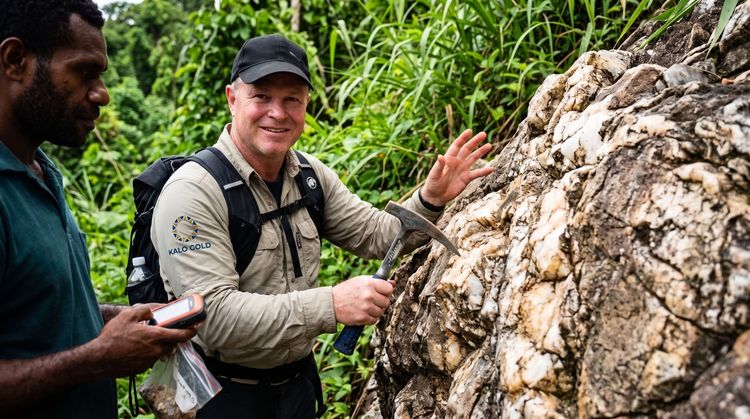
Striking high-grade mineralization on previously untouched ground is the ultimate reward for mineral explorers, and Fiji’s Pacific Ring of Fire just delivered another prime candidate. Kalo Gold Corp. (TSX-V: KALO | OTCID: KLGDF) has announced high-grade gold and silver rock sampling results from a newly identified target area at its 367-square-kilometer Vatu Aurum Project on Vanua Levu.
Collected from a single, previously unsampled outcrop dubbed the New Vein Cluster, reconnaissance rock samples yielded gold grades reaching up to 7.83 grams per tonne and silver topping 108 grams per tonne. What makes the discovery particularly compelling for exploration geologists is its remarkable consistency across the exposure. Five of the seven samples returned gold grades exceeding 2 g/t, with three topping the 4 g/t mark. Exposed over roughly 15 meters of strike length before running under soil cover, the outcrop reveals two distinct, intersecting vein sets trending north-northwest and east-west.