
Tiff Macklem Pulls the Trigger: Inside the Bank of Canada’s First Rate Hike Since 2023
Why Tiff Macklem took away the punch bowl, how Bay Street and Main Street are reacting, and what negative real yields mean for Canadian gold producers.
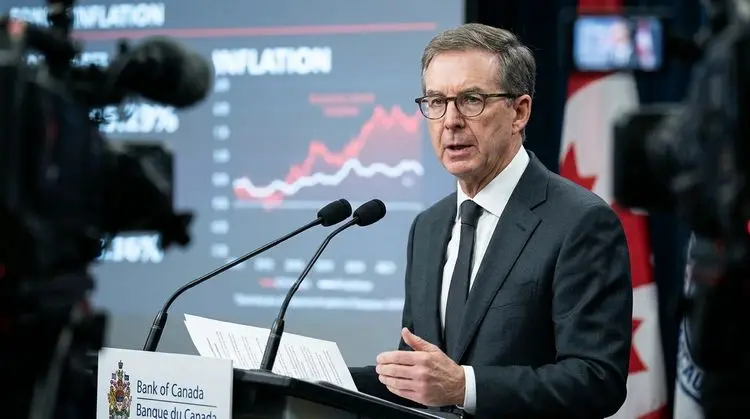
Tiff Macklem has officially taken away the punch bowl just as Canadian households and business owners were praying for an extended refill. Breaking a prolonged freeze that kept the overnight rate parked at 2.25 percent across seven consecutive meetings, the Bank of Canada has bumped its benchmark lending rate by a quarter-point to 2.50 percent. The adjustment marks Ottawa’s first rate increase since July 2023, arriving at a delicate moment when domestic growth is fragile and cross-border trade friction remains an open wound.
The central bank insists this is an act of preventative hygiene rather than an attack on domestic momentum. With annual inflation accelerating to 3.1 percent in September and geopolitical strife in the Middle East keeping crude elevated, policymakers fear that stubborn input costs are poised to infect every aisle of the retail economy. Macklem framed the dilemma plainly: Canadians are already paying painful premiums at the pump, but the governing council felt compelled to act before merchants pass persistent freight and fuel bills directly onto consumers, forcing households to effectively pay for the energy shock twice.
The bank’s revised baseline paints a sobering picture for consumer prices. Policymakers now project inflation to crest around 3.5 percent before the year wraps up, lingering at or above 3.0 percent throughout 2027 before finally drifting back toward the sacred 2.0 percent target by mid-2028. Even though the Canadian economy expanded at an annualized 3.3 percent clip in the second quarter and tracked around 2.0 percent in the third, Macklem described the policy rate as low enough that it will not strangle growth, promising that the council will deliberate on future trajectory one meeting at a time.
Bay Street economists greeted the central bank’s autumn surprise with a mixture of pragmatic validation and cautionary realism. At Canadian Imperial Bank of Commerce (TSX: CM), senior economist Andrew Grantham posited that the governing council will probably hit pause at its December session before delivering another 25-basis-point push in January. Grantham stressed that borrowing costs need not cross 2.75 percent, the midpoint of the bank's estimated neutral band, to pull consumer price trends back into alignment.
A similar tone of risk management emerged from Toronto-Dominion Bank (TSX: TD), where economist Marc Ercolao noted that the central bank acted preemptively to keep medium-term inflation from slipping out of reach. Ercolao observed that while the domestic economy possesses enough baseline resilience to swallow twenty-five basis points, broad recovery remains constrained by tighter global bond yields, U.S. tariffs, and an uneven employment backdrop that shed 68,000 net jobs in September.
Currency traders, meanwhile, spent the morning giving the Canadian dollar an unsteady reception near $0.7124 against the greenback. Karl Schamotta, chief market strategist at payments solutions provider Corpay, Inc. (NYSE: CPAY), warned that currency desks are struggling to square rate tightening against a sluggish domestic baseline. Schamotta highlighted that foreign exchange markets might be overly enthusiastic about Ottawa's hiking endurance, expecting a bout of loonie weakness before year-end as cross-border yield differentials swing back in favor of the U.S. dollar.
If financial desks viewed the rate change as calculated insurance, Main Street saw it as an unprovoked tax on survival. Simon Gaudreault, chief economist at the Canadian Federation of Independent Business, lamented that veteran entrepreneurs with quarter-century track records have rarely endured such excruciating operating overhead. With variable-rate commercial mortgages and equipment debt ticking higher immediately, Gaudreault warned that boosting capital costs in the middle of trade uncertainty will sap expansion plans and squeeze shopper wallets.
Provincial leaders were equally blunt. Ontario Premier Doug Ford branded the rate hike a massive mistake, arguing that ratcheting up credit burdens on local manufacturers and middle-class earners is a misguided response to supply shocks engineered thousands of miles away.
Prospective homebuyers will also find little comfort in the latest monetary policy report. Bank of Canada Deputy Governor Carolyn Rogers conceded that borrowing costs will weigh on residential transactions, forecasting subdued housing volume growth of around one percent over the next two years. Rogers pointed out that high structural uncertainty naturally keeps buyers on the sidelines, with cooling trends most noticeable across Vancouver and Toronto. Weighing in on the property landscape, Phil Soper, president of Royal LePage, the national brokerage network operated by Bridgemarq Real Estate Services Inc. (TSX: BRE), cautioned that prolonged softness in residential housing is already holding back overall economic momentum, a drag that higher interest payments will only exacerbate.
While conventional trading textbooks preach that higher interest rates depress non-yielding bullion, this particular macroeconomic mixture creates a unique dynamic for precious metals producers. The key lies in real interest rates: with nominal rates at 2.50 percent and domestic inflation trending toward 3.5 percent, real yields in Canada sit in distinctly negative territory. Negative real yields have historically served as a fertile environment for gold investment and safe-haven accumulation.
For heavy producers such as Agnico Eagle Mines Limited (TSX: AEM) and Barrick Gold Corporation (TSX: ABX), the landscape is a balancing act. On one hand, persistent crude oil prices drive up diesel expenses, lifting all-in sustaining costs across open-pit and underground operations. On the other hand, a soft Canadian dollar acts as an organic windfall, allowing domestic operators to pay local expenses in cheaper loonies while booking revenues in high-priced U.S.-dollar bullion.
Royalty and streaming champions occupy an even sweeter spot. Powerhouses like Franco-Nevada Corporation (TSX: FNV) and Wheaton Precious Metals Corp. (TSX: WPM) carry zero direct operational exposure to expensive heavy fuel or mine-site labor inflation. If the Bank of Canada's stubborn inflation battle keeps retail investors hunting for asset protection, streaming vehicles stand to capture rising precious metal margins while dodging the credit costs that make capital-intensive miners sweat.
Sources
- Bank of Canada: Monetary Policy Report and Press Conference Transcript, October 2026
- Statistics Canada: Consumer Price Index and Labour Force Survey Releases
- Canadian Federation of Independent Business (CFIB): Economic Research Briefing
- Canadian Imperial Bank of Commerce (CIBC) Economics: Macro Strategy Research Note
- Toronto-Dominion Bank (TD) Economics: Financial Markets Commentary
- Corpay Cross-Border Solutions: FX Market Intelligence Briefing
- Royal LePage & Bridgemarq Real Estate Services: Housing Market Outlook Report
Disclaimer
Neither the author of this article nor JuniorStocks holds equity, stock options, or any other financial positions in Agnico Eagle Mines Limited (TSX: AEM), Barrick Gold Corporation (TSX: ABX), Franco-Nevada Corporation (TSX: FNV), Wheaton Precious Metals Corp. (TSX: WPM), Canadian Imperial Bank of Commerce (TSX: CM), Toronto-Dominion Bank (TSX: TD), Bridgemarq Real Estate Services Inc. (TSX: BRE), Corpay, Inc. (NYSE: CPAY), or any other companies mentioned in this publication.
This content is published by JuniorStocks strictly for informational purposes, was prepared independently without company compensation, and utilized AI assistance for text editing, formatting, and generating accompanying media. While macroeconomic monetary shifts, interest rate trends, and the precious metals sector represent compelling areas of market analysis, this article does not constitute investment or financial advice. Investors are strongly advised to conduct their own thorough, independent due diligence and consult with a qualified financial professional before making any investment decisions.