Can $99 Million Across 21 Projects Finally Unlock America’s Unlimited Geothermal Potential?
How $99 million in federal funding, advanced oilfield drilling, and subsurface AI are unlocking gigawatts of 24/7 clean baseload power beneath our feet.
 Editorial Team (ET)September 22, 2026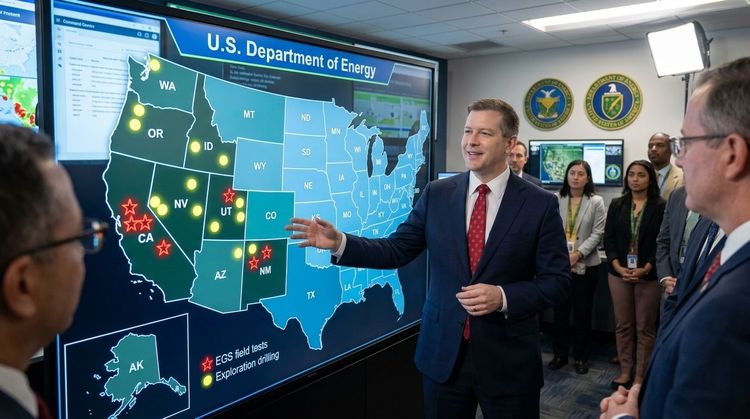
Forget variable solar arrays and wind farms for a moment.
The most reliable clean energy generator on Earth might already be sitting right beneath our feet, waiting for someone with a tough enough drill bit to tap into it. The U.S. Department of Energy (DOE) has officially selected 21 pioneering projects to share over $99 million in federal funding, launching a targeted effort to turn heat trapped miles underground into continuous, 24/7 domestic electricity.
Cracking the Code on Next-Generation Enhanced Geothermal Systems
While traditional geothermal plants rely on rare, naturally occurring hot springs, Enhanced Geothermal Systems (EGS) create engineered reservoirs deep in hot, dry, impermeable rock. Five key projects in the new DOE cohort are conducting field-scale EGS tests under real-world, high-temperature conditions.
Among the high-profile awardees, Fervo Energy Company is heading to Elmore County, Idaho, to drill, complete, and stimulate EGS wells while deploying a high-temperature three-component geophone array engineered to operate at or above 200°C. Tim Latimer, CEO and Co-founder of Fervo Energy Company, noted that horizontal drilling can dramatically improve project economics by providing consistent fluid flow and massive surface area for heat exchange.
Simultaneously, Quaise Energy is taking aim at extreme conditions on the southern flank of Oregon's Newberry Volcano, targeting bottomhole temperatures between 265°C and 365°C. Carlos Araque, CEO and Co-founder of Quaise Energy, envisions scaling the site to gigawatt-scale production, while Matt Houde, Chief of Staff at Quaise Energy and Geothermal Rising Board Member, highlights how supercritical geothermal delivers maximum baseload reliability while occupying a fraction of the land required by surface renewables.
To the south, Zanskar Geothermal and Minerals is deploying AI-assisted directional drilling and horizontal injection at the Lightning Dock field in Hidalgo County, New Mexico. Carl Hoiland, CEO and Co-founder of Zanskar Geothermal and Minerals, emphasizes that combining machine learning models with advanced drilling unlocks terawatt-scale potential, a view echoed by CTO Joel Edwards, who points out that speed and cost efficiency are essential to winning the race for carbon-free firm power.
Rounding out the EGS field demonstrations, AlterG Resources is conducting comparative hydraulic stimulation programs using plug-and-perf and sliding sleeve completions across Pershing and Churchill Counties, Nevada. At the same time, researchers at the University of Utah are designing and validating a high-performance EGS doublet at Nevada’s Dixie Valley West field to demonstrate that engineered reservoirs constructed adjacent to existing hydrothermal systems can sustain commercial thermal output.