
Trump Administration Cuts a $500M Check to Supercharge America’s Battery Minerals
The U.S. Department of Energy pours $500 million into seven domestic projects to secure critical battery supply chains, boost processing capacity, and curb foreign market dependency.
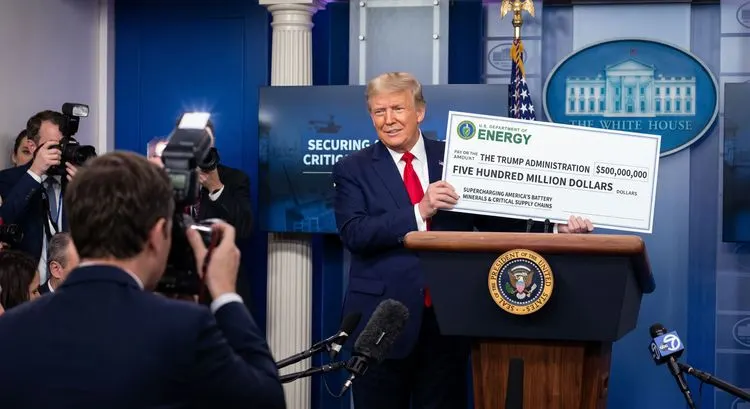
Washington is placing a $500 million wager on the periodic table.
The U.S. Department of Energy is cutting grant checks to seven domestic companies building critical lithium, cobalt, and next-generation battery projects. The move marks the latest push by the Trump administration to transform the nation into an energy and minerals superpower while loosening China’s tight grip on the processing market. Ongoing geopolitical strain, including the conflict with Iran, has injected fresh urgency into fortifying the defense industrial base and replenishing depleted weapons stockpiles.
Selected from hundreds of applicants under the Battery Materials Processing and Battery Manufacturing programs, the awardees represent the highest-return opportunities across key areas of the supply chain, according to Energy Department assistant secretary Audrey Robertson. Taking center stage is Lilac Solutions, which landed $100 million to build a direct lithium extraction facility on Utah’s Great Salt Lake. Backed by German automaker BMW (ETR: BMW), Lilac Solutions aims to be online by 2028 with an annual output of 5,000 metric tons of lithium carbonate. The project joins earlier federal investments in domestic lithium developers like ioneer (Nasdaq: IONR), Standard Lithium (NYSE American: SLI), and Lithium Americas (NYSE: LAC).
Cobalt is getting its own domestic lifeline as Jervois secures $100 million to construct the nation’s sole refining facility in Idaho. Despite being taken private following market turbulence, Jervois remains vital for military hardware, defense electronics, and commercial batteries, with future potential to process deep-sea nodules. On the recycling front, Nth Cycle, backed by commodities trader Trafigura, snagged $100 million for a facility dedicated to processing mineral-rich battery scrap known as black mass. While the administration recently blocked exports of black mass to keep critical materials onshore, officials stress that building home-grown processing infrastructure is the real long-term objective.
Rounding out the half-billion-dollar allocation are three $50 million grants for specialized component production. Princeton NuEnergy will expand cathode reprocessing, Arcanum Ventures is set to produce essential chemicals for battery electrolytes, and Coreshell Technologies is advancing silicon anodes to replace industry-standard graphite. Together, these capital injections aim to construct a fully domestic battery ecosystem from raw brine to recycled scrap.
Source
- Reuters | August 20, 2026
Disclaimer
Neither the author of this article nor JuniorStocks holds equity, stock options, or any other financial positions in Lilac Solutions, BMW (ETR: BMW), ioneer (Nasdaq: IONR), Standard Lithium (NYSE American: SLI), Lithium Americas (NYSE: LAC), Jervois, Nth Cycle, Trafigura, Princeton NuEnergy, Arcanum Ventures, Coreshell Technologies, or any other companies mentioned in this publication. This content is published by JuniorStocks strictly for informational purposes, was prepared independently without company compensation, and utilized AI assistance for text editing, formatting, and drafting. While domestic critical minerals and battery supply chain projects represent a compelling growth sector, this article does not constitute investment or financial advice. Investors are strongly advised to conduct their own thorough, independent due diligence and consult with a qualified financial professional before making any investment decisions.