
The U.S. Opens a Tollbooth in Hormuz: From Freedom of Navigation to Pay-to-Play
Washington upends maritime law with an unprecedented 20% protection fee, forcing global shipping giants to abandon the Persian Gulf.
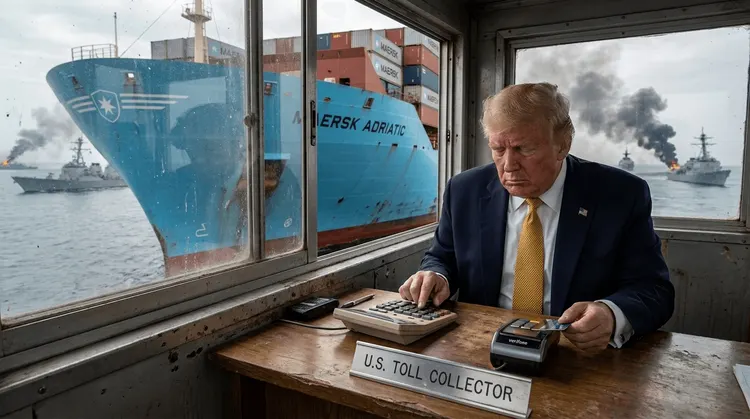
The global shipping industry is entirely accustomed to paying for passage through artificial canals, but paying protection money to transit a natural international strait is a brand-new line item.
Following the White House's declaration that the U.S. is reinstating its naval blockade on Iranian ports and assuming the title of "Guardian of the Hormuz Strait," maritime legal experts and corporate logistics departments are staring at an existential mathematical equation. The administration's mandate to levy a 20% surcharge on the value of all cargo shipped through the Persian Gulf's primary chokepoint has turned traditional maritime economics entirely upside down.
Legal analysts are quick to highlight the extraordinary paradox at the center of this new maritime doctrine.
For decades, international maritime navigation has operated under the bedrock principle that straits used for international transit must remain unhindered. As noted by industry authorities like gCaptain, the United Nations Convention on the Law of the Sea explicitly protects the right of transit passage through these critical corridors. While the U.S. has historically positioned its military assets to enforce this open access against Iranian interference, Washington's sudden pivot to charging a 20% security toll essentially adopts the very mechanism of sovereign regulatory control it once spent decades condemning.
For the boardrooms managing global supply chains, the operational reality is grim. Standard transit fees are usually predictable flat rates, but a 20% levy on the actual value of an entire cargo hull introduces staggering liabilities. A modern ultra-large container ship or a primary crude supertanker frequently transports goods worth upwards of one hundred million dollars, meaning a single trip through the strait could demand a multi-million dollar check up front. Corporate giants like AP Moeller - Maersk A/S Class B (CPH: MAERSK-B) and Hapag-Lloyd AG (ETR: HLAG) must now calculate whether it is cheaper to pay this unprecedented military surcharge or completely abandon the route. Real-time tracking data from platforms like MarineTraffic.com shows the industry has already made its choice, with commercial traffic via alternative routes dropping to minimal levels as vessels overwhelmingly choose the lengthy detour around Africa’s Cape of Good Hope.
Commodity traders and market strategists are similarly scrambling to adjust their economic models.
Financial analysis platforms like Seeking Alpha point out that oil markets are entering uncharted waters. While geopolitical disruptions in the Middle East typically trigger price spikes due to the fear of physical supply shortages, traders must now price in a government-mandated logistics tax. With global crude benchmarks already climbing roughly 5% following the weekend's escalation, the combination of astronomical war-risk insurance premiums and the mandatory U.S. fee threatens to spark a massive global freight rate surge. Instead of stabilizing a volatile region, the new protection policy may simply price global commerce entirely out of the Persian Gulf.
Sources:
- The Associated Press, gCaptain, Seeking Alpha