
Cenovus CEO and Prime Minister Mark Carney Face Off Over the Fate of Canadian Oil Investment
As Ottawa pushes for greener barrels, the oil patch warns of a capital exodus. Who wins when the global energy transition hits the domestic balance sheet?
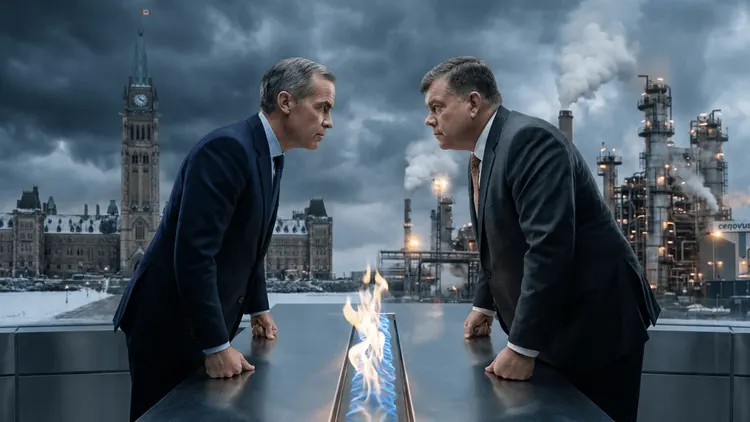
Energy executives and politicians rarely sing from the same hymn sheet, but the latest public back-and-forth between Cenovus Energy (TSX: CVE) CEO Jon McKenzie and Prime Minister Mark Carney is hitting some exceptionally discordant notes. As the federal government attempts to thread the needle between environmental mandates and global energy superpower status, the domestic oil patch is aggressively pushing back.
During a highly anticipated first-quarter earnings call this Wednesday, McKenzie did not mince his words. Assessing the state of the Canadian oil sands, he argued that the national dialogue has become myopically focused on the climate agenda, actively ignoring the massive economic and energy security benefits the sector provides. According to McKenzie, Ottawa’s pursuit of a tougher industrial carbon tax, a key bargaining chip in negotiations for a new Pacific Coast pipeline, does not effectively incentivize domestic decarbonization. Instead, it practically hands investment capital to competing jurisdictions. He firmly warned investors and analysts that Ottawa has created a set of national policies and regulations that make resource development and investment in Canada fundamentally uncompetitive with the rest of the world.
If McKenzie was hoping the stark warning would force an immediate pivot from Ottawa, Prime Minister Mark Carney quickly dispelled that notion. Speaking at an event in suburban Montreal shortly after the earnings call, Carney offered a classic political counter-punch, flipping the script on what actually defines competitiveness in the modern global energy landscape.
Carney’s argument rests heavily on the shifting appetite of the international market. While he acknowledged that the oil and gas sector remains an undeniable economic engine for Canada, he stressed that it is also one of the country's heaviest emitters. Carney noted that international buyers, particularly in crucial Asian markets, are increasingly demanding lower-carbon conventional energy. In his view, leaning into these environmental regulations isn't an investment killer, but an essential survival tactic. Getting emissions down, Carney argued, will inherently make the oil sands more attractive, make Canada more competitive, and secure the nation's role in a much larger, inevitable energy transition.
While Carney’s broader policy approach has attracted some degree of international confidence, evidenced by the massive recent acquisition of ARC Resources Ltd. (TSX: ARX) by Shell PLC (NYSE: SHEL), domestic heavyweights like Cenovus Energy (TSX: CVE) are clearly losing patience.
The standoff highlights a fascinating paradox in Canada’s current economic climate. McKenzie’s dire warnings of uncompetitiveness arrive precisely as his own company reported blockbuster financial wins, boasting a first-quarter revenue of $15.01 billion and an 83 percent jump in profits. Yet, the underlying structural friction remains. McKenzie insists that while squeezing more barrels out of existing operations is highly profitable today, the burdensome cost of greenfield development under the current regulatory regime makes building brand-new, from-scratch projects nearly impossible.
As Ottawa and Alberta continue to blow past their own deadlines to finalize a formal energy pact, the tension between appeasing international climate demands and fostering domestic economic growth continues to boil. Carney is betting the house that green-tinged oil will eventually win the global market, while McKenzie is warning that there won't be any new oil to sell if the capital flees the country first.
Sources:
- Morningstar — "Cenovus CEO Warns Canada's 'Myopic' Focus On Environment Risks Energy-Superpower Promise" (May 6, 2026)
- Global News — "Cenovus CEO says oilsands dialogue 'myopically focused on the climate agenda'" (May 6, 2026)