
The Science Behind Kalo Gold’s Latest Exploration Breakthrough in Fiji
How microscopic electrum inside drill hole VA26-DH19 is vectoring exploration teams toward Fiji's next potential gold discovery at Vatu Aurum.
 Editorial Team (ET)September 29, 2026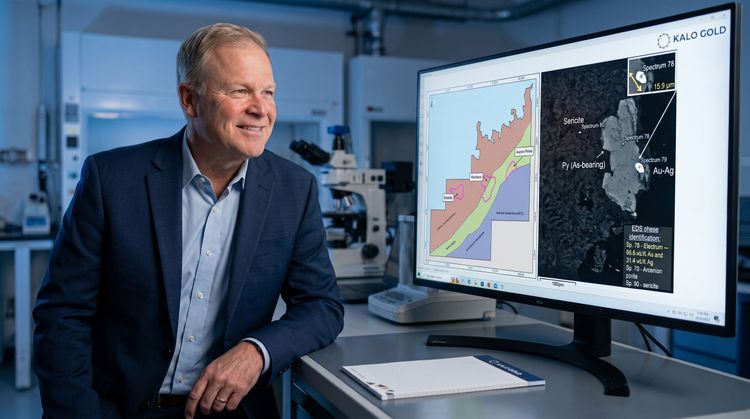
Here at JuniorStocks.com, we have had our eye on the Fijian mineral exploration story, and specifically Kalo Gold Corp. (TSXV: KALO / OTCID: KLGDF), for quite some time, tracking how their systematic technical program on Vanua Levu would evolve.
Unlocking high-grade potential in the South Pacific takes equal parts field persistence and microscopic precision, and the company just delivered a major mineralogical milestone at its flagship Vatu Aurum Project. By confirming the presence of fine-grained electrum deep within drill core at the Wainikoro target using advanced scanning electron microscopy, the team has locked down direct, visual evidence of the physical gold and silver powering this epithermal hydrothermal system.
The milestone comes directly out of an academic-industry research partnership led by Heidi Walton at the Camborne School of Mines, University of Exeter, supported directly by Kalo Gold. Examining drill core from hole VA26-DH19 at a downhole depth between 189.88 and 191.00 meters, high-resolution SEM-EDS analysis identified a discrete electrum grain measuring roughly 20 micrometers across. Energy-dispersive spectroscopy measured its composition at approximately 68.6 weight percent gold and 31.4 weight percent silver. Sitting directly along the margin of an arsenian pyrite grain inside a sericite-bearing matrix, the electrum occurs within a chlorite-altered polymictic volcanic breccia cut by quartz-carbonate veinlets and disseminated trace sulfides.