
Is the Shift from Electric Vehicles to Humanoids the Smartest Move for Europe?
Leveraging a century of manufacturing supremacy, legacy automotive parts suppliers are pivoting to bipedal machines to capture a trillion-dollar autonomous future.
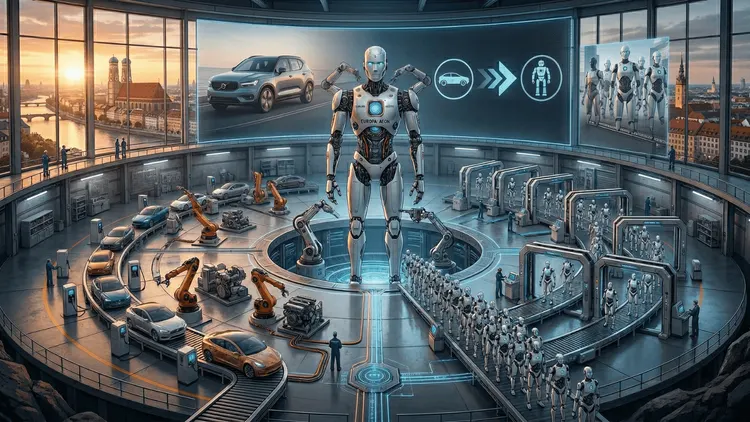
Europe might have arrived fashionably late to the artificial intelligence software party and stalled at the starting line of the electric vehicle sprint against China, but the continent is far from sitting out the next technological revolution. Instead of fighting lost battles, European legacy manufacturers are pivoting their century-old industrial prowess toward a brand-new frontier: humanoid robots. By leaning into generations of precision engineering, the region is aggressively staking its claim in a sector that analysts project will become a trillion-dollar opportunity by 2035.
At the bleeding edge of this European renaissance is precision measurement giant Hexagon AB (STO: HEXA-B). The Swedish firm is rapidly advancing its Aeon humanoid robot, moving aggressively from a handful of pilot programs to a targeted production run of several thousand units by 2030. According to Arnaud Robert, Hexagon’s head of robotics, the company is on a fast track to fully commercialize the Aeon by 2026. This lightning-fast development cycle is a calculated masterstroke that repurposes Europe’s deep expertise in machine parts to offset slowing orders from the traditional automotive sector. The Aeon is already hitting the factory floor, undergoing rigorous assembly and logistics training at a Leipzig, Germany, battery plant operated by BMW AG (ETR: BMW).
The financial momentum backing this mechanical workforce is staggering. German startup Neura Robotics GmbH recently cemented Europe’s heavyweight status by securing a massive €1 billion funding round. This capital injection, which catapulted the company’s valuation to roughly €4 billion, pulled in major multinational backers including Amazon.com Inc. (Nasdaq: AMZN) and Qualcomm Inc. (NASDAQ: QCOM). Neura is developing the 4NE1, a bipedal powerhouse capable of safely hauling up to 100 kilograms alongside human co-workers.
For Europe’s massive automotive suppliers, the leap to humanoids is less of a technological pivot and more of a lateral slide. These two-legged machines rely heavily on the exact same components driving electric vehicles, from high-capacity batteries and advanced electric motors to precision sensors. Recognizing this immense market potential, legacy parts suppliers like Schaeffler AG (ETR: SHA) and Robert Bosch GmbH are enthusiastically throwing their hats into the ring. Schaeffler Chief Executive Officer Klaus Rosenfeld explicitly noted that the core technologies required for robotics, lasers, gearboxes, and electric motor integration, are already sitting squarely in the company's wheelhouse. Schaeffler has aggressively signed partnerships across the globe, including deals with Agility Robotics and China’s Leju Robotics, aiming to generate a tenth of its total revenue from new business ventures like humanoids by 2035.
However, the path to a fully automated utopia is not without its hurdles. While the hype reached a fever pitch at CES in Las Vegas this past January, highlighted by an awe-inspiring stage performance from the Atlas robot by Hyundai Motor Co. (KRX: 005380) and its Boston Dynamics unit that sent Hyundai shares skyrocketing 80%, practical application remains a complex beast. KTH Royal Institute of Technology robotics professor Danica Kragic offered a dose of pragmatic reality, noting that bipedal balancing, unpredictable lighting, and unknown objects present significant engineering headaches. Kragic cautioned that large-scale deployment is likely still five to ten years away, predicting a fair share of robot graveyards before the industry perfects the technology.
This European push is happening against the backdrop of an intensely competitive global arena. In the United States, heavy hitters like Tesla Inc. (Nasdaq: TSLA) and the Nvidia Corp. (NASDAQ: NVDA) backed Figure AI, which BMW is also testing, are vying for the same factory floor space. Meanwhile, China has elevated embodied AI to a national strategic priority. With roughly 150 humanoid robotics firms currently operating, companies like Xiaomi Corp. (HKG: 1810) and UBTech Robotics Corp. (HKG: 9880) are already running trial operations in factories, pushing aggressively for rapid scale.
As the geographic lines of the robotic supply chain begin to fragment, Europe's seasoned industrial titans are proving they possess both the hardware legacy and the financial agility to stand shoulder-to-shoulder with the world's best. The race to build the ultimate artificial workforce has officially begun, and this time, Europe is striding forward right from the front of the pack.