
How Did Data Centers Quietly Capture 7% of America’s Total Power Demand?
How the race for AI dominance shifted from a scramble for microchips to an all-out war for gigawatts.
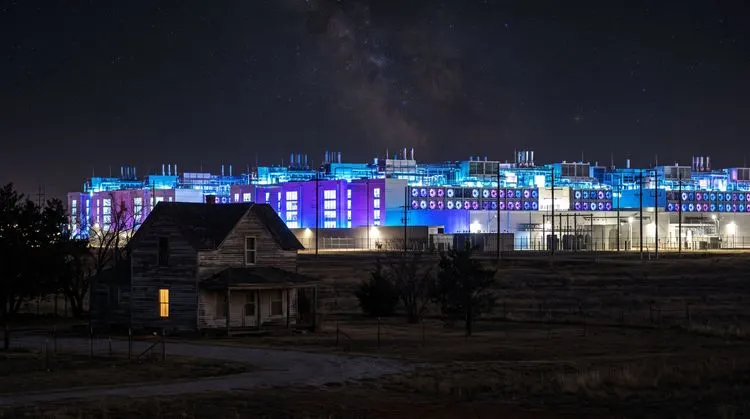
The cloud, as it turns out, is not a weightless collection of digital vapor floating serenely in the atmosphere.
It is a massive, heavily air-conditioned, humming fortress of silicon and concrete, and it is exceptionally thirsty. As artificial intelligence shifts from a quiet tech-lab experiment into a full-scale industrial arms race, the physical reality of keeping the machines running has hit home. Data centers now command roughly 7% of total U.S. electricity demand, a staggering leap from under 2% less than a decade ago.
The velocity of this growth has caught almost everyone off guard. According to a recent analysis by Goldman Sachs (NYSE: GS), U.S. data center power demand is projected to more than double from 31 gigawatts in 2025 to 66 gigawatts by 2027. During peak summer periods, the data center share of the national power grid is expected to reach 8.5% in 2027. This isn't just a minor blip for local utility companies; it is a fundamental restructuring of the nation's energy landscape.
The core of the problem lies in a severe speed discrepancy. A state-of-the-art AI data center can be built and filled with advanced chips in less than two years. However, building a new power generation plant and routing the high-voltage transmission lines required to feed it can easily take five to ten years. This regulatory and infrastructural bottleneck is turning what used to be a chip shortage into an outright power struggle.
Silicon Valley’s brightest minds are increasingly sounding like frustrated industrial engineers. Elon Musk, CEO of Tesla (Nasdaq: TSLA) and founder of xAI, has warned that the industry is hitting a massive hardware wall, noting that the next major shortage after chips and transformers will be basic electricity. Sam Altman, CEO of OpenAI, has echoed similar concerns, predicting that the ultimate cost of AI will inevitably converge to the cost of the energy required to power it.
To bypass the sluggish process of traditional grid expansion, tech giants are taking matters into their own hands. They have quickly pivoted from passive energy consumers to active energy developers. <a class="tvreplink" target="_blank" href="https://www.tradingview.com/chart/?symbol=Nasdaq%3AMSFT">Microsoft (NASDAQ: MSFT) made waves by signing a massive deal to help resurrect a retired nuclear reactor at the Three Mile Island facility owned by Constellation Energy (NASDAQ: CEG). Meanwhile, search giant Alphabet (NASDAQ: GOOGL) and e-commerce leader Amazon (NASDAQ: AMZN) are aggressively pursuing power purchase agreements and exploring Small Modular Reactors (SMRs) to secure carbon-free, always-on baseline power. In fact, the International Energy Agency reported that the technology sector accounted for approximately 40% of all corporate renewable power purchase agreements signed globally in 2025.
This sudden surge in demand has forced utility companies to rewrite their playbooks.
John Ketchum, CEO of renewable energy giant NextEra Energy (NYSE: NEE), recently compared the current scale of power demand to the post-World War II industrial revolution. The Electric Power Research Institute (EPRI) has warned that if current development trajectories hold, data centers could consume up to 17% of total U.S. electricity generation by 2030, with certain data-center-heavy states like Virginia seeing that figure rise to over 50%.
For years, tech companies operated under the assumption that software was eating the world. Now, they are discovering that the software has an insatiable appetite for physical electrons. The race for artificial intelligence supremacy is no longer just about who has the smartest algorithm; it is about who can keep the lights turned on.
Sources
- The International Energy Agency details the surge in tech sector capital expenditure and power agreements in its April 2026 report, available at: https://www.iea.org/news/data-centre-electricity-use-surged-in-2025-even-with-tightening-bottlenecks-driving-a-scramble-for-solutions
- Goldman Sachs Commodities Research outlines the doubling of U.S. data center power demand and the 8.5% peak summer demand projection for 2027 in its May 2026 update, available at: https://www.goldmansachs.com/insights/articles/us-data-center-power-demand-projected-to-double-by-2027
- The Electric Power Research Institute details its projections of data centers consuming up to 17% of U.S. electricity by 2030 in its February 2026 analysis, available at: https://www.globenewswire.com/news-release/2026/02/26/3245491/0/en/epri-data-centers-could-consume-up-to-17-of-u-s-electricity-by-2030.html
- The historical context of data center energy usage growth and the 7% threshold is documented by the Belfer Center for Science and International Affairs, available at: https://www.belfercenter.org/research-analysis/ai-data-centers-us-electric-grid
- The rise of the 7% baseline and market dynamics is also tracked by Charlie Bilello’s market research, available at: https://bilello.blog/2026/the-week-in-charts-3-17-26