
Inside the American Nuclear Renaissance: A Year of Unprecedented Growth
How streamlined regulation, massive capital injections, and next-gen tech triggered a historic power surge in the American energy grid.
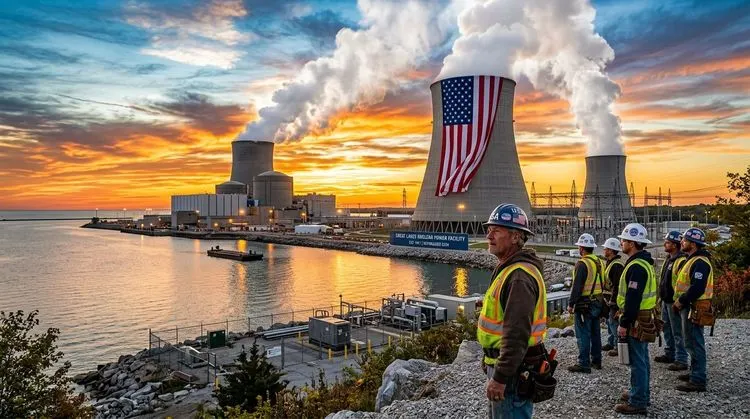
A year can feel like an eternity in the fast-moving technology sector, but in the traditionally glacial world of nuclear regulation, twelve months usually amounts to a mere rounding error. That baseline was completely upended when a suite of four executive orders landed on May 23, 2025, lighting an administrative fire under the federal energy apparatus.
Fast forward to May 2026, and the U.S. Department of Energy has successfully turned what used to be a sluggish bureaucracy into an outright sprint toward domestic energy dominance. The overarching goal is an unprecedented American nuclear renaissance, and the operational milestones coming out of Washington suggest that this momentum is fully real.
The first order of business for this revitalization strategy was dismantling the regulatory drag that historically plagued advanced reactor deployment. Under its newly streamlined authorization process, the Department of Energy carved out the Reactor Pilot Program to bypass traditional bottlenecks, fast-track commercial licensing, and unlock trapped private capital. Eleven distinct projects are currently navigating this fast lane, with three already securing a Final Documented Safety Analysis as the department pushes toward getting at least three advanced reactor designs to reach criticality by July 4, 2026. Meanwhile, specialized test beds are opening their doors ahead of schedule, evidenced by the world's first microreactor test bed, known as DOME, going live at the Idaho National Laboratory in April 2026. The facility offers a safe, real-world environment to gather performance data, and private innovator Radiant is already on track to test its Kaleidos reactor experiment inside the facility later this year. To widen the net for commercialization, the Nuclear Energy Launch Pad was also established in March 2026, inviting developers to iteratively test advanced tech on both federal and non-federal lands.
Proving these experimental designs in a lab environment is a vital first step, but transforming the American grid requires scaling these technologies to a massive commercial level. This is where the race to add 300 gigawatts of new capacity by 2050 truly begins, pulling in massive corporate investments and international partnerships.
Small Modular Reactors, or SMRs, are leading this commercial charge. In late 2025, the federal government committed up to $800 million in cost-shared funding to support early SMR deployments by the public utility Tennessee Valley Authority and Holtec Government Services. Regulators are currently reviewing a construction permit for a GE Vernova Hitachi (NYSE: GEV) BWRX-300 reactor in Oak Ridge, Tennessee, a momentum that multiplied in March 2026 when the Department of Commerce locked in a massive $40 billion strategic energy partnership with Japan to deploy those same systems across the region. On the design approval front, NuScale Power (NYSE: SMR) secured regulatory uprating approval for its system, solidifying its place as a market frontrunner. The advanced Gen IV reactor market is achieving its own historic milestones alongside these SMR rollouts. The Bill Gates-backed enterprise TerraPower shattered expectations by receiving the first-ever commercial construction permit for a non-light-water power reactor, breaking ground on its Natrium plant in Wyoming in April 2026. At the same time, heavy industry giants are stepping up, with an active permit review underway for an X-energy reactor at a Dow (NYSE: DOW) facility in Texas. Silicon Valley is also funding the wave to satisfy its insatiable power demands, as Kairos Power initiated nuclear construction on its Hermes test reactor and broke ground on Hermes 2, a commercial demonstration fleet built in direct partnership with Google (Nasdaq: GOOGL) to power next-generation artificial intelligence data centers.
While breaking ground on these futuristic plants represents a critical leap forward, the immediate demands of the grid require an equally aggressive look at what is already standing. Consequently, the federal strategy is simultaneously targeting the resurrection of recently retired assets and squeezing more juice out of existing infrastructure.
Through the Office of Energy Dominance Financing, the government is executing an up to $1.52 billion loan to Holtec to breathe life back into Michigan’s Palisades Nuclear Plant, marking a national first for a facility entering decommissioning. Similarly, a $1 billion loan finalized in November 2025 is funding the restart of the Crane nuclear power plant under Constellation Energy Generation (Nasdaq: CEG). For the assets already online, the newly minted Utility Power Reactor Incremental Scaling Effort, or UPRISE initiative, is aggressively chasing efficiency. UPRISE aims to extract an additional 2.5 gigawatts of capacity by 2027 and 5 gigawatts by 2029 purely through power uprates and efficiency tweaks. Early phases are already underway at the Hatch, Vogtle, and Farley plants, adding 345 megawatts of baseload capacity backed by a massive $26.5 billion loan package to Southern Company (NYSE: SO).
Sustaining this massive influx of revived and newly constructed reactors demands a total modernization of the foundational elements supporting them. This requires a profound shift toward securing domestic fuel lines, leveraging cutting-edge software, and deploying nuclear technology into entirely new frontiers.
In a bid to drop operational costs by over 50 percent and double project delivery speeds, the Office of Nuclear Energy has launched the Genesis Mission, deploying human-supervised artificial intelligence to optimize everything from reactor design to waste disposition. Of course, advanced hardware is nothing without fuel, prompting the Fuel Line Pilot Program to debut in July 2025 to foster domestic production, followed by a massive $2.7 billion federal allocation in January 2026 to boost domestic low-enriched and high-assay low-enriched uranium enrichment capabilities. A consortium established under the Defense Production Act in April 2026 has unified more than 90 companies to insulate this entire domestic supply chain against foreign vulnerabilities. This energy surge is even extending far beyond civilian grids into national security and space. The military is getting in on the action with Project Pele, a mobile microreactor prototype developed alongside BWX Technologies (NYSE: BWXT) that successfully received its advanced fuel delivery in late 2025, while defense installations screen locations under the Janus program to deploy microreactors for resilient local power. Meanwhile, space exploration is getting a nuclear upgrade via a partnership with NASA to prepare a lunar surface reactor for launch by 2030. Internationally, American nuclear expertise is turning into multi-billion-dollar export value, evidenced by the U.S. capturing over $56 billion in announced energy deals at the Indo-Pacific Energy Security Ministerial, while simultaneously advancing a staggering $25 billion commercial deployment contract in Poland through a partnership with Westinghouse and Bechtel.
Ultimately, this past year has proven that when federal mandates and private capital align, the results can be explosive. By removing bureaucratic roadblocks and treating nuclear energy as a cutting-edge tech sector rather than a relic of the past, the nation has laid a foundation for hundreds of gigawatts of reliable power that will reinforce the grid and fuel the future for decades to come.
Source
This article is based on official program data, policy outcomes, and multi-billion-dollar infrastructure updates released by the U.S. Department of Energy detailing the 12-month progress of the federal nuclear energy revitalization directives as of May 2026.