
The DOE's 60-Day Sprint to Rebuild the US Nuclear Industrial Base
How Executive Order 14302 and a newly minted Defense Production Act shield are sparking a 60-day sprint to secure America's uranium supply chain.
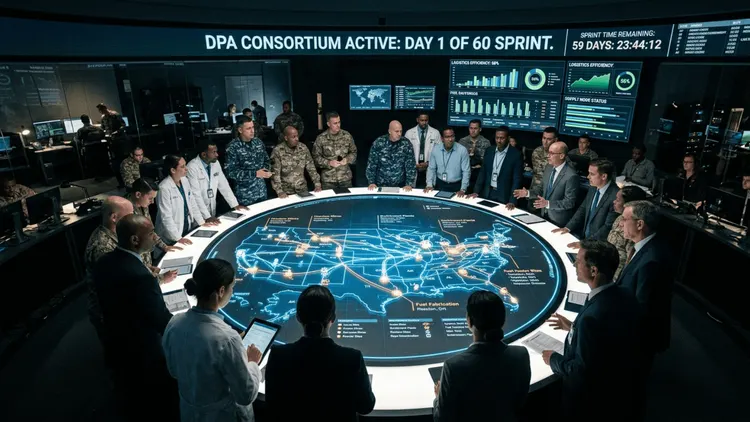
The chatter surrounding America's nuclear renaissance just traded its theoretical wings for a federally mandated engine. As of April 23, 2026, the Department of Energy’s Nuclear Fuel Supply Chain Consortium is officially live, effectively initiating a coordinated, government-backed overhaul of the domestic nuclear ecosystem. For an industry historically bogged down by fragmented logistics and regulatory red tape, today's Federal Register publication signals a definitive shift from broad policy goals to executed logistics.
The Legal Blueprint: Antitrust Shields and Executive Orders
This isn't just another bureaucratic working group designated to draft white papers. The consortium's foundation is built on Executive Order 14302, fittingly titled "Reinvigorating the Nuclear Industrial Base." By invoking Section 708 of the Defense Production Act (DPA), the government is handing the domestic nuclear sector a highly coveted legal shield.
Following a crucial antitrust clearance issued by the Department of Justice on April 17, industry competitors can now legally collaborate. They are authorized to share proprietary supply chain data, pool resources, and map out strategic logistics without the looming threat of federal anti-competition lawsuits. The legal runway is completely clear, and the mandate is straightforward: establish an airtight domestic supply chain and sever reliance on foreign nuclear fuel.
Three Plans of Action and 60-Day Sprints
Instead of tackling the sprawling fuel cycle in disconnected pieces, the DOE's finalized Voluntary Agreement streamlines the entire industry into three comprehensive Plans of Action, officially designated as POA Committees.
The first committee, Material Sufficiency, commands the foundational stages of the cycle, organizing the crucial steps of mining, milling, conversion, and enrichment. The second committee, Market-Integrated Fuel Utilization, focuses on the mid-to-late stages, covering fabrication, deconversion, recycling, reprocessing, and the end-user reactors themselves. Finally, the Human Mobilization committee addresses the critical structural bottlenecks that often derail infrastructure mega-projects, specifically targeting workforce development, broader supply chain logistics, and economics and finance.
To prove this initiative isn't a slow-moving federal exercise, officials at today's launch event announced the immediate start of intensive 60-day sprints. The DOE is not looking for long-term theoretical roadmaps; they are demanding actionable, near-term deliverables from these groups right now.
The Corporate Players Positioned to Win
For investors tracking the uranium and nuclear infrastructure spaces, this federal coordination is a massive structural catalyst. Companies operating within the first POA's mining and enrichment sphere, such as Cameco (NYSE: CCJ), Energy Fuels (NYSE: UUUU), and Uranium Energy Corp (NYSE: UEC), are now positioned to coordinate their raw output directly with national security objectives.
On the fabrication and advanced reactor side, Centrus Energy (NYSE: LEU) stands to play a pivotal role in the Market-Integrated Fuel Utilization committee, especially given the ongoing race to secure domestic High-Assay Low-Enriched Uranium (HALEU) for next-generation reactors. Private innovators like Oklo, TerraPower, and X-energy are also expected to be vital participants in shaping future fuel demand and reactor deployment. For those playing the broader sector, the Global X Uranium ETF (NYSEARCA: URA) remains the ultimate barometer for tracking the success of this newly minted, legally protected supply chain coalition.
Sources:
- Federal Register, Vol. 91, No. 78 (April 23, 2026) – Notice Pursuant to the Defense Production Act of 1950 (Document 2026-07900)
- Executive Order 14302 – Reinvigorating the Nuclear Industrial Base
- Department of Justice Antitrust Clearance Finding (April 17, 2026)