
A Nuclear Fourth of July: Inside America’s 250th Birthday Atomic Push
The Department of Energy is sprinting to achieve atomic criticality by America’s 250th birthday, but turning that nuclear spark into commercial electricity is an entirely different battle.
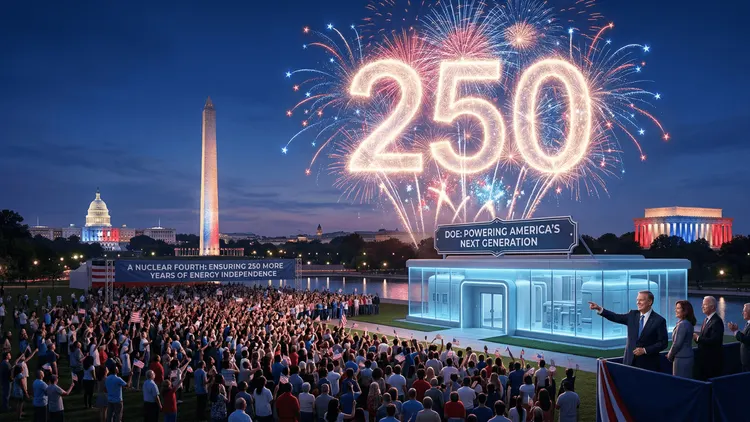
Forget the traditional barbecue and sparklers. This Independence Day, the United States Department of Energy is aiming for a different kind of fireworks: the sustained atomic chain reaction of next-generation nuclear reactors.
Launching what the administration has confidently dubbed the American nuclear renaissance, U.S. Energy Secretary Chris Wright has laid down an exceptionally aggressive gauntlet. Driven by a sweeping set of executive orders signed by President Trump in May 2025, the DOE is officially racing to get three advanced, small modular reactors to reach criticality by July 4, 2026. The target date is, of course, no accident; it is heavily branded to coincide with the United States' Semiquincentennial, or 250th anniversary.
This push represents a seismic shift in domestic energy strategy, explicitly aimed at slashing the notorious regulatory red tape that has historically suffocated nuclear development. To fast-track this historically sluggish process, the DOE opened up over a million acres of its national laboratory land, providing a highly desirable testing ground for private energy developers. A cohort of advanced nuclear companies was tapped for an expedited pilot program, with a select few heavily favored to cross the July 4th finish line.
Among the high-profile players racing against the clock is Oklo Inc. (NYSE: OKLO), a fast-fission startup that has already made significant headway on its Aurora powerhouse in Idaho and recently secured a massive energy deal with tech giants like Meta Platforms Inc. (Nasdaq: META). Emerging disruptors like Aalo Atomics and Valar Atomics are also accelerating their proprietary testing phases. To keep the momentum going, the DOE has assigned these companies "concierge teams" to ensure that regulatory authorizations, which traditionally take months or years, are pushed through in a matter of days.
But before anyone expects these reactors to start powering the nation's air conditioners this summer, a healthy dose of reality is required. Reaching "criticality" by July 4th is a massive technological milestone, but it absolutely does not mean these plants will be delivering electricity to the commercial grid. In the nuclear sector, achieving criticality simply means the reactor core has achieved a self-sustaining nuclear chain reaction.
For the majority of these pilot programs, this milestone will look like "zero power criticality," also known as cold criticality. This is a vital testing phase used to validate core physics calculations, neutron dynamics, and safety control systems at minimal power output, without actually generating significant heat or electricity. Turning that atomic reaction into commercial power involves complex turbine integration and an entirely separate gauntlet of regulatory hurdles.
The broader strategy behind this accelerated timeline is fiercely economic. The U.S. electrical grid is currently gasping for reliable baseload power to feed the insatiable energy appetites of new AI data centers, advanced manufacturing facilities, and widespread industrial electrification. By streamlining the permitting process and heavily promoting domestic supply chains for uranium enrichment, the administration hopes to treat small modular reactors more like factory-assembled consumer products and less like sprawling, decades-long megaprojects.
Whether three reactors actually achieve this milestone by the time the fireworks go off remains a fiercely debated topic among energy analysts and nuclear engineers. It is an incredibly ambitious timeline for an industry fundamentally bound by extreme precision and uncompromising safety standards. However, the sheer influx of capital and government willpower suggests that the American energy landscape is undergoing a radical, atom-splitting transformation. As the 250th anniversary approaches, all eyes are on the DOE to see if they can turn bold executive mandates into a self-sustaining reality.
Sources:
- U.S. Department of Energy updates on the Reactor Pilot Program and advanced nuclear deployment goals.
- ClearPath Action policy summaries of the May 2025 Trump Administration Nuclear Energy Executive Orders.
- Corporate filings and operational updates from Oklo Inc. and associated energy partners.