
How a New Fiji Port and $20B Mineral Deal Unite the US, India, Japan, and Australia
How an alliance traded diplomatic pleasantries for heavy-duty supply chains, a $20 billion critical minerals buffer, and a hard-nosed physical presence in the Pacific.
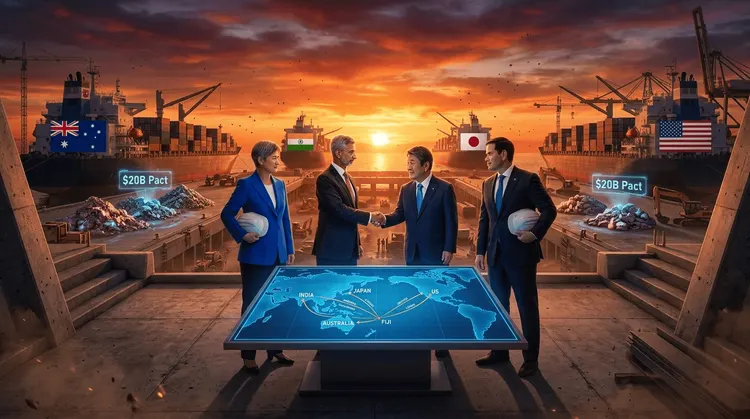
Diplomacy is often a game of high-minded words and low-impact handshakes, but the Quadrilateral Security Dialogue just decided to trade its talking points for a pair of heavy-duty construction boots.
Meeting at Hyderabad House in New Delhi, the foreign ministers of Australia, India, Japan, and the United States gave the alliance an aggressive injection of economic reality.
Instead of another round of vague communiqués concerning regional stability, the diplomats walked away with signed pacts to build a brand-new port in Fiji and an ambitious $20 billion critical minerals framework, proving that this partnership is evolving from a diplomatic talking shop into a coordinated industrial offensive.
This practical pivot begins directly on the coastlines of the Pacific Islands.
In what marks the alliance's first-ever joint physical infrastructure build, the Quad is partnering with Fiji to dramatically upgrade its port capacity. US Secretary of State Marco Rubio framed the initiative as a practical demonstration of the group's collective ability to deliver high-quality, resilient infrastructure where it is needed most. The move clearly aims to counter Beijing's expanding maritime footprint in the South Pacific, presenting a democratic alternative to state-backed financing while simultaneously pledging to connect every single Pacific Island Forum country via secure undersea cables by the end of 2026.
Yet, physical ports are only half the battle when the real modern warfare is being fought over the periodic table, which is why the alliance paired this maritime push with a newly minted critical minerals framework. The four nations have pledged to mobilize up to $20 billion in government and private sector capital to secure the mining, processing, and recycling of strategic metals. This comes as a direct response to vulnerabilities exposed when China previously squeezed exports of strategic elements crucial to defense, aerospace, and semiconductor industries.
Public markets immediately registered the geopolitical undertone of this financial engine, signaling a massive strategic tailwind for specialized Western producers like MP Materials Corp. (NYSE: MP) and Australia’s Lynas Rare Earths (ASX: LYC), where an allied funding mandate of this scale underscores a systemic shift toward non-aligned supply nodes. Even diversified mining behemoths like BHP Group (ASX: BHP) and Rio Tinto (ASX: RIO) are finding their long-term project pipelines heavily influenced by this newly accelerated era of state-sponsored "friend-shoring."
While the policy looks incredibly sharp on paper, navigating the transition from a diplomatic agreement to an operational supply chain requires dealing with harsh industrial realities. Market intelligence trackers at Crux Investor pointed out that bureaucratic handshakes do not instantly yield operational refineries, noting that "Diplomatic agreements do not immediately increase mineral processing or transport capacity. New mines, refineries, and export infrastructure typically require years of permitting and construction before reaching commercial output. As a result, manufacturers remain exposed to higher raw material costs."
Despite the lengthy runway required for these massive industrial builds, political analysts argue that this granular focus on economic resilience is exactly the kind of glue needed to keep the Quad cohesive. The partnership faced stagnation last year after trade friction between US President Donald Trump and Indian Prime Minister Narendra Modi delayed a major leaders' summit, but delivering real, systemic achievements at the ministerial level proves the alliance can maintain its momentum regardless of scheduling conflicts at the very top. Premesha Saha, a senior policy fellow at Asia Society Australia, highlighted the resilience of this approach, noting that "The absence of a leaders' summit has raised some doubts, but that does not necessarily indicate declining importance. If the Quad can keep delivering at the ministerial and working levels, it can remain relevant even without regular leaders-level signalling."
This capacity to deliver becomes even more critical as the broader global horizon darkens.
The New Delhi meeting wrapped up against a backdrop of tightening global friction, with ministers voicing deep concern over the volatile situation in the Middle East and calling for an uninterrupted flow of commerce through the Strait of Hormuz amid recent shipping disruptions. By tying energy security, critical technology, and maritime surveillance together into a single continuous narrative, the Quad is making it clear that it is building an integrated economic fortress capable of weathering a highly fractured global landscape.
Sources
- Reuters / Times of Oman: India-Australia-Japan-US QUAD to build a port in Fiji, unveil pact on critical minerals (May 26, 2026)
- Crux Investor Report: Quad Mineral Pact & 8.3% Industrial Inflation Boost Reshoring & Recycling Investments (May 26, 2026)
- The Times of India: Quad meeting in Delhi: Terrorism, maritime security and energy dominate talks (May 26, 2026)
- Mining.com: US, India establish framework for critical minerals partnership (May 26, 2026)