
Goldman Sachs picks the hard-asset market winners that aren't AI stocks
Forget Theme Parks and Stadium Seats, How Base Metals and Mining Hold the Ultimate Moat Against AI Disruption (While Quietly Powering It)
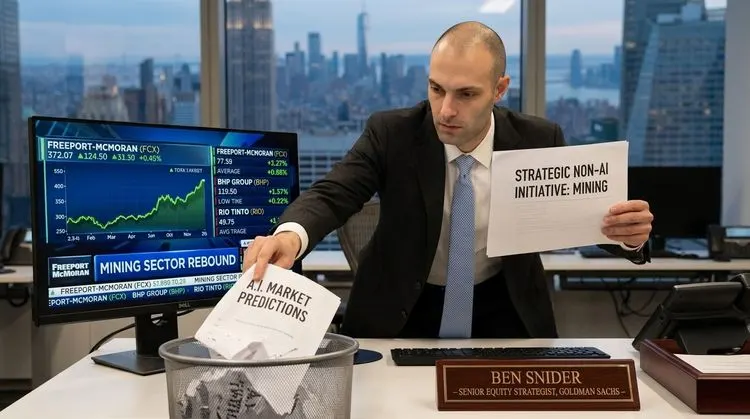
While Silicon Valley spends trillions attempting to teach digital software agents how to write code and analyze financial statements, a quiet realization is sweeping through institutional equity desks: algorithms cannot dig copper out of the ground.
When Yahoo Finance Executive Editor Brian Sozzi unpacked a strategic note from Goldman Sachs highlighting market winners immune to artificial intelligence disruption, the headlines naturallygravitated toward physical consumer experiences. The underlying thesis was intuitive enough, as an AI agent can write an essay or automate customer service, but it cannot sit in a stadium seat, stay at a resort, or board a cruise ship. Yet in the rush to celebrate concert venues and theme parks, broad market commentary overlooked the most fundamental hard-asset sector sitting right beneath our feet.
Goldman Sachs strategist Ben Snider screened thirty-six experience-driven companies across leisure, gaming, and hospitality, spotlighting household names such as Walt Disney Company (NYSE: DIS), Live Nation Entertainment (NYSE: LYV), and Royal Caribbean Cruises (NYSE: RCL). These consumer experience picks presented a compelling narrative backed by undemanding valuations and strong post-pandemic secular demand. However, if the primary criteria for insulation against AI disruption is an inescapable physical presence, the mining and materials sector represents an even broader economic moat.
An algorithm cannot operate a haul truck in a open-pit mine, nor can a large language model process raw copper cathode into electrical infrastructure. Software operates in the cloud, but the physical assets required to extract essential elements from the earth remain strictly bound to human engineering, massive capital expenditure, and real-world geology.
Herein lies the ultimate market paradox: while mining is entirely safe from being displaced by artificial intelligence, it simultaneously serves as the single most vital bottleneck enabling the AI revolution. Software algorithms require exponential amounts of computing power, computing power demands massive hyperscale data centers, and data centers require unprecedented amounts of electricity and industrial metals.
Goldman Sachs Research estimates that artificial intelligence will drive a 165% increase in global data center power demand by 2030. Every transformer, utility substation, and high-voltage transmission line needed to link these server campuses to the power grid requires tons of industrial copper. S&P Global and BloombergNEF projections further indicate that cumulative copper locked into data centers could surpass four million metric tons over the coming decade, creating structural supply shortfalls that software cannot solve.
Investors seeking real-world assets tied to this structural dynamic are looking directly at major global producers. Premier copper giant Freeport-McMoRan (NYSE: FCX) stands out as a direct equity vehicle for investors targeting electrification and data center infrastructure growth, backed by high-tier assets like the Grasberg mine complex. Diversified resource titans such as BHP Group (NYSE: BHP) and Rio Tinto (NYSE: RIO) bring immense scale and cash flow generation, with BHP Group (NYSE: BHP) projecting global copper demand to jump over seventy percent by mid-century driven by grid modernization and clean energy transitions.
In the base metals space, pure-play copper producers are capturing significant analyst attention due to tight supply dynamics outside North America. European-listed Antofagasta (LSE: ANTO) and mid-tier operator Lundin Mining (TSX: LUN) both feature prominently in institutional strategies due to high revenue leverage to copper and strong operational cash generation. Meanwhile, Canadian base metals producer Teck Resources (NYSE: TECK) offers further exposure to essential industrial metals as global mine development timelines continue to stretch beyond ten years from discovery to first production.
While leisure and hospitality equities offer an appealing valuation entry point trading at a median twelve times forward EBITDA, primary mining stocks provide an added layer of strategic value: pricing power anchored in real-world supply constraints. Mine supply cannot be duplicated or expanded with the click of a button or a cloud software update. As Wall Street continues to search for non-AI equities capable of delivering durable returns, the real winner may not just be the ticket you buy for weekend entertainment, but the raw metals buried underground that keep the entire modern economy connected.
Sources
- Yahoo Finance: Goldman Sachs picks 36 market winners that aren't AI stocks, reported by Brian Sozzi (July 2026).
- Goldman Sachs Equity Research: Physical Consumer Experiences & Capital Goods Strategy Report, led by strategist Ben Snider.
- Goldman Sachs Commodities Research: Global Copper Market Supply/Demand Forecasts & Data Center Power Demand Analysis (2026).
- S&P Global / BloombergNEF: Copper in the Age of AI & Energy Transition Demand Outlook (2025–2026).