
Buffalo Potash Maps Out Accelerated Production Path at Disley Project in Saskatchewan
How a junior miner is disrupting Saskatchewan’s potash sector by swapping traditional mega-shafts for a nimble, oilfield-inspired blueprint.
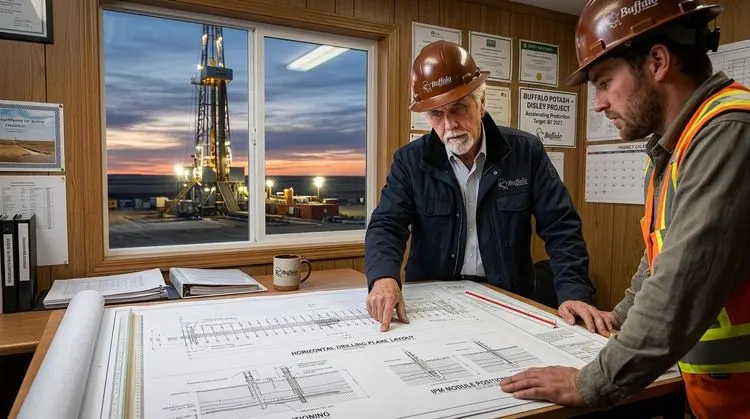
Forget the age-old rulebook that says a new potash mine requires a decade of waiting and a multi-billion-dollar down payment.
Buffalo Potash Corporation (TSXV: BUFF | OTCQB: BLPTF) is rewriting the script in Saskatchewan with a modular, nimble approach that borrows heavily from the oil and gas playbook. The company has officially laid out its blueprint to hit first production by early 2027 at its flagship Disley property, proving that sometimes, smaller really is smarter.
The cornerstone of this ambitious strategy is the Initial Production Module, a streamlined facility designed to pump out 125,000 tonnes per annum of soluble-grade potash. Instead of attempting a massive, budget-straining mega-build right out of the gate, the company is focusing on capital efficiency. According to the company's Preliminary Economic Assessment, this initial phase boasts a remarkably tight 12-month payback period from the moment the first commercial brine flows. If all goes according to plan, this module will serve as the launchpad for a full-scale build-out. By eventually tacking on the Disley East and Disley West expansions, the operation aims to reach a staggering 1,125,000 tonnes per annum. The economics on that final picture look lucrative, featuring an estimated after-tax net present value of US$1.1 billion at an 8% discount rate and an internal rate of return sitting comfortably at 30%.
Getting to that sweet spot requires a meticulous five-phase development plan.
The technical team, supported by engineering design from Rheaume Engineering Inc., is rolling out a proprietary Horizontal Line-Drive mining method. First, the company will drill two vertical wells. The source well will draw brackish water from the Mannville Formation to be saturated with sodium chloride, while the disposal well will inject processed brine safely into the Deadwood Formation. Second, the operation shifts to horizontal drilling, carving out three parallel horizontal legs spanning up to 600 meters directly at the base of the high-grade potash seam. Third comes brine circulation, where the fluid is pumped down to selectively dissolve the potassium-bearing mineral sylvite while leaving the unwanted sodium behind in the ground. Fourth, surface site development will winterize the facility, constructing insulated structures to house pumps and crystallizers for year-round operation. Finally, surface processing will see the installation of a two-stage cooling crystallization circuit to turn the rich brine into high-grade potassium chloride crystals, while testing an innovative Vortex Crystallizer to see if they can shave even more off their operating costs.
Geography is certainly on their side.
The Disley Project sits directly adjacent to the massive Bethune solution mine operated by K+S AG (XETRA: SDF) and just north of the Belle Plaine solution mine run by The Mosaic Company (NYSE: MOS). While rubbing shoulders with the industry's heaviest hitters validates the rich endowment of the region, the company's leadership is fully aware that they are taking a walk on the wild side. In a candid disclosure that sets them apart from typical mining hyperbole, management has noted that their production decision is not backed by a traditional feasibility study of mineral reserves. Advancing straight from a preliminary assessment carries a notoriously higher risk of technical or economic bumps. Furthermore, their patented horizontal mining method has yet to prove its mettle at full commercial scale.
To help broadcast this high-stakes journey to the global market, the company has tapped investor marketing firm Global One Media Group Pte. Ltd. to scale up its digital communications strategy over the next six months. With drill rigs slated to mobilize this month, the market will soon find out if this modular gamble will revolutionize the fertilizer industry or serve as a cautionary tale.
Sources:
- Buffalo Potash Corporation (TSXV: BUFF) (OTCQB: BLPTF) Official Press Release via Newsfile Corp. – July 6, 2026.
- NI 43-101 Preliminary Economic Assessment Technical Report prepared by Micon International Co Limited – May 21, 2026 (Effective April 15, 2026).
- Buffalo Potash Corporation (TSXV: BUFF) (OTCQB: BLPTF) Commercial Engineering Design Engagement – Rheaume Engineering Inc. – May 27, 2026.
Disclaimer:
This article on Buffalo Potash Corporation (TSXV: BUFF) (OTCQB: BLPTF) was produced without any compensation from the company or related parties. The authors have had no communication or interactions with the company. The written content and accompanying image thumbnail were generated with the assistance of artificial intelligence. Readers are strongly advised to conduct their own independent research and financial due diligence before making any investment decisions.
Forward-Looking Statements:
This article contains "forward-looking information" within the meaning of applicable securities laws, including statements regarding Buffalo Potash Corporation’s anticipated development timelines, the five-phase IPM rollout, projected production capacities, and economic metrics derived from its preliminary economic assessment (PEA). These statements are based on current management expectations and assumptions that involve significant risks and uncertainties. Actual results, performance, or achievements could differ materially from those expressed or implied. Junior mining projects advanced without a completed feasibility study of mineral reserves carry a statistically higher risk of technical and economic failure.