
Trump's Stocks for Tots: Why Toddlers Can't Buy Junior Mining Stocks
Federal "Baby Bonds" launch with a $1,000 government seed and billions in philanthropic backing, but high-risk commodities trading is strictly locked out.
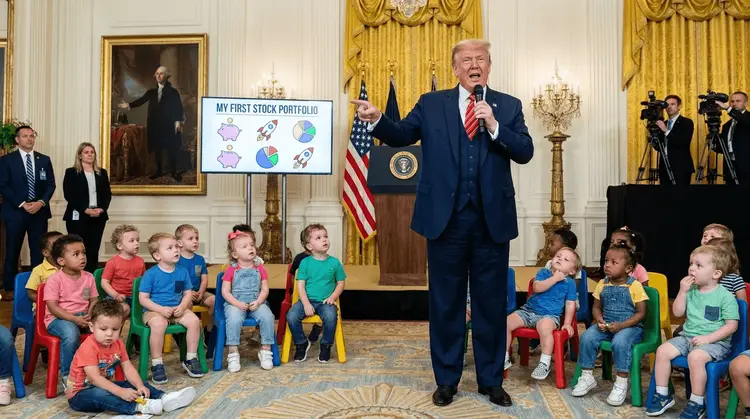
Wall Street set up a temporary outpost in the Oval Office on Monday morning, bringing a literal opening bell into the White House to kick off an ambitious and heavily branded experiment in childhood capitalism.
President Donald Trump hosted executives from both the New York Stock Exchange and Nasdaq for an unprecedented joint market opening, marking the official first trading day for the government-backed initiative known as "Trump accounts." The president even expressed a desire to keep the ceremonial bell to display in a forthcoming White House ballroom, adding a characteristically personal touch to a policy rollout designed to give millions of American children a direct stake in the stock market.
Though the initiative bears the president’s unmistakable personal branding, a naming convention Trump claimed he did not request but has happily accepted in other contexts, the underlying mechanism is rooted in the bipartisan concept of compounding childhood savings. Formally established under the One Big Beautiful Bill Act, these accounts are designed to help families build long-term wealth, particularly targeting those born into economic hardship.
The baseline mechanics are straightforward. Every American child born between January 2025 and December 2028 is entitled to a one-time $1,000 seed deposit funded directly by the federal government. From there, the accounts function as a tax-advantaged custodial vehicle where parents, friends, and employers can collectively contribute up to $5,000 annually into the fund.
However, parents hoping to use these accounts to day-trade or gamble on highly speculative, high-risk assets will find the door firmly shut. Anyone looking to buy into junior mining companies, micro-cap exploration stocks, or penny-stock gold and silver plays will find the legislation's guardrails entirely unyielding. The law dictates that all investments must automatically default into ultra-low-fee, diversified index funds tied strictly to broad-market U.S. equities. Individual stock-picking and niche sector plays are completely off the table, effectively locking out speculative junior miners to ensure that a child's money compounds safely alongside the broader American economy rather than riding the unpredictable swings of the commodities casino.
Parents and guardians retain custodial control over the accounts via the IRS until the child reaches adulthood. Upon turning 18, the beneficiary assumes full ownership of the accumulated wealth. The saved-up funds can then be deployed penalty-free to finance higher education, purchase a first home, or provide the seed capital to start a business venture.
While the federal government provides the starting line for newborns, a massive influx of private philanthropic capital is expanding the program's reach to older children who initially missed the age cutoff. Tech magnates and financial elite have begun directing billions of dollars into the initiative to bolster the accounts of children living in economically disadvantaged areas.
Michael Dell, the billionaire founder of Dell Technologies (NYSE:DELL), alongside his wife Susan, committed a staggering $6.25 billion to the cause. This massive charitable contribution will inject an additional $250 into the accounts of 25 million children under the age of 10 who reside in low-income ZIP codes. Trump praised the donation during the press conference, humorously promising to get the billionaire his money back by encouraging the public to buy more Dell computers.
The financial sector joined the push as well. Billionaire hedge fund manager Ray Dalio and his wife Barbara contributed capital to ensure that roughly 300,000 children living in lower-income areas of Connecticut receive an identical $250 boost. On the aerospace front, Gwynne Shotwell, the president and CEO of SpaceX, announced a $350 million contribution to the initiative. Shotwell noted that her gift would prioritize families living in areas with lower average household incomes, with a specific geographic emphasis on communities surrounding the central Texas operations of SpaceX. She expressed hope that the financial foundation would inspire the next generation to continue the journey of enabling humanity to fly among the stars.
With billions of dollars in public and private capital already flowing into these index-backed accounts, the administration is betting that early exposure to compounding market returns will fundamentally reshape the long-term financial security of the next generation of Americans.
Source
- Chidi, George. "Trump rings New York Stock Exchange bell to mark first trading day for ‘Trump accounts’." The Guardian, Monday, July 6, 2026.