
BHP CEO-Elect Defends US$15.3 Billion Total Price Tag for Jansen Potash Complex
BHP absorbs a US$2.3 billion blow to dominate global fertilizer, proving that digging deep into Saskatchewan's potash market requires an even deeper corporate wallet.
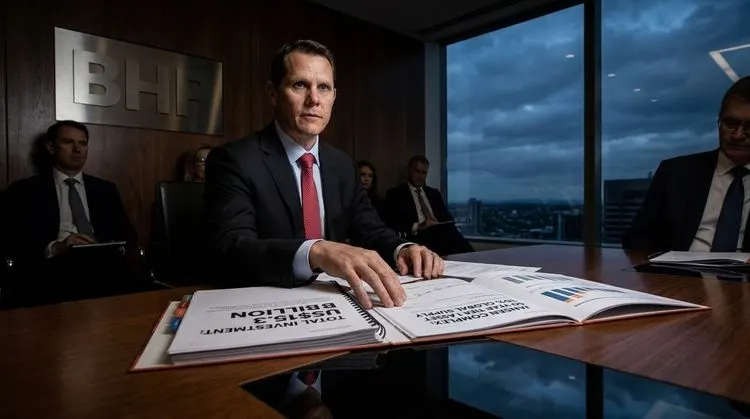
Saskatchewan’s subterranean pink gold has a habit of demanding a king’s ransom before it yields a single tonne of fertilizer, and global mining heavyweight BHP Group (ASX: BHP) is the latest to pay the premium. Rather than pulling back on its massive Jansen potash project east of Saskatoon, the Melbourne-based miner is digging its heels in, and opening its wallet wider. A comprehensive internal review of the project’s second phase has forced the company to face the music, acknowledging that building the future of global crop nutrients is going to take significantly longer and cost much more than the board promised back in 2023.
The price tag for Jansen Stage 2 has officially ballooned by 40 percent, escalating from an initially anticipated US$4.9 billion to a staggering US$6.9 billion. When tacked onto the capital estimate for Stage 1, which has already climbed to US$8.4 billion, the total cost of the twin-stage megaproject now sits at a breathtaking US$15.3 billion. Along with the expanding budget comes a temporal shift; first production for Stage 2 has been pushed out to late 2031, trailing the original 2029 timeline. BHP attributed this multi-billion-dollar adjustment to systemic macroeconomic pressures, citing an increase in required construction hours, a tight local labor market, and higher material quantities identified now that engineering is 83 percent complete. Public markets promptly expressed their displeasure with the update, sending shares of BHP Group (ASX: BHP) down over 4 percent to their lowest levels in weeks while forcing the company to flag a pre-tax non-cash impairment charge of US$2.3 billion against its aggregate Jansen asset base.
Despite the red ink bleeding into short-term financial reporting, the executive suite is treating this as a necessary recalibration to secure a generational crown jewel. Brandon Craig, the President for Americas and CEO-elect for BHP Group (ASX: BHP), strongly defended the project’s overarching trajectory, emphasizing that with the reset of Jansen Stage 2, the company is progressing with its intention of building a Tier 1 asset. Craig noted that the combined Jansen Stage 1 and 2 will be a low-cost, long-life asset with almost a 60-year mine life and is expected to generate benefits for shareholders for decades. He added that once operational, Jansen will establish the company as a leading player in the global potash industry, eventually controlling roughly 10 percent of the world's supply.
Global investment analysts are proving a bit tougher to win over with promises of 60-year horizons. This revision marks the third consecutive time that the mining giant has broken past its cost and timeline projections across the Jansen complex, a trend that typically invites a skepticism discount from institutional fund managers. Market professionals at global financial services firm Jefferies Financial Group (NYSE: JEF) were quick to point out the operational friction, noting in a research brief that the capital expenditure jump exceeded expectations and labeled the market update unhelpful given the currently soft global pricing environment for fertilizer. The firm ultimately reiterated its hold rating on the stock, advising clients that they see better value elsewhere in the mining sector for the time being.
Yet, if you look past the immediate sticker shock, the underlying long-cycle economics still retain a compelling defense mechanism. At 83 percent engineering completion, Stage 2 has successfully de-risked a substantial chunk of its remaining underground unknowns. More importantly, when the asset finally scales up, it is projected to capture the crown as the lowest-unit-cost Canadian potash mine, churning out product at an incredibly lean US$114 to US$130 per tonne. The mining major is also actively fortifying its logistical pipeline, having recently locked down long-term rail transportation agreements with national carriers Canadian National Railway (TSX: CNR) and Canadian Pacific Kansas City (TSX: CPKC) to seamlessly haul its output straight to Westshore Terminals in Vancouver. For a resource giant eager to diversify its portfolio away from traditional steelmaking coal and iron ore, absorbing a paper impairment today appears to be the calculated price of admission for a dominant foothold in the agricultural future of tomorrow.
Sources:
- The Canadian Press / BNN Bloomberg: "BHP hikes cost of Jansen potash mine project in Saskatchewan by US$2 billion" (Published June 19, 2026).
- BHP Group Global Media Release: "Update - Jansen Stage 2 Potash Project" (Published June 18, 2026).
- Reuters / Mining Weekly: "BHP shares head for worst day in months on Jansen project cost overruns" (Published June 19, 2026).
- The Northern Miner: "BHP takes $2.3B hit on Jansen potash mine as cost forecast swells again" (Published June 18, 2026).