
USA Rare Earth Expands French Footprint to Build Allied Mine-to-Magnet Chain
How a transatlantic mine-to-magnet strategy aims to break Beijing’s critical mineral monopoly amid a looming domestic legal battle.
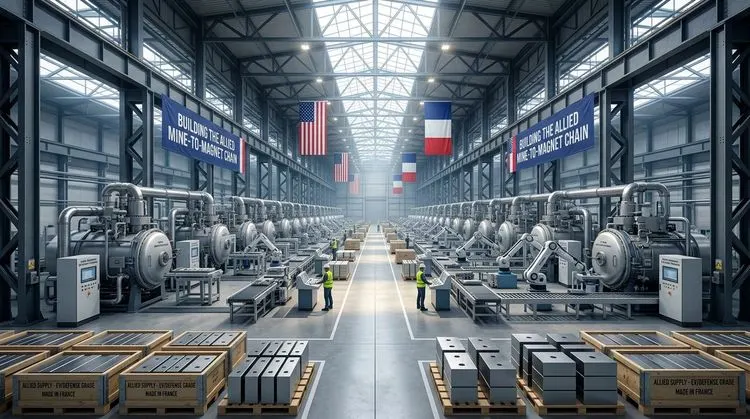
Western superpowers have long stared down an uncomfortable geopolitical reality: their high-tech, green-energy future is effectively on lease from China. But a massive new transatlantic blueprint aims to rewrite the critical mineral scoreboard entirely, turning a reliance on foreign monopolies into a localized powerhouse. At the center of this industrial shakeup is USA Rare Earth (Nasdaq: USAR). Speaking at the high-profile Choose France summit in Paris, the company unveiled a sweeping strategy to deploy more than €175 million ($204 million) across France through 2030, a multimillion-dollar investment designed to scale up rare-earth metal, alloy, and permanent magnet manufacturing capacity on European soil.
This ambitious expansion does not start from a blank slate, as the capital injection builds on a prior agreement where USA Rare Earth (NASDAQ: USAR) committed €40 million ($47 million) to acquire a stake in Carester, a specialized French rare-earth processor. Together with co-located facilities in the industrial hub of Lacq, the broader ecosystem is projected to create more than 300 skilled manufacturing jobs. For USA Rare Earth, the move represents a giant leap toward cementing a closed "mine-to-magnet" value chain, linking raw extraction projects like its Round Top deposit in Texas, slated for commercial production by 2028, directly to allied European processing plants.
Building an independent industrial pipeline of this magnitude requires far more than corporate ambition; it demands deep political alignment. Chief Executive Officer Barbara Humpton highlighted that France offers a rare trifecta of robust industrial infrastructure, a re-emerging chemical processing cluster, and a highly skilled workforce ready to reclaim critical mineral sovereignty. Humpton noted that the proposed expansion aligns closely with agreements between the company and the U.S. Commerce Department, demonstrating a coordinated transatlantic effort to secure defense and tech supply chains.
Recognizing the strategic importance of the project, Paris is prepared to smooth the financial runway. The French government could provide vital incentives, including green industry tax credits, debt guarantees, or potentially a direct equity stake in the company’s European subsidiary. This financial and political tag-team between Washington and Paris underscores a wider urgency across Western nations to secure magnets that power electric vehicles, wind turbines, aerospace electronics, and sensitive defense applications.
Yet, navigating the high-stakes critical minerals sector is rarely a smooth ride, and USA Rare Earth (Nasdaq: USAR) is simultaneously fighting an aggressive defensive battle on the home front. The massive European expansion arrives just as the company faces serious legal headwinds from its primary domestic rival, MP Materials (NYSE: MP). In a lawsuit filed recently, MP Materials accused the developer of industrial espionage, alleging that a former employee pilfered proprietary "grain boundary diffusion" formulations, a highly guarded chemical processing technique used to make high-strength permanent magnets resistant to extreme heat, and shared them with USA Rare Earth, which then allegedly disclosed the data to a third-party technology company.
The corporate pushback has been immediate and unyielding, with USA Rare Earth flatly denying the allegations and countering that the litigation severely misrepresents its company culture, ethics, and workforce. While the company vows to defend itself appropriately in court, the legal battle casts a dramatic shadow over an otherwise triumphant international expansion, leaving the industry to watch whether this courtroom drama will stall its broader global ambitions.
Source
This article is based on reporting from MINING.COM: "USA Rare Earth deepens France bet with $204M expansion" by Cecilia Jamasmie, published June 1, 2026.