
Buffetts, Banks, and Bezos: Tony Ciero’s Billion-Dollar Buffet
How Berkshire Hathaway, Royal Bank, and Amazon Are Shaping the Investment Strategy of Caldwell Securities' Tony Ciero
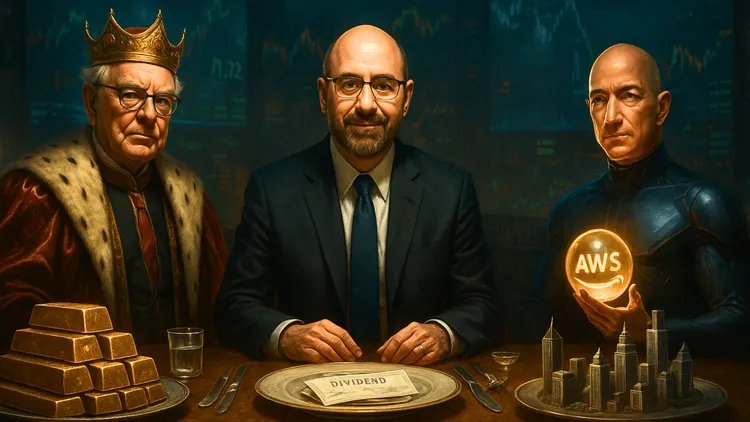
As the third quarter heats up, the equity markets have found their stride again, but investor sentiment still feels like it's walking a tightrope. Tariffs, trade deals, and political maneuvering are dominating headlines. Tony Ciero, Vice President and Senior Portfolio Manager at Caldwell Securities, isn’t chasing headlines. He’s looking for opportunity where stability, fundamentals, and long-term strategy align. And right now, that means putting his weight behind North American large caps.
With the U.S. Federal Reserve holding rates steady and Canada grappling with rising unemployment and looming housing pressures, Ciero is narrowing his focus. He sees the potential not just in policy reform, but in companies that are well-positioned to benefit from it. Three names rise to the top of his list: Berkshire Hathaway, Royal Bank of Canada, and Amazon.
Berkshire Hathaway (BRK.B)
Berkshire Hathaway remains a fortress of diversified investments. With stakes in everything from Geico to Dairy Queen, and major public holdings like Apple, Coca-Cola, and American Express, it's a masterclass in long-term capital allocation. As of 2025, Berkshire is on track to rake in $4.37 billion in annual dividend income. That staggering figure is the result of decades of patient, intelligent investing and brand loyalty.
What’s more, Berkshire has leaned heavily into artificial intelligence, funneling capital into AI-linked ventures that are still only beginning to show their full potential. But the real game-changer this year is the leadership transition. Warren Buffett’s announcement that he’ll step down by year-end sent a jolt through the market. Shares have slipped 12 percent since, but for Ciero, that’s an opening. Greg Abel, Buffett’s hand-picked successor and long-time understudy, is no novice. He’s been in the wings since 2011 and is expected to preserve Buffett’s legacy while charting a modern path forward. Despite short-term jitters, Berkshire remains a top-10 U.S. firm with a $1 trillion market cap, and Ciero sees this as a rare moment to buy quality at a discount.
Royal Bank of Canada (RY.TO)
At home, Ciero’s confidence is in Canada’s crown jewel: Royal Bank of Canada. With a $250 billion market cap, RBC is the largest company in the country and a dividend powerhouse. While Canadian economic indicators look shaky, including a high unemployment rate nearing seven percent and a possible housing crisis, Ciero isn’t flinching. He’s looking through the fog.
RBC’s integration with HSBC Bank Canada is still unfolding, and Ciero believes revenue synergies aren’t fully priced in. The bank has been conservative, setting aside higher-than-expected loan loss provisions, which could provide a cushion in tougher times. But the real upside? A Canada that finally gets serious about breaking down internal trade barriers.
Ciero argues that if Prime Minister Mark Carney takes bold action to eliminate inter-provincial trade hurdles, it could unlock internal growth that far outweighs any fallout from cross-border tariffs. In that scenario, the banks win big. RBC, in particular, would be central to underwriting, financing, and facilitating a new wave of economic expansion. Ciero sees it as a foundational hold, not just for portfolios, but for the country’s financial future.
Amazon.com (AMZN)
Across the border, Ciero’s conviction extends to one of tech’s undisputed giants: Amazon. The company has crossed several key thresholds. Over 300 million users, billions in daily sales, and, for the first time, it surpassed Walmart in quarterly revenue. The next milestone? Overtaking Walmart in annual sales by year-end 2025—a feat that would rewrite the e-commerce playbook.
But it’s not just Amazon’s retail dominance that excites Ciero. The real value lies in AWS—Amazon Web Services. As the company pours capital into AI infrastructure, its cloud division is quietly evolving into a digital backbone for global innovation. A planned $100 billion spend in 2025 signals just how aggressively Amazon is positioning itself for the next wave of AI-driven services.
Ciero is laser-focused on CAPEX. He’s watching how Amazon allocates resources, how it scales its tech stack, and how it continues to widen the moat between itself and the competition. To him, Amazon is more than a retailer. It’s an innovation engine, a cloud titan, and a strategic AI investor all rolled into one. That’s the kind of story that still has chapters left to write.
The Macro Picture
While equity returns have been strong this quarter, it’s the uncertainty that continues to shape investor psychology. Tariff policies are in flux, with August 1 being pegged as a potentially decisive moment. Trade deals with Japan and the European Union have helped ease tensions, but clarity remains elusive.
In Canada, sentiment is mixed. The economic data isn’t great, but the path forward is clear if policymakers act. Reducing internal trade frictions and kickstarting infrastructure projects could be the spark the country needs. Ciero believes these shifts would have a powerful ripple effect, benefiting sectors like construction, lending, and financial services.
In the U.S., the central bank is walking a tightrope. President Trump wants lower rates. Fed Chair Jerome Powell is holding firm. Any drastic move could spook the markets, and that’s something investors can’t afford. For Ciero, this isn’t the time for wild bets. It’s a moment to rely on fundamentals, on companies with strong cash flows, solid balance sheets, and clear long-term strategies.
Conclusion
Tony Ciero isn’t chasing the news cycle. He’s building conviction in companies that are built to endure. Berkshire Hathaway offers long-term value and an AI-driven upside. Royal Bank is a domestic giant poised to benefit from political reform. Amazon is a global force reshaping the tech frontier. In a market clouded by tariffs and rate pressures, these three picks stand out not for what they might do next quarter, but for what they’ve proven they can do across decades.