
You Can’t Build Missiles Out of IOUs: Taiwan’s Raw Material Reality Check
By slashing funds for domestic weapons manufacturing, Taipei is betting its defense on American contractors who still rely on Beijing for critical minerals.
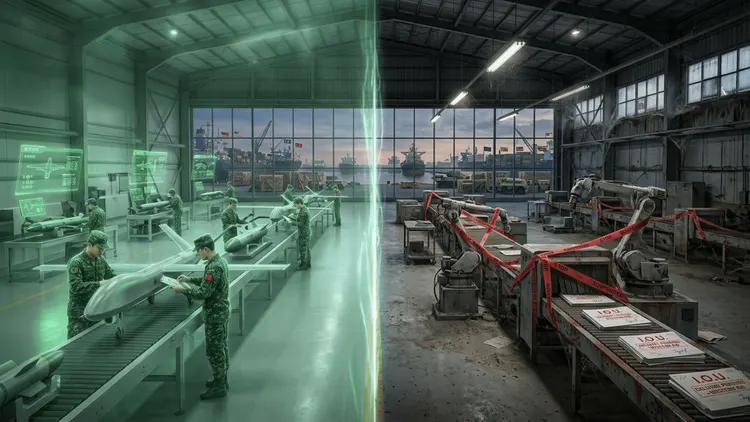
Dollars do not fight wars; raw metal, silicon, and chemical compounds do.
Yet the fierce political wrangling in Taipei seems to have missed that critical memo. Taiwan’s opposition-controlled parliament recently greenlit a $25 billion defense spending package, dramatically undercutting President Lai Ching-te’s proposed $40 billion ambition. The budget cut slashes funding for Taiwan’s domestic production of drones and missiles, outsourcing the island’s defense hardware almost entirely to American defense contractors. On the surface, this looks like a standard political compromise aimed at curbing waste. Pull back the curtain, however, and you reveal a geopolitical irony of staggering proportions.
By relying on the United States for finished weapons instead of building them at home, Taiwan has inadvertently outsourced its supply chain vulnerabilities to a defense industrial base that is dangerously dependent on Beijing. To fulfill Taiwan’s orders for Patriot missiles, Himars, and advanced surface-to-air systems, American defense giants like Lockheed Martin (NYSE: LMT), RTX Corporation (NYSE: RTX), and The Boeing Company (NYSE: BA) require massive quantities of critical minerals. These include rare earths for guidance systems, antimony for armor-piercing munitions, and gallium and germanium for advanced military optics and semiconductors.
The glaring paradox here is that China essentially holds the monopoly on the mining and processing of these exact materials. By shifting the manufacturing burden to the US, Taiwan is betting its survival on America's ability to secure raw materials from the very adversary Taiwan is trying to deter.
Beijing is acutely aware of this leverage and has spent the last few years weaponizing it. Following sweeping export controls on gallium and germanium in 2023, China escalated to severe restrictions on shipments of these materials and antimony to the US, explicitly targeting defense contractors. These critical minerals remain trapped behind a draconian licensing regime governed by the Chinese Ministry of Commerce. For defense powerhouses like General Dynamics (NYSE: GD) and Lockheed Martin (NYSE: LMT), this means the raw materials required to fulfill Taiwan's multi-billion-dollar weapons orders could be delayed or denied by Chinese bureaucrats on a whim.
While Beijing tightens its grip, the Western defense sector is scrambling to develop non-Chinese sources for these vital materials to avoid crippling production bottlenecks. Junior mining companies are racing to fill the void and secure allied supply chains. For instance, Military Metals Corp (CSE: MILI | OTCQB: MILIF) has been aggressively exploring and developing its flagship Trojarová antimony-gold project in Slovakia. Efforts like these are crucial for establishing a reliable, Western-friendly supply chain for the exact type of antimony required for munitions, explosives, and advanced defense tech, bypassing Beijing entirely.
However, developing new mines takes time, time Taiwan may not have. By defunding its own domestic defense manufacturing, Taiwan passed up a crucial opportunity to stockpile these raw materials on the island during peacetime. Had the original $40 billion budget passed, Taiwanese aerospace firms could have aggregated rare earths and battery metals locally, ensuring a continuous flow of home-grown drones and counter-unmanned aerial systems even in the event of a naval blockade. Instead, Taiwan’s defense supply chain is now a vulnerable logistical tether stretched across the Pacific Ocean, completely reliant on just-in-time transits of finished goods.
The reality of modern deterrence is that it requires more than just signed purchase agreements with Washington; it requires an ironclad supply chain. By tying its military readiness to an American defense industry inextricably linked to Chinese critical minerals, Taiwan may have just bought an expensive umbrella to protect against a storm, without realizing the guy bringing the rain also controls the umbrella factory's supply of waterproof fabric.
Sources:
- Financial Times, "Taiwan passes $25bn defence budget that undercuts president’s demands," detailing the legislative cuts to Taiwan's defense spending and its shift toward reliance on US arms sales.
- Center for Strategic and International Studies (CSIS), "China Imposes Its Most Stringent Critical Minerals Export Restrictions Yet Amidst Escalating U.S.-China Tech War," outlining China's targeted restrictions on antimony, gallium, and germanium exports.
- TMX Money / GlobeNewswire, "Military Metals Reports Maiden Inferred Resource Estimate Containing 67,000 Tonnes of Antimony and 222,000 Ounces of Gold at Flagship Trojarova Project, Europe," providing data on Western efforts to secure allied antimony supply chains.
Disclaimer:
This article mentions Military Metals Corp. The author holds shares in Military Metals Corp and may buy or sell at any time. This article is for informational purposes only, was prepared independently without company involvement, and utilized AI assistance. It is not investment advice. Consult a qualified financial advisor before making investment decisions.