
The ETF Built to Break China’s 90% Monopoly on the Modern World
How the new Sprott REXC ETF offers investors a pure-play strategy to bypass Beijing’s critical minerals monopoly and bet on Western supply chain independence.
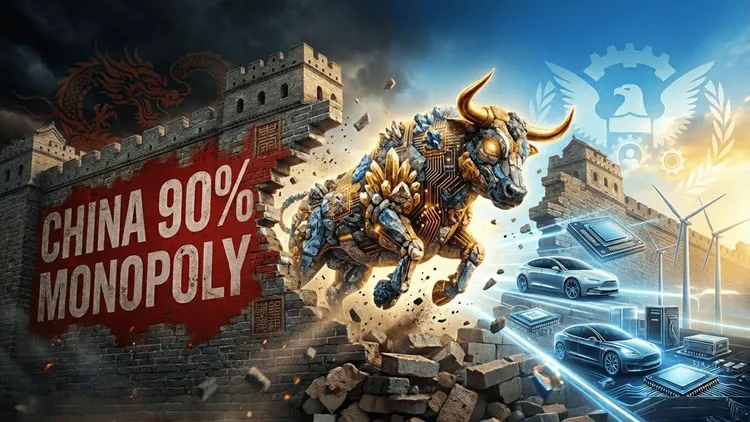
For years, Western technology and defense industries have harbored a dirty little secret: an almost absolute dependency on China for the very elements that power the modern world. With Beijing historically controlling roughly 70 percent of global mining and a staggering 90 percent of refining capacity, the aggressive export controls of 2023 and 2025 transformed a lingering supply chain headache into a full-blown national security crisis. For developed nations reliant on these materials for everything from artificial intelligence infrastructure to fighter jets, finding alternative sources became a mandate.
Enter the Sprott Rare Earths Ex-China ETF (Nasdaq: REXC). Launched in mid-April 2026, this is not just another broad-market thematic fund; it is a financial instrument explicitly built for the new era of deglobalization. Tracking the Nasdaq Sprott Rare Earths Ex-China Index, it currently stands as the only pure-play ETF of its kind in the Morningstar Natural Resources Sector Equity universe designed to completely bypass Chinese exposure. At a competitive 0.65 percent expense ratio, the fund packages the messy, capital-intensive reality of critical mineral independence into a single, tradable ticker.
Peeking under the hood reveals a highly concentrated, strategic bet on Western-aligned production. Launching with just over $2 million in assets under management across 34 companies, the portfolio is heavily anchored by the few operators capable of scaling operations outside of Asia. Lynas Rare Earths (ASX: LYC), the undisputed heavyweight of ex-China producers, commands a massive 22.85 percent index weight. Right behind it is MP Materials (NYSE: MP) at 19.11 percent, serving as the absolute cornerstone of domestic sourcing in the United States. The top five holdings are rounded out by USA Rare Earth (NASDAQ: USAR) at 5.85 percent, Australian mineral sands giant Iluka Resources (ASX: ILU) at 5.24 percent, and the uranium-rare earth processing hybrid Energy Fuels (NYSE: UUUU) at 3.09 percent.
Investors looking for a sleepy, blue-chip ride should look elsewhere because this is decidedly not a large-cap story. Nearly 44 percent of the ETF consists of small-cap companies valued at under $2 billion, domiciled across a diverse mix of jurisdictions including Australia, the United States, Canada, the United Kingdom, Chile, and Guernsey. These are companies navigating complex regulatory landscapes and shifting government policies, meaning volatility is practically guaranteed. They live and die by commodity pricing and the pace at which Western governments are willing to subsidize their own strategic supply chains.
Ultimately, the launch of this fund proves that the geopolitical decoupling narrative is no longer just theoretical political posturing. Whether viewed as a long-term thematic hold for the clean energy and tech transition, or a tactical hedge against the next inevitable trade spat, securing the modern supply chain is finally a directly investable asset class.
Sources:
- Sprott ETFs Official Fact Sheet and Prospectus (sprottetfs.com)
- Nasdaq Stock Market Pricing and Index Data (April 16, 2026)
- Morningstar Natural Resources Sector Equity ETF Universe Data