
How Deep Will Washington Dive to Ensure America’s Clean Energy and Defense Security?
How high-level U.S. policy signals, domestic NOAA permit filings, and a million-dollar promotional push are turning polymetallic nodule exploration into the market’s newest geopolitical trade.
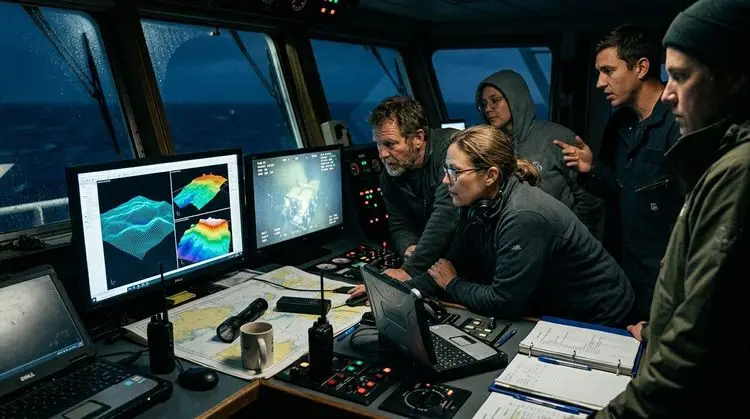
There is gold in them thar abyssal plains, or more precisely, billions of metric tons of battery-grade nickel, cobalt, copper, and manganese, and the upper echelons of American economic statecraft have formally lowered their periscope to inspect the seabed floor.
Vancouver-based Deep Sea Minerals Corp. (CSE: SEAS | OTCQB: DSEAF) saw its stock surge by double digits after seizing upon an unexpected endorsement from Washington. In an official statement submitted to the World Bank Development Committee and the International Monetary Fund on October 14, 2026, U.S. Treasury Secretary Scott Bessent openly plugged deep-sea extraction as a legitimate frontier for securing critical mineral supply chains. The nod was subtle, but in an industry starving for Western regulatory legitimacy, even a diplomatic whisper can register as a sonic boom.
Bessent’s remarks arrived against the backdrop of the World Bank’s newly minted Metals and Minerals Implementation Plan. In his statement, the Treasury Secretary stressed the need for regulatory overhauls, domestic processing capacity, and infrastructure financing to dismantle bottlenecks in critical minerals. He singled out the ocean floor, arguing that multilateral lenders can play a catalytic role by providing knowledge and guidance in what remains a nascent sector.
For junior explorers navigating treacherous legal and marine waters, having the U.S. Treasury Secretary utter the phrase "deep sea mining" in the same breath as international economic security is pure rhetorical fuel. Chief Executive Officer James Deckelman wasted little time framing the comments as validation of his firm’s strategic thesis, pointing out that establishing clear regulatory pathways and solid environmental baseline data are precisely the hurdles early movers must overcome.
Even so, executive management made sure to tuck a healthy dose of reality into the regulatory disclaimers. The Treasury statement does not offer a single dollar in federal funding, grants no operating permits, and refrains from endorsing any commercial enterprise by name.
The geopolitical backdrop makes this policy signal particularly intriguing. Rather than waiting for the United Nations-mandated International Seabed Authority (ISA) to finalize its tortuous, years-delayed exploitation code, American-aligned companies are taking matters into their own hands.
Operating through its U.S. subsidiary, American Deep Sea Minerals Corp., the company has applied directly to the National Oceanic and Atmospheric Administration under the domestic Deep Seabed Hard Mineral Resources Act of 1980. The exploration license covers roughly 147,368 square kilometers of the Clarion-Clipperton Zone, an abyssal plain stretching between Hawaii and Mexico that hosts the richest deposit of polymetallic nodules on Earth. The strategy closely mirrors the sovereign-rights playbook championed by sector pioneer The Metals Company (NASDAQ: TMC), which has long argued on Capitol Hill that Washington cannot afford to cede the seabed floor to Chinese industrial conglomerates.
In tandem with its domestic U.S. regulatory filings, the company is quietly scouting potential licensing agreements within the Exclusive Economic Zone of the Cook Islands, where local authorities hold direct sovereign jurisdiction over vast nodule reserves.
Convincing the public and market regulators that scooping potato-sized metallic rocks off the abyssal seafloor is a viable commercial endeavor does not come cheap. Alongside its political victory lap, the company revealed a third contract extension with Vancouver-based investor relations and digital marketing firm Capital Gain Media Inc.
The renewal carries a fresh US$100,000 upfront price tag, pushing the company’s total marketing and promotion tab to roughly $1.22 million since listing on the Canadian Securities Exchange on January 19, 2026. That figure comfortably exceeds original budget projections. Management justified the hefty promotional burn by explaining that an early mover in an uncharted industry must spend capital educating the market about the fundamentals of subsea mining itself, rather than simply issuing routine operational milestones.
Whether retail investors or environmental watchdogs will share that generous interpretation remains to be seen. While deep-sea exploration captures the imagination of policymakers eager to break foreign critical mineral monopolies, turning deep-sea nodules into refined battery metals requires massive capital, complex offshore recovery technology, and surviving intense regulatory crossfire. For now, junior operators will gladly take the Treasury Secretary’s blessing, and continue spending heavily to ensure everyone in the market hears about it.
Sources
- U.S. Department of the Treasury: Statement by Secretary Scott Bessent for the World Bank Development Committee and IMF International Monetary and Financial Committee (Press Release sb0659, October 14, 2026).
- Deep Sea Minerals Corp.: Corporate News Release, "Deep Sea Minerals Corp. Highlights U.S. Treasury Recognition of Deep Sea Mining in Critical Minerals Policy and Provides Corporate Update" (GlobeNewswire / Canadian Securities Exchange filing, October 19, 2026).
- The Canadian Securities Exchange: Listing Statement (Form 2A) and Regulatory Filings for Deep Sea Minerals Corp. (January–October 2026).
Disclaimer
Neither the author of this article nor JuniorStocks holds equity, stock options, or any other financial positions in Deep Sea Minerals Corp. (CSE: SEAS; OTCQB: DSEAF; FSE: X450), The Metals Company (NASDAQ: TMC), or any other companies mentioned in this publication. This content is published by JuniorStocks strictly for informational purposes, was prepared independently without company compensation, and utilized AI assistance for text editing, formatting, and generating accompanying media. While deep-sea mineral exploration and polymetallic nodule harvesting in the Clarion-Clipperton Zone represent a compelling new frontier in the global critical minerals supply chain, this article does not constitute investment or financial advice. Investors are strongly advised to conduct their own thorough, independent due diligence and consult with a qualified financial professional before making any investment decisions.