
Venture Capital Is Funding Everything in Critical Minerals Except the Hole in the Ground
Forty startups raised US$2.1 billion in a year for magnets, refining and recycling. Less than 5% went to finding new deposits, the job listed juniors still do.
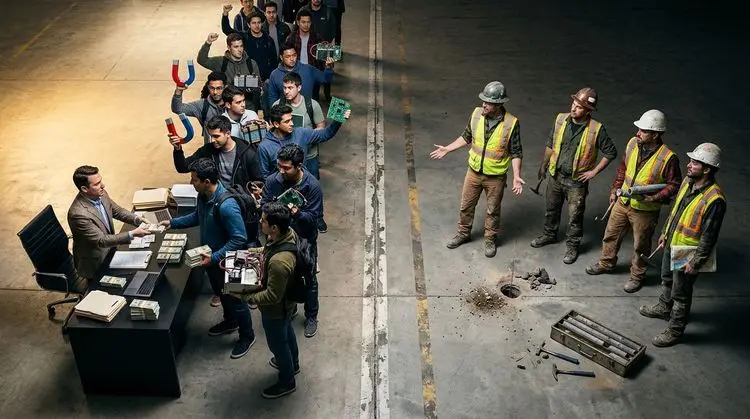
Silicon Valley has discovered critical minerals, just not the part that involves rocks. Forty critical-minerals startups raised a combined US$2.1 billion in their latest equity rounds between November 2025 and November 2026, according to data compiled by Fundable. Look at where the money went and a pattern jumps out: investors are lining up to fund what happens to metal after it leaves the ground, and barely funding the search for new ground at all.
JuniorStocks sorted Fundable's 40 companies by what each one does. Roughly US$754 million, about 36%, went to processing, refining and extraction technology. Magnet and motor makers took about US$682 million, or 32%. Battery, magnet and electronics recycling drew about US$579 million, or 27%. Exploration, including AI deposit-targeting and new drilling technology, attracted about US$91 million, roughly 4% of the total.
The money is also concentrated. The top three rounds in Fundable's data add up to about US$1.17 billion, or 55% of the total: rare-earth magnet maker Vulcan Elements, which Fundable lists at US$430.7 million (Vulcan has not publicly announced the round's size), battery recycler Redwood Materials at US$425 million and Mariana Minerals at US$310 million. Redwood, founded by Tesla co-founder JB Straubel, closed its US$425 million Series E in January with Google joining existing backers Capricorn and Goldman Sachs Alternatives, the company said. Mariana, which uses autonomous software to run mines and has restarted an idled copper mine in Utah, raised its US$310 million Series B in August at a US$1.5 billion valuation in a round led by Khosla Ventures, Fortune reported. Rare-earth magnet maker Noveon Magnetics completed a US$215 million Series C in January.
AI exploration startups are the exception that proves the rule. Atana Elements (US$27.5 million), Lithosquare (US$25 million), Terra AI (US$20 million) and Quminex (US$1.1 million) are all trying to find deposits faster, but together they raised less than Redwood's round on its own.
Now compare that with the listed market, where most of the world's exploration actually happens. The money there has not dried up; it has gone to gold. Global exploration budgets slipped 1% to US$12.4 billion in 2025, the third straight annual decline, with gold up 11% to US$6.15 billion, or half of all spending, according to S&P Global Market Intelligence data reported by BusinessDay. Battery metals went the other way: lithium exploration budgets fell 46% to US$595 million, nickel fell 37% to US$332 million and cobalt fell 41% to US$31 million. Junior company budgets dropped 13% to US$4.39 billion, and grassroots exploration, the early-stage work that finds new deposits, fell 8% to US$2.57 billion.
The gap is striking. Redwood's single round is equal to about 71% of the entire world's 2025 lithium exploration budget. Fundable's 40 startups raised an average of about US$54 million each (excluding one undisclosed round). On the TSX Venture Exchange, issuers raised about C$9.95 billion across 1,118 financings in the first ten months of 2026, according to TMX Group, an average of under C$9 million per financing, across all sectors.
That creates an awkward supply-chain question. Magnet plants, refineries and recyclers need feedstock. Recycling can supply part of it, but new demand still has to come from new mines, and new mines start as discoveries, mostly made by small listed companies raising a few million dollars at a time. Private capital is building the downstream part of the critical-minerals chain while the upstream search for battery metals has been shrinking.
The caveats. These figures compare different things: Fundable's data counts equity raised by private companies, while S&P's figures are planned exploration budgets and TMX's cover all sectors. Several startups straddle categories, so the split is JuniorStocks' own grouping based on Fundable's descriptions. Gold-heavy junior financing has also been strong, with junior and intermediate fundraising more than doubling in 2025 per S&P, so this is a story about battery metals, not about juniors as a whole. And venture rounds are no guarantee of commercial success.
Still, the message for junior investors is clear enough. The downstream boom is real and well funded. If those plants get built, someone will have to find the metal to feed them.
Sources:
- 40 critical minerals startups that raised," Fundable (infographic shared on LinkedIn; latest equity round per company, Nov 2025 to Nov 2026), November 2026. Data: Fundable.
- Redwood Materials Announces Final Close of $425M Series E," Redwood Materials, January 28, 2026: redwoodmaterials.com
- Khosla and a16z bet on a startup to reinvent mining," Fortune Term Sheet (Allie Garfinkle), August 3, 2026: fortune.com
- Noveon Magnetics Completes $215 Million Series C," Noveon Magnetics via Cision/Newswire, January 19, 2026: newswire.ca
- Gold drives mining exploration as global budgets fall for third year," BusinessDay (Lindiwe Tsobo), citing S&P Global Market Intelligence, April 9, 2026: businessday.co.za
- TMX Group Equity Financing Statistics – October 2026," TMX Group via Newsfile, November 10, 2026: financialcontent.com
Disclaimer:
Neither the author of this article nor JuniorStocks holds equity, stock options, or any other financial positions in any of the companies mentioned in this publication, all of which are privately held. This content is published by JuniorStocks strictly for informational purposes, was prepared independently without company compensation, and utilized AI assistance for text editing, formatting, and generating accompanying media. While the flow of venture capital into critical minerals represents a compelling growth story, this article does not constitute investment or financial advice. Investors are strongly advised to conduct their own thorough, independent due diligence and consult with a qualified financial professional before making any investment decisions.