
Drowning in Red Tape: While the West Debates Ethics, China Mines the Deep
How Beijing turned thirty years of Western regulatory hesitation into an uncontested industrial and military monopoly beneath the waves.
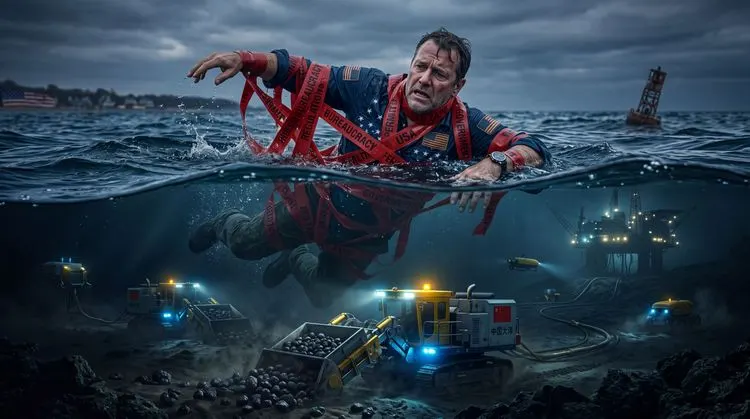
While the West spent the last three decades learning how to swim in regulatory red tape and ethical hand-wringing over deep-sea mining, China was already deep-sea fishing for the future of global power.
Humanity has spent years looking up at the sky, mesmerized by the prospect of mining asteroids and colonizing Mars, while Beijing has been looking straight down to the bottom of the ocean.
This is not a traditional mining story; it is a masterclass in long-term strategic capability. The deep sea, comprising roughly half of the planet, remains largely unexplored and legally unclaimed, but the international race to dominate its resources is rapidly transforming these abyssal plains into the next major geopolitical flashpoint.
Under the watchful eye of the International Seabed Authority (ISA), the United Nations-affiliated body overseeing international waters, China has secured five exploration contracts. This is more than any other nation on Earth, covering polymetallic nodules, sulphides, and cobalt crusts. But the treasure hunt extends far beyond raw materials. Mining the deep ocean requires highly specialized robotics, heavy-duty submersibles, and advanced sonar systems, all of which possess distinct dual-use military capabilities. Security analysts note that China’s extensive oceanographic research fleet spends only a fraction of its time within designated mining zones. The vast majority of its operational hours are dedicated to mapping strategic maritime chokepoints and submarine transit corridors. By gathering precise bathymetric and acoustic data, state-backed entities are essentially constructing an underwater surveillance network. This data-driven landscape threatens to strip away the traditional stealth advantages enjoyed by Western naval forces, turning a resource play into a security stronghold.
The strategic encirclement does not stop in international waters. China has actively pursued bilateral partnerships in the South Pacific, striking co-exploration deals within the Exclusive Economic Zones of island nations like the Cook Islands and Kiribati. By embedding itself directly into the maritime backyards of regional powers, Beijing ensures its infrastructure is firmly anchored before the West can even agree on a rulebook. Western enterprises are waking up to this reality, but they are operating with a profound structural disadvantage. Private firms are bound by quarterly profit margins and intense public pressure over environmental degradation, whereas their Chinese state-backed counterparts enjoy multi-generational horizons insulated from electoral shifts.
Despite these hurdles, public-market players are pushing ahead. Leading the charge is The Metals Company (Nasdaq: TMC), which focuses on harvesting polymetallic nodules in the Clarion-Clipperton Zone of the Pacific. These potato-sized rocks are rich in nickel, cobalt, copper, and manganese—the exact cocktail required to fuel the clean energy transition and modern defense hardware. Similarly, European industrial heavyweights are anchoring their own claims. DEME Group NV (Euronext Brussels: DEME) operates extensively in seabed exploration through its specialized subsidiary, Global Sea Mineral Resources. In Scandinavia, innovators like Loke Marine Minerals have entered the fray by acquiring legacy seabed licenses previously held by Western defense conglomerates, looking to carve out a secure, non-Chinese supply chain for Europe.
The regulatory environment remains a chaotic maze, particularly for American interests. Because the United States has never ratified the UN Convention on the Law of the Sea, American companies lack a direct legal pathway to claim resources in international waters. To bypass this gridlock, firms are seeking alternative domestic frameworks. Recent regulatory milestones have seen companies navigate compliance determinations from the National Oceanic and Atmospheric Administration under legacy domestic statutes, providing a tentative baseline for Western operations. This includes exploratory tracking by micro-cap innovators like Deep Sea Minerals Corp. (CSE: SEAS) as they signal a renewed push for Western mineral independence.
The rush to vacuum up the ocean floor is fundamentally about maintaining a broader industrial monopoly. China already controls approximately 60% of terrestrial critical mineral production and a staggering 85% of global processing capacity. For Beijing, seabed extraction is a preventative measure designed to ensure that even if the global supply chain shifts from land to sea, the world will still rely on Chinese refining infrastructure. Terrestrial giants like China Rare Earth Resources and Technology Co., Ltd. (Shenzhen Stock Exchange: 000831.SZ) are heavily integrated into this vertical ecosystem. By expanding state influence into marine environments, these mega-corporations can effectively hedge against land-based resource depletion while ensuring Western competitors remain structurally dependent.
Ultimately, the deep-sea race is not just about who plants the first flag on the seabed.
It is about who owns the proprietary technology, who compiles the topographic data, and who dictates the international maritime standards. As Western policymakers face the choice between enforcing strict environmental moratoriums and countering a supply chain monopoly, the window to contest the ocean floor is rapidly closing.
Sources:
- International Seabed Authority (ISA) documentation on global exploration contracts and seabed mining regulations.
- National Oceanic and Atmospheric Administration (NOAA) regulatory compliance frameworks under the Deep Seabed Hard Mineral Resources Act.
- Mongabay Data Studio and CNN International Investigation fleet tracking data and operational analysis of Chinese oceanographic research vessels.
- RAND Corporation strategic reports detailing critical mineral supply chain security and terrestrial processing monopolies.
- Financial data, market tracking, and corporate disclosures for The Metals Company, DEME Group NV, Deep Sea Minerals Corp., and China Rare Earth Resources and Technology Co., Ltd.