
FMF 2026: What Happens When Mining Becomes National Defense?
How American urgency and Saudi capital just ended the free market era of critical minerals.
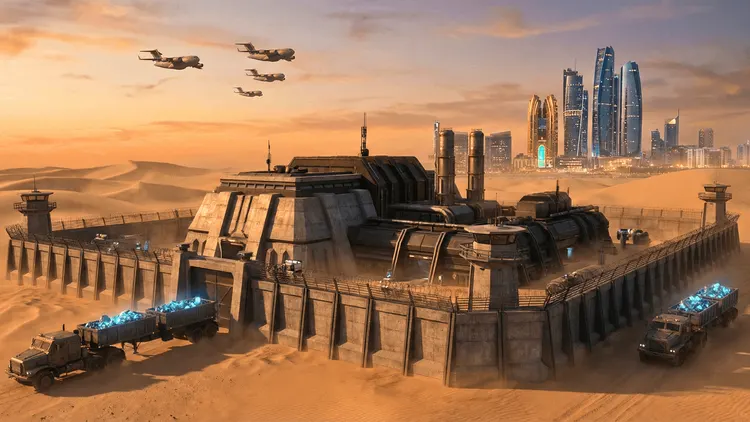
If you want to witness the precise moment the free market era of mining died and the era of industrial statecraft was born, you didn’t need to be on Wall Street or in Washington this week. You needed to be in Riyadh.
For three days in mid-January, the Future Minerals Forum (FMF) transformed the Saudi capital into the unlikely epicenter of the global energy transition. What was once a regional gathering has metastasized into the "Davos of Dirt," a geopolitical spectacle where the world’s superpowers finally admitted that the invisible hand of the market isn't digging holes fast enough to save them.
The 2026 iteration of the forum made one thing painfully clear: the West is done asking nicely for critical minerals. It is now demanding them, funding them, and protecting them with a fervor that would make a central planner blush.
The United States Declares War on Red Tape
The shockwave of the conference came courtesy of David Copley, a top official from the Trump 2.0 administration’s National Energy Dominance Council. In a room filled with executives weary of regulatory purgatory, Copley didn’t offer platitudes; he offered a complete rewriting of the American regulatory playbook.
For decades, the United States has been content to outsource the dirty work of extraction, resulting in a lethargic permitting average of nearly 29 years per mine. Copley’s message was blunt: that era is over. Under the banner of national security, the U.S. government is pivoting to a strategy of aggressive interventionism. The plan involves treating mining projects not as commercial ventures but as national defense assets, utilizing emergency declarations to slash permitting timelines from decades to mere months.
But the White House isn't just cutting tape; it is writing checks. Copley outlined a strategy that sees the U.S. government effectively donning a private equity fleece vest, deploying direct equity investments into miners to ensure deals pencil out. Coupled with a massive $2 billion stockpiling initiative, the largest since the Cold War, and promises of protectionist price floors to combat foreign dumping, the message was unmistakable. The U.S. is going to buy its way to mineral independence, and it is bringing a war chest to the desert.
The Saudi Pivot: From Oil Wells to Processing Cells
While the Americans brought the urgency, the Saudis brought the infrastructure. It is a lazy cliché to view Saudi Arabia merely as an oil giant looking for a new hobby. As Amanda van Dyke observed from the conference floor, the Kingdom’s mining strategy is a sophisticated response to a demographic ticking clock. With 70% of the population under the age of 35, Saudi Arabia needs an industrial economy, not just rent-seeking revenue.
The Kingdom has correctly identified the bottleneck of the 21st century. The world doesn’t just lack mines; it lacks the capacity to turn raw rock into battery-grade chemicals, a step currently dominated by China. Saudi Arabia is pitching itself as the global solution to this "midstream" crisis.
The value proposition presented in Riyadh was seductive in its simplicity. If you build your processing facility in the Kingdom, the state won’t just hold the door open; it will finance up to 80% of your capital expenditures and connect you to low-cost energy within 60 days. It is a level of state capacity that Western jurisdictions, bogged down in grid connection queues and local opposition, simply cannot match. The result is a burgeoning alliance where Western firms like Barrick Gold and Ivanhoe Electric bring the geological expertise, and Riyadh provides the capital-intensive processing ecosystem.
The Realism of the "Super Region"
This convergence of American desperation and Saudi ambition set the tone for the entire event. The idealistic fluff of previous years was replaced by the hard-nosed realism of industry titans like Robert Friedland, who brought his trademark bluntness to the stage. Friedland reminded the attendees that the current trajectory of electrification is mathematically impossible without "astronomical" amounts of new copper, calling the idea that we can electrify every car in the world a "fraud" under current supply constraints.
That reality check drove the deal-making. Canada, usually a quiet player, signed a significant Memorandum of Understanding with Saudi Arabia to integrate their supply chains. This wasn’t just paper-pushing; it materialized immediately in a commercial deal between Northern Graphite and the Saudi Obeikan Investment Group to build a battery anode facility in the Kingdom. It was a textbook example of the new world order: Canadian dirt, Saudi processing, destined for global markets.
The Dawn of Industrial Statecraft
The 2026 Future Minerals Forum will be remembered as the moment the mining industry stopped pretending it could solve the supply gap alone. The $5 trillion investment deficit looming over the sector has forced governments to step in as the ultimate guarantors of demand.
We are witnessing the birth of a new "Super Region" stretching from Africa to Central Asia, anchored by Saudi capital and driven by Western security needs. The free market may have efficiency, but industrial statecraft has speed. And as the delegates left Riyadh, the consensus was that speed is the only commodity that matters anymore.