
G7 Sets 2030 Deadline to Cap Rare Earth Dependence on China
The G7’s 2030 Pivot: Can a Collective Strategy Finally Break the Dependence on Chinese Mineral Monopolies?
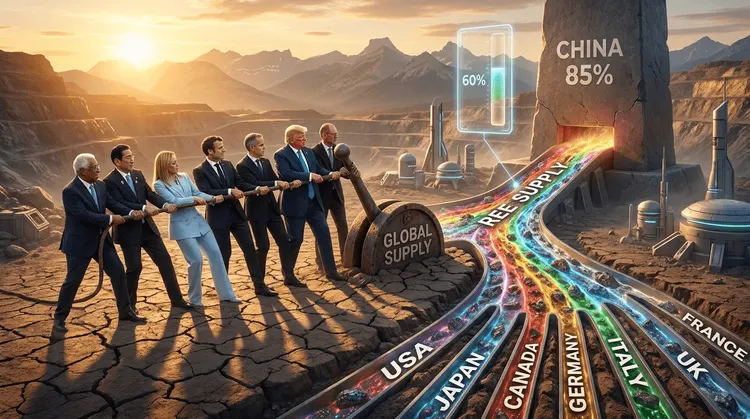
The Group of Seven has officially signaled a collective pivot away from their heavy reliance on Chinese supply chains for the materials that keep the modern world humming.
Gathering in the scenic French town of Evian this week, G7 leaders codified a long-simmering anxiety into a definitive policy: the group aims to ensure that no single country supplies more than 60% of their imported rare earths and permanent magnets by 2030.
If the group hits that milestone, the target is slated to drop further to 50% as soon as possible.
It is a stark admission that the era of "just-in-time" global supply chain efficiency has been sidelined by the reality of economic coercion.
The strategy, while broad, is not without its operational teeth. Leaders have committed to a new coordination platform designed to act as an early-warning system for supply disruptions, with plans to kick off pilot programs for lithium and nickel. This move creates a high-stakes environment for industry players like MP Materials (NYSE: MP), which operates the Mountain Pass facility in California. As one of the few integrated, large-scale producers outside of China, MP Materials stands as a vital benchmark for Western efforts to rebuild domestic processing capacity.
However, the policy is already facing scrutiny from industry veterans.
David Abraham, a noted expert on critical minerals and author of The Elements of Power, has raised significant concerns regarding the technical feasibility of the G7's "blanket" approach. Abraham points out that the term "rare earths" is an umbrella covering seventeen distinct elements, each with a vastly different market profile. While the world may be well-supplied with more abundant elements like cerium or lanthanum, the supply chains for high-value heavy rare earths like dysprosium or lutetium remain significantly more constrained and concentrated.
According to Abraham, the G7’s goal risks muddling the difference between "rare earths" as a general commodity and the granular reality of specific material supply lines. He argues that forcing a 60% cap on the entire category may not address the acute, element-specific dependencies that actually threaten the defense and automotive sectors. By lumping these elements into a single "basket," critics fear the G7 might be setting an arbitrary target that fails to account for the specialized, end-to-end processing dominance that Beijing has cultivated over decades.
Whether the 2030 deadline serves as a genuine roadmap or merely an optimistic piece of summit theater remains a subject of intense debate.
What is clear is that the G7 has signaled that the era of ignoring single-source supply chain risks is over.
As governments look to coordinate demand and potentially introduce sectoral quotas, the market is bracing for a decade of expensive, complex, and mandatory restructuring.
Sources:
- G7 Leaders’ Declaration on Securing Supply Chains for Critical Minerals, Bundesregierung, June 17, 2026.
- G7 Launches Critical Minerals Alliance to Reduce Dependence on China, Modern Diplomacy, June 17, 2026.
- G7 aims to see China supply no more than 60% of rare earths, MINING.COM, June 17, 2026.
- David S. Abraham, The Elements of Power: Gadgets, Guns, and the Struggle for a Sustainable Future in the Rare Metal Age, Yale University Press (2015).
- Rare Earth Export Restrictions One Year Later, Center for Strategic and International Studies (CSIS), April 2026.