
Ethereum’s Wall Street Campaign Is Just Beginning
Ethereum’s boldest believers are betting billions that Wall Street’s future will run on its rails.
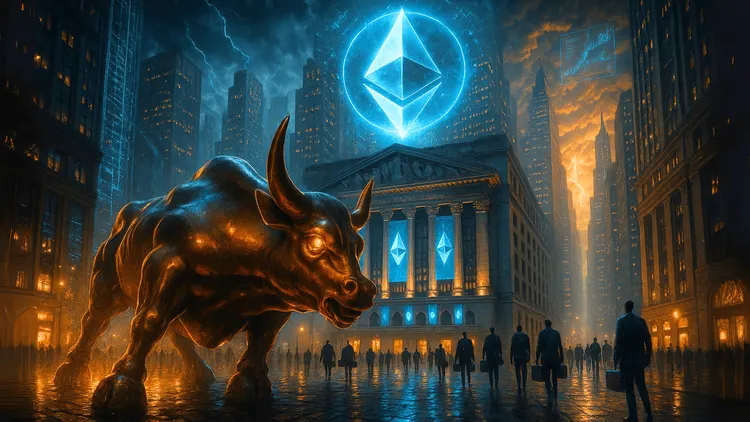
In the grand banking hall of Cipriani 42nd Street in Manhattan, Ethereum’s most influential champions gathered under marble columns and chandeliers to declare what they believe is the next great financial shift. The event, part of Ethereum NYC 2025, carried the air of a victory lap and a sales pitch rolled into one. Days earlier, Ether had surged nearly 75 percent since June, brushing close to its all-time high. Now, executives and investors framed Ethereum not merely as a cryptocurrency, but as the foundation of a future monetary system poised to reach deep into Wall Street.
The campaign is clear. Ethereum is no longer being positioned as just a token for traders, but as programmable money that corporate treasuries can stockpile, lock away, and leverage as infrastructure for tomorrow’s financial rails.
Ethereum’s Value Proposition
Ethereum has always promised more than Bitcoin. While Bitcoin is digital gold, Ethereum is a programmable ledger where software called smart contracts can run automatically. This makes it a decentralized computer for financial activity, whether trading tokens, moving stablecoins, or securing loans. Each action requires Ether, creating built-in demand for the token.
Tom Lee, chairman of BitMine Immersion Technologies, captured the essence of this pitch on stage. His company controls more than $6 billion in Ether, a staggering sum for a firm relatively unknown in traditional finance. His claim was direct: “Ethereum is where Wall Street and AI will converge.”
Lee and others argue that the more institutions adopt Ethereum, the more its token becomes indispensable. Corporate treasuries quietly accumulating Ether are betting not just on price appreciation, but on Ethereum’s rails forming the architecture of the next financial system.
Borrowing From Bitcoin’s Playbook
Ethereum’s backers are not reinventing the wheel. They are following the corporate treasury model pioneered by Michael Saylor of MicroStrategy, who turned his company into a quasi-Bitcoin ETF in 2020, eventually amassing tens of billions in Bitcoin. BitMine’s stake in Ether is smaller—about 1 percent of the circulating supply—but the ambition mirrors Saylor’s. Lock away supply, create scarcity, and let market forces do the rest.
The math works in Ethereum’s favor. Unlike Bitcoin, a portion of every transaction fee on Ethereum is permanently destroyed, reducing supply over time. Long-term treasuries could amplify this scarcity, giving Ether a structural advantage if adoption deepens.
The Staking Advantage
Another edge for Ethereum is staking. By locking up Ether to secure the network, holders earn yield, effectively turning the asset into a dividend-paying instrument. It is a unique proposition that positions Ether as more than a speculative token. BlackRock and other major issuers are already pushing to incorporate staking into their exchange-traded funds, potentially opening the door for mainstream investors to capture both price appreciation and yield.
If approved, it would cement Ethereum’s role as not just a technology play, but as a financial product with parallels to both equity and fixed income.
Rivals and Resistance
Yet Ethereum faces challenges. Faster and cheaper blockchains like Solana are rising fast, attracting developers and users with lower fees and higher speeds. Meanwhile, traditional financial heavyweights are building their own private blockchain rails. Circle and Stripe are among those developing proprietary systems, which could bypass Ethereum entirely.
Joe Lubin, Ethereum’s co-founder, acknowledges the race. He argues that locking away Ether through treasury strategies could offset these competitive threats by creating a structural floor under the token’s price. Still, if proprietary networks take hold, Ethereum risks being boxed out of the very systems it hopes to power.
Wall Street’s Early Movers
Despite the uncertainty, the money flowing into Ethereum is real. Joseph Chalom, co-CEO of SharpLink Gaming and a former BlackRock executive, highlights the opportunity. SharpLink has accumulated over $3 billion in Ether, while BlackRock’s own Ether ETF has already grown to $16 billion in assets.
Projections are bold. Lee suggests Ether could soar to $60,000 from its current levels near $4,300 if Wall Street piles in. Standard Chartered has raised its year-end target to $7,500, while Ark Investment Management has lifted its long-term outlook. The believers span from bank research desks to political circles, with entities tied to Donald Trump’s network also disclosed as Ether buyers.
The Road Ahead
The test for Ethereum is no longer about its technology but about staying power. Can it remain central to financial innovation when markets turn down? Can corporate holders resist the temptation to sell during downturns? And can Ethereum translate its ecosystem of decentralized finance, tokenization, and smart contracts into real-world financial adoption?
Ethereum has positioned itself as the bridge between crypto and Wall Street. Its advocates see it as the biggest macro trade of the next decade. Its skeptics caution that corporate treasuries can sell as easily as they buy.
But the fact remains, Ethereum is no longer a fringe experiment. It is a serious contender for the financial future, one that has already drawn billions from the biggest names in the game.
Conclusion
Ethereum’s rise from speculative coin to Wall Street’s new darling is one of the most ambitious campaigns in financial history. Its backers are betting that corporate treasuries, institutional investors, and mainstream financial giants will not only buy in, but hold through volatility and build new systems on its rails. The surge in price, the billions already committed, and the sheer scale of belief suggest that Ethereum has already crossed a point of no return. Whether it becomes the backbone of global finance or another speculative bubble will be decided not in trading pits, but in boardrooms, regulatory filings, and the quiet decisions of treasury managers.