
Did Elon Musk Just Declare War on Donald Trump?
A former political alliance implodes as Elon Musk slams Trump’s budget bill, sparking a war of words and widening cracks in the GOP.
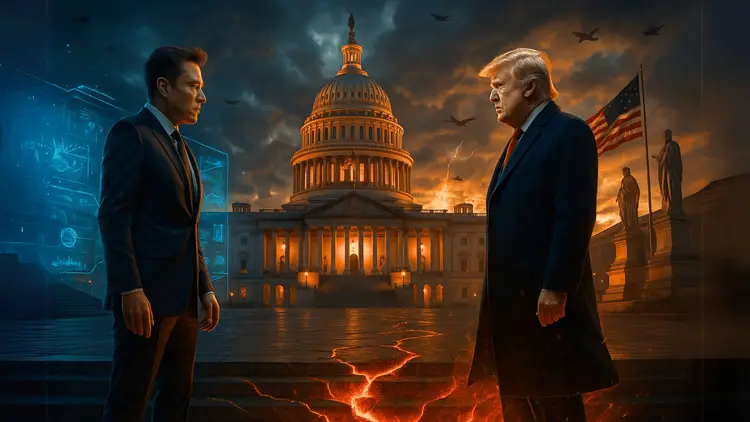
The alliance that once symbolized the fusion of tech innovation and populist politics is unraveling in dramatic fashion. U.S. President Donald Trump publicly expressed his dismay with Elon Musk, the billionaire entrepreneur who once stood squarely in his corner. Now, that support appears fractured beyond repair.
Once Allies, Now Adversaries
Standing at the podium beside German Chancellor Friedrich Merz, Trump didn’t mince words. “I’m very disappointed because Elon knew the inner workings of this bill better than almost anybody sitting here,” he said, clearly agitated. “All of a sudden he had a problem.”
Trump’s frustration stems from Musk’s scathing critique of the administration’s proposed budget bill. The bill, which proposes sweeping tax cuts and deep spending reductions, has been heralded by Trump as essential to restoring fiscal discipline. Musk, on the other hand, has labeled it a “disgusting abomination” and has gone as far as to accuse Trump of “ingratitude” in a series of pointed posts on X.
The Budget Bill That Tore Them Apart
At the heart of the feud is Trump’s centrepiece economic proposal— a budget bill that promises to slash government spending by hundreds of billions. It passed the House with Republican support, though with vocal dissent from some within the party and unified opposition from Democrats. The bill targets cuts across numerous agencies, including controversial eliminations like the United States Agency for International Development (USAID), and rolls back incentives for electric vehicles and solar energy.
Musk, who briefly led the Department of Government Efficiency (Doge), had been tasked with helping streamline federal expenditures. During his short-lived tenure, he boasted of saving $180 billion through department shutdowns and mass layoffs. But even that number is in dispute—and well short of the $2 trillion in cuts Musk initially aimed for.
What seems to have triggered the fallout was Trump’s decision to maintain oil and gas subsidies while stripping support for electric vehicles. Musk has strongly denied that his opposition is based on Tesla’s interests, insisting instead that it’s about “wasteful pork” embedded in the bill. “Keep the EV/solar incentive cuts in the bill, even though no oil & gas subsidies are touched (very unfair!!), but ditch the MOUNTAIN of DISGUSTING PORK,” he wrote on X.
From Praise to Public Rebuke
It wasn’t long ago that Musk was one of Trump’s most vocal allies. He endorsed the former president last July in the wake of an assassination attempt in Pennsylvania and reportedly contributed $250 million toward Trump’s reelection campaign. Their bond was further solidified in late May when Trump presented Musk with a golden key in a lavish ceremony, symbolizing his trust in the tech mogul’s fiscal acumen.
Yet within days, Musk’s tone changed. The Tesla and SpaceX CEO has openly challenged the assumptions behind the bill, claiming he hadn’t seen its full contents before it was voted on and accusing Trump of violating earlier promises about budget transparency and balance. In one of his most stinging posts, Musk declared, “Without me, Trump would have lost the election. Dems would control the House and the Republicans would be 51-49 in the Senate.”
The comments hit a nerve. Trump’s irritation has since evolved into open hostility. “He hasn’t said bad things about me personally, but I’m sure that’ll be next,” Trump quipped to the press.
Behind the Scenes Power Struggles
Observers say this spat is more than just bruised egos—it represents a deeper fracture within the Republican ranks between pro-business pragmatists and populist ideologues. While Trump’s supporters applaud the aggressive cost-cutting, others fear it’s a step too far, especially with projections showing the bill could swell the national debt by $2.4 trillion over the next decade. The Congressional Budget Office has also estimated that nearly 11 million Americans could lose government-backed health insurance as a result.
Musk has used these numbers to amplify his critique, contrasting them with Trump’s earlier campaign promises to avoid cuts to healthcare and entitlement programs. He’s also revived older tweets where Trump spoke of balanced budgets and reduced deficits—reminders, Musk implies, that the president has abandoned his own economic principles.
Political Theater or Genuine Rift?
There are those who believe this feud is more calculated than chaotic. Some insiders suggest Musk’s departure from Doge was not solely due to policy disagreements but also a strategic pivot to regain control of his public image. Being too closely tied to the administration’s polarizing policies, they argue, could alienate Tesla’s consumer base and international partners.
For Trump, the fallout with Musk could be a political liability. With the Republican Party gearing up for a bruising primary season, alienating one of the world’s most influential entrepreneurs might not be the wisest move. Still, Trump has rarely shown hesitation in burning bridges—especially if it helps energize his base.
The Long-Term Fallout
As of now, both men appear committed to their respective positions. Trump remains determined to push the budget bill through the Senate, confident that its reforms are both necessary and overdue. Musk, meanwhile, has continued to unleash his digital wrath, reposting charts, historical quotes, and economic analyses to back his stance.
Neither seems ready to extend an olive branch. For two figures who once seemed to share a mutual vision of American greatness—albeit from radically different platforms—the breakup is both personal and political.
And as Washington braces for another fiscal showdown, one thing is certain: the bromance is over, and the battle lines are drawn.
Conclusion
What started as a high-profile alliance between two of the world’s most powerful men has now devolved into a very public political divorce. Trump and Musk were once united by ambition and ideology, but today they are locked in a dispute that could reshape not only their personal legacies but also the political direction of the Republican Party. The only question now is—who will come out stronger when the dust finally settles?