
Debunking the "Buying Greenland" Myth: It’s Not About Critical Minerals
Why the US obsession with the Arctic island is less about rare earth magnets and more about missile shields, Russian submarines, and 31 billion barrels of oil.

When headlines scream about the United States wanting to "buy" Greenland, the public imagination usually drifts toward a real estate deal of absurd proportions, a Trumpian tower on a glacier or a desperate grab for rare earth magnets to power our iPhones. But if you peer behind the curtain of sensationalism, as Critical Minerals expert Amanda van Dyke points out, the reality is far colder, more calculated, and infinitely more strategic. The narrative that the U.S. is chasing Greenland solely for its mineral wealth is, to put it politely, a red herring. The real game isn't about what’s in the ground; it’s about where the ground is, who controls the sky above it, and the security of the digital infrastructure we rely on.
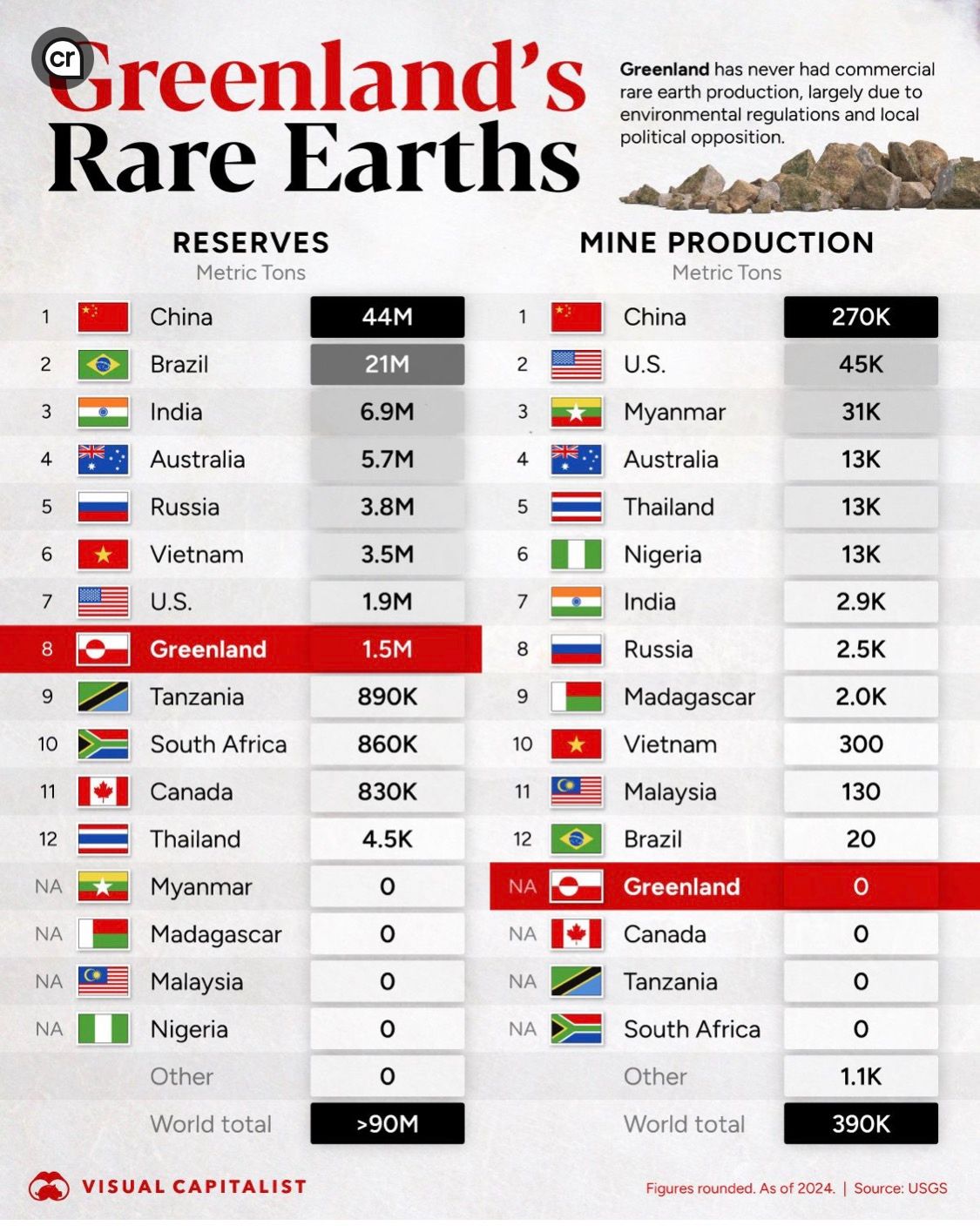
Let's look at the numbers regarding those much-hyped minerals. As illustrated by recent data from the USGS and Visual Capitalist, Greenland sits on a respectable 1.5 million metric tons of rare earth reserves. That lands it at number eight globally, a significant figure, certainly. But in the ruthless arithmetic of global supply chains, "reserves" do not equal "supply." The disparity is painfully clear when you realize that while China churns out 270,000 metric tons of production annually, Greenland’s production is exactly zero. To turn that zero into a meaningful number would require decades of infrastructure development, regulatory wrangling, and capital investment. As Van Dyke notes, these minerals are a "nice but minor bonus." They are not the geopolitical main course. If the U.S. simply needed dysprosium or neodymium, there are easier places to dig.
The primary driver of American interest is actually a concept that dates back to the U-boat anxieties of World War II known as the GIUK Gap. This naval choke point, spanning the waters between Greenland, Iceland, and the United Kingdom, is the only exit ramp for the Russian Northern Fleet to enter the Atlantic Ocean. Control over Greenland isn't just about territory; it’s about maintaining the "cork in the bottle" of the North Atlantic. With the Arctic ice melting and opening new shipping lanes, this frontage becomes the world's newest and most volatile maritime border. Furthermore, Greenland hosts the Pituffik Space Base, the U.S. military’s northernmost listening post. It is the unblinking eye of the American missile defense shield, essential for detecting ICBM launches over the Arctic. In a world where hypersonic missiles shrink response times to minutes, possessing the high ground at the top of the world is non-negotiable.
The urgency to secure this northern flank is compounded by the creeping integration of rival technology into Western infrastructure, creating a quiet crisis of embedded vulnerabilities. Two recent examples underscore why the U.S. is wary of European dependence on Chinese tech. First, despite vocal opposition from intelligence communities, the UK government recently greenlighted plans for a massive Chinese "super embassy" in London, a diplomatic fortress that security experts fear could double as a surveillance hub. Second, and perhaps more chilling, is the scandal involving Chinese-manufactured electric infrastructure. Security audits revealed that hundreds of electric buses in Scandinavia, including fleets in Denmark, contained "kill switches" and remote monitoring capabilities hidden within their battery management systems. These backdoors theoretically allow a foreign actor to paralyze public transport networks with the push of a button. For the U.S., allowing Greenland, a critical strategic outpost, to remain vulnerable to similar technological infiltration is a risk it cannot afford.
Finally, there is the energy equation. While rare earths are the headline-grabber, the quieter giant sleeping beneath the ice is oil. The USGS estimates that North-East Greenland could hold roughly 31 billion barrels of oil equivalent (BOE). Currently, this wealth is locked away not just by ice, but by politics. The Greenlandic government, operating under strict environmental mandates and its association with EU climate goals, has placed a moratorium on extraction. However, the calculus changes entirely if the political status shifts. Access to 31 billion barrels would not only secure economic independence for the territory but would also provide a massive strategic energy reserve for the United States, far outweighing the value of the unmined rare earths. The U.S. gaze upon Greenland is not a bout of impulsive shopping; it is a strategic necessity driven by the return of great power competition, designed to close the backdoor to the North American continent and ensure the infrastructure of the future isn't built with someone else's kill switch inside.
Sources:
- Van Dyke, A. (2026). Commentary on Greenland's Strategic Importance via Critical Minerals HUB/CMIAlliance.
- U.S. Geological Survey (USGS). (2024). Mineral Commodity Summaries: Rare Earths.
- Visual Capitalist. (2024). Greenland's Rare Earths Reserves vs. Production.
- U.S. Geological Survey (USGS). (2007/2023). Assessment of Undiscovered Oil and Gas Resources of the East Greenland Rift Basins Province.
- Reuters/Al Jazeera. (Jan 2026). Reports on UK approval of Chinese Embassy in Royal Mint Court.
- Ruter/Movia Security Reports. (Dec 2025). Investigation into vulnerabilities in Yutong electric buses in Scandinavia.