
Will Doug Ford’s High-Stakes Bet on Nuclear SMRs Deliver an $800-Billion Economic Boom?
How Queen’s Park is deploying small modular reactors, CANDU mega-refurbishments, and a closed-loop domestic uranium supply chain to anchor Canada’s industrial future.
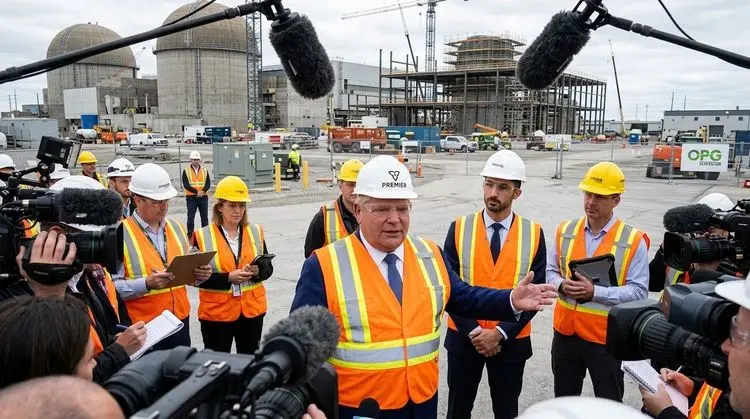
While much of the industrialized world spent the past decade wringing its hands over strained electrical grids and praying for steady breezes, Queen’s Park decided to split more atoms.
Addressing the Empire Club of Canada, Ontario Premier Doug Ford and Energy and Mines Minister Stephen Lecce laid out a multi-decade roadmap designed to turn Canada’s industrial engine into a global energy superpower. The provincial thesis is simple: artificial intelligence data centers, electric vehicle battery gigafactories, and electric arc steel furnaces require staggering amounts of reliable baseload electricity, and intermittent energy sources simply cannot carry that weight alone.
The provincial government's long-term economic projections estimate that Ontario’s nuclear infrastructure strategy could inject up to $800 billion into the gross domestic product over the multi-decade lifespans of these assets. Far from an aspirational talking point, the expansion is already pouring concrete, engineering reactor pressure components, and rewriting the modern playbook for Western energy independence.
The claim that Ontario is orchestrating the largest nuclear and small modular reactor (SMR) expansion in the Western world is backed by heavy capital. At the forefront sits the Darlington New Nuclear Project, operated by Crown utility Ontario Power Generation. The site is slated for a fleet of four BWRX-300 small modular reactors delivering 1,200 megawatts of capacity, representing the first commercial, grid-scale SMR development underway in any G7 nation. The project brings together nuclear technology architects GE Vernova (NYSE: GEV) and Hitachi, Ltd. (TYO: 6501) through their joint venture, supported on the ground by heavy civil contractor Aecon Group (TSX: ARE) and specialized manufacturer BWX Technologies (NYSE: BWXT).
Northwest along the shores of Lake Huron, private operator Bruce Power is laying the groundwork for Bruce C, a monumental pre-development project that could add up to 4,800 megawatts of new generation. If fully realized, this expansion would make the Bruce complex the single largest operating commercial nuclear facility on Earth.
Meanwhile, Ontario is actively extending the longevity of its existing CANDU reactor fleet. Ontario Power Generation is driving the multibillion-dollar life-extension of the Pickering B station and executing the Darlington refurbishment alongside engineering giant AtkinsRéalis (TSX: ATRL), the commercial custodian of CANDU reactor technology. Rather than decommissioning heritage assets, Ontario is systematically resetting the clock on thousands of megawatts of zero-emission baseload power through the late 2050s.
The massive $800-billion economic footprint projected by Queen's Park is calculated across the total design life of this new generation fleet, spanning construction, ongoing operations, fuel supply, and industrial spillovers. Unlike offshore manufacturing or imported infrastructure, roughly 80 to 90 percent of capital deployed in Canada's nuclear sector stays domestic. Specialized boiler makers, precision machinists, high-voltage electrical contractors, and nuclear safety engineers in Ontario form a self-contained ecosystem that retains domestic capital.
Beyond direct construction payrolls, the calculation hinges on economic competitiveness. Modern high-tech industries are fleeing jurisdictions paralyzed by grid bottlenecks and volatile spot electricity pricing. By guaranteeing predictable, stable, and low-carbon baseload rates for the next sixty years, Ontario is positioning its grid as a magnet for domestic and international capital. The province's power sector is already roughly 90 percent emissions-free, with nuclear generating more than half of that total; securing additional nuclear capacity ensures that industrial electrification does not force a retreat to fossil fuels.
A global reactor buildout is meaningless without fuel, and this is where Ontario's expansion intersects with one of the most concentrated resource advantages in the world. Saskatchewan hosts the world’s highest-grade uranium deposits in the Athabasca Basin, while Ontario houses the downstream processing infrastructure to refine it. Primary fuel supplier Cameco Corporation (TSX: CCO, NYSE: CCJ) manages the entire upstream-to-midstream cycle, moving raw yellowcake to its refinery in Blind River and on to the Port Hope conversion facility, with fuel assembly finalized alongside BWX Technologies (NYSE: BWXT).
This integrated supply chain shields the province from the geopolitical supply bottlenecks currently unsettling Western utilities reliant on Russian enrichment services. As European and North American grids scramble to secure certified, Western-aligned nuclear fuel, Canada stands as one of the few nations capable of mining, refining, fabricating, and deploying uranium power entirely within its own borders.
Ontario’s aggressive nuclear push represents a deliberate return to heavy industrial engineering. By committing capital, political capital, and domestic supply chains to a multi-decade atomic expansion, the province is aiming to turn stable, carbon-free megawatts into a long-term economic moat.
Sources
- Ontario Ministry of Energy and Mines: Energy for Generations Plan and SMR Development Roadmap
- The Empire Club of Canada: Keynote Addresses by Premier Doug Ford and Minister Stephen Lecce
- Ontario Power Generation: Darlington New Nuclear Project & Refurbishment Overviews
- Bruce Power: Bruce C Expansion Environmental Assessment and Pre-Development Briefs
- Canadian Nuclear Association: Economic Impact and Domestic Supply Chain Assessments
Disclaimer
Neither the author of this article nor JuniorStocks (juniorstocks.com) holds equity, stock options, or any other financial positions in Cameco Corporation (TSX: CCO; NYSE: CCJ), AtkinsRéalis (TSX: ATRL), Aecon Group (TSX: ARE), BWX Technologies (NYSE: BWXT), GE Vernova (NYSE: GEV), Hitachi, Ltd. (TYO: 6501), or any other companies mentioned in this publication. This content is published by JuniorStocks strictly for informational purposes, was prepared independently without company compensation, and utilized AI assistance for text editing, research synthesis, and formatting. While nuclear energy, small modular reactors (SMRs), and Ontario’s power grid expansion represent a compelling frontier in clean-tech infrastructure and resource development, this article does not constitute investment or financial advice. Investors are strongly advised to conduct their own thorough, independent due diligence and consult with a qualified financial advisor before making any investment decisions.