
The Presidential Portfolio: Wall Street, Washington, and the Ethics of Executive Trading
How a sitting president’s 104-page ethics filing revealed a lucrative masterclass in timing the market, blurring the lines between Oval Office policy and personal profit.
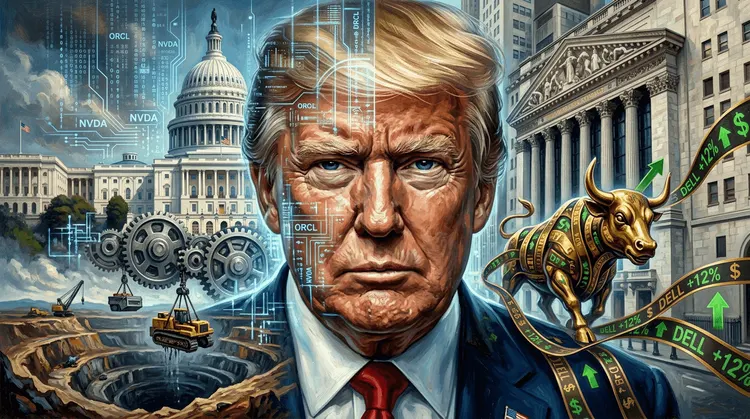
Timing is everything on Wall Street, but it is an entirely different ballgame when your office comes with the nuclear codes and a global microphone.
The newly released Office of Government Ethics financial disclosures for President Donald Trump have sent shockwaves through both Washington and the financial sector. Far from a passive portfolio of mutual funds, the 104-page filing reveals an aggressive, highly lucrative rotation into artificial intelligence, defense contracting, and tech infrastructure, all deeply entangled with the very industries his administration regulates.
The undeniable centerpiece of this unfolding drama involves Dell Technologies (NYSE: DELL). According to the raw filings, the President amassed a personal position worth up to $5 million in the tech giant across a series of transactions spanning February and March of 2026. Fast forward to a White House event on May 8, where Trump stood at a podium to publicly thank Michael and Susan Dell for a staggering $6.25 billion donation to a federal wealth-building program. He then delivered a line that would make any corporate compliance officer break out in hives, flatly telling the American public to go out and buy a Dell because they are great. The company's shares predictably surged twelve percent to an all-time high. Mere days later, the OGE disclosure became public, revealing the Commander-in-Chief had already loaded up on the equity long before delivering his bullish endorsement.
Beyond personal computers, the filings reveal a massive, calculated pivot into the backbone of the modern digital and military economy.
The President’s portfolio is loaded with recent, heavy acquisitions in silicon and software titans like Nvidia (Nasdaq: NVDA), Intel (NASDAQ: INTC), Broadcom (NASDAQ: AVGO), and Oracle (NYSE: ORCL). On the national security front, lucrative entries into defense-tech leaders like Palantir (NYSE: PLTR) and GE Aerospace (NYSE: GE) were executed months ago. Many of these trades conspicuously preceded a flurry of geopolitical flare-ups, AI chip export negotiations, and federal defense spending shifts. Stripped of the political noise, the President's personal ledger is essentially a masterclass in trading a defense-heavy, tech-driven macroeconomic cycle.
Meanwhile, retail investors and online sleuths have been frantically searching the President's personal ledger for mining plays like United States Antimony (NYSE American: UAMY), but they are looking at the wrong balance sheet.
The real mining action is happening on the federal dime.
Under the highly controversial Executive Order 14241 signed in early 2025, the administration effectively bypassed standard congressional disclosures to aggressively purchase direct federal equity in critical mineral supply chains. The administration has quietly pumped taxpayer dollars into direct equity stakes in firms like Lithium Americas (NYSE: LAC) and MP Materials (NYSE: MP). Congress is now fiercely investigating whether any administration officials hold undisclosed personal stakes in the very companies receiving these unprecedented state-sponsored equity bailouts.
The overlap of private enterprise and public policy becomes even murkier when examining the wider Trump family’s ventures. Donald Trump Jr. and Eric Trump are closely tied to Skyline Builders, an investment vehicle that recently agreed to merge with the mining group Cove Kaz Capital to develop what is being billed as a massive tungsten project in Kazakhstan. That specific project is currently seeking an additional $400 million in financing from the U.S. Defense Department’s Office of Strategic Capital, a request that is raising major ethical red flags given the direct familial link to the administration holding the purse strings.
Amid the frenzy of these financial revelations, a wave of digital misinformation has swept across the internet, attempting to conflate these presidential ethics forms with the broader market's regulatory calendar. Many internet commentators have mistakenly claimed that these personal disclosures are part of a wider institutional reveal. It is vital to separate Trump's individual federal OGE disclosures from the Securities and Exchange Commission's 13F filings. The mid-May 13F deadline is a strict legal requirement for institutional hedge funds and massive asset managers managing over $100 million to show their hands, completely distinct from the personal financial diary of a sitting president.
Ultimately, the disclosures paint a picture of a White House where the lines between personal wealth generation, family business ventures, and federal economic policy have been thoroughly, and perhaps permanently, erased.
Sources: Office of Government Ethics (OGE) Form 278-T Disclosures, May 2026. Executive Order 14241: Advancing American Mineral Independence, March 2025. U.S. Securities and Exchange Commission, Form 13F Reporting Guidelines. U.S. Defense Logistics Agency and Office of Strategic Capital Public Contract Records, 2026.