The Mining Sector’s $2.1 Trillion Challenge to Meet 2050 Demands
The global mining industry faces a $2.1 trillion investment gap to meet the raw material demands for a net-zero emissions future by 2050, according to BloombergNEF’s annual Transition Metals Outlook.
The world is on the brink of a monumental energy shift, and the mining industry is at the heart of it. According to BloombergNEF’s (BNEF) latest Transition Metals Outlook, the mining sector will need a staggering $2.1 trillion in new investments by 2050 to meet the raw material demands necessary for a net-zero emissions future. With the global push toward greener technologies like electric vehicles (EVs), wind turbines, and energy storage systems, the pressure on raw material supply is increasing exponentially.
Overview of BloombergNEF Report
BNEF’s Transition Metals Outlook presents a sobering yet essential call for massive investments in the mining sector. The report outlines how critical raw materials, particularly energy transition metals such as aluminum, copper, and lithium, are in danger of falling short of meeting future demands. Despite a decade of robust growth in metals supply, the current availability is far from enough to sustain the acceleration required for the green energy transition.
The Importance of Investment in the Mining Industry
The race to net-zero by 2050 is more than just a climate goal—it’s an economic one. With $2.1 trillion needed to fund new mining projects, the industry faces an unprecedented demand for investment. This funding will be vital in ensuring that critical metals are not only available but are extracted, processed, and recycled sustainably.
Current State of Raw Material Availability
Over the last decade, the global supply of transition metals has grown considerably, driven by a combination of technological advancements and increased mining operations. However, the demand for these materials continues to outpace supply, creating a significant gap that could threaten the world's progress toward a low-carbon economy.
The past ten years have seen an increase in metal production to support new technologies, but this growth hasn't kept up with surging demand. While the mining industry has expanded its capacity, it remains far from being able to meet the future needs of a net-zero world.
With existing supplies running thin, BNEF warns that critical shortages of metals like copper, aluminum, and lithium could become more pronounced as early as this decade. These shortages could severely impact the development of key technologies, slowing down the progress toward a cleaner energy future.
Critical Energy Transition Metals and Supply Deficits
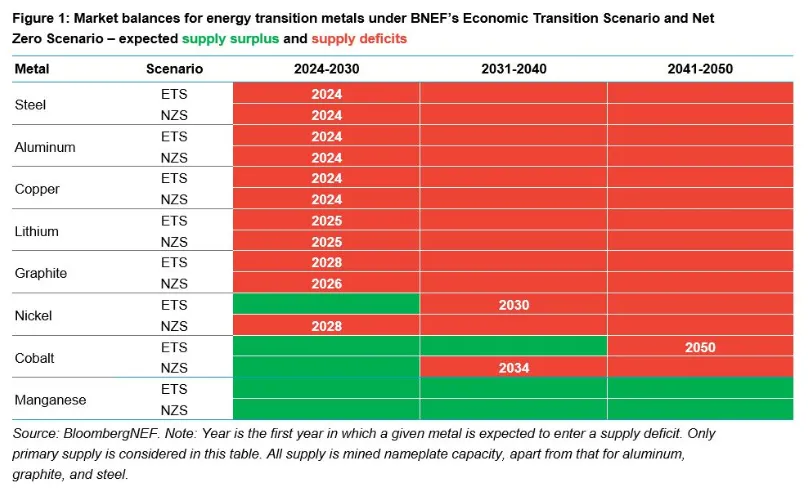
Aluminum plays a pivotal role in the manufacturing of EVs, wind turbines, and solar panels. Its lightweight and highly conductive properties make it indispensable for the energy transition. However, BNEF forecasts a looming supply deficit that could hinder production in various sectors.
Copper is the backbone of electrification, with its usage extending across renewable energy infrastructure, electric vehicles, and charging stations. With its demand set to surge, copper could face one of the largest deficits in the metals market, potentially stalling electrification efforts globally.
Lithium, the key component in electric vehicle batteries, is expected to face extraordinary demand growth in the coming years. As automakers ramp up EV production, lithium supply could fall short, jeopardizing the ambitious electrification targets set by many nations.
BNEF warns that the deficits in aluminum, copper, and lithium could emerge as soon as this decade, with some metals facing critical shortages before 2030. This would pose a significant risk to the energy transition and could lead to higher costs for green technologies.
The Economic Transition Scenario (ETS) by BloombergNEF
BNEF’s Economic Transition Scenario estimates that between 2024 and 2050, the world will need 3 billion tonnes of metals to support low-carbon solutions. This figure rises dramatically to 6 billion tonnes when considering the ambition to achieve net-zero emissions by 2050.
Achieving a net-zero world by 2050 requires far more than current mining capacity can offer. BNEF’s report stresses the importance of scaling up production across the board, from mining operations to refining processes, to meet the needs of a decarbonized global economy.
Challenges in Meeting the Demand for Transition Metals
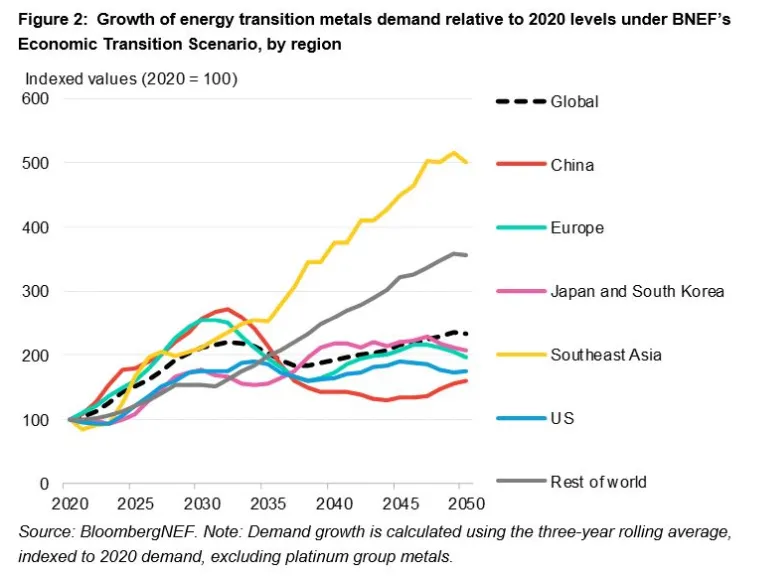
BNEF’s outlook highlights that the pace of demand growth for transition metals will vary significantly by region. While global demand continues to rise, certain regions will experience peaks and plateaus at different times, driven by varying policies and industrial growth rates.
China, the world's largest consumer of transition metals, has seen its consumption surge in recent years. However, according to BNEF, China's demand is expected to peak by 2030, at which point other regions will likely take the lead in metals consumption.
By the 2030s, Southeast Asia is projected to become the fastest-growing market for transition metals. With rapid industrialization and increasing energy demands, countries in this region will require vast quantities of raw materials to fuel their energy transitions.
Recycling as a Solution to Ease Supply Pressure
Recycling is poised to play a crucial role in mitigating the pressure on raw material supply. BNEF forecasts that secondary sources of metals will become increasingly vital, helping to fill the gaps left by primary production.
Governments worldwide will need to implement robust policies that support recycling efforts. These policies include establishing collection networks, setting recovery rate requirements, and creating frameworks for second-life battery management. Without these, recycling's potential may not be fully realized.
Government Policies Crucial for Mining Industry Success
Governments must enact policies that encourage the recycling of batteries and other stationary storage systems. Doing so will not only alleviate the supply deficit but also foster a more sustainable and circular economy.
Effective regulations will drive innovation and investment in recycling technologies, reducing the reliance on virgin raw materials and contributing to a more resilient supply chain.
The Future of the Mining Industry
Looking ahead, strategic investments will be critical for the mining industry to meet future demands. These investments must focus on sustainable practices, expanding production capacity, and advancing recycling technologies.
Achieving the ambitious goals set for 2050 will require global cooperation, with governments, industries, and investors aligning their efforts to ensure a steady and sustainable supply of raw materials.
Conclusion
The mining industry is at the forefront of the global energy transition, but it faces unprecedented challenges in meeting future demand. With $2.1 trillion in new investments required by 2050, the industry must act now to scale up production, improve recycling efforts, and work closely with governments to establish supportive policies. As the world shifts toward a net-zero future, the success of this transition will largely depend on the mining sector’s ability to deliver the critical materials needed to power green technologies.