Supply and Demand: The Story of Asia's Thermal Coal Imports
China's Dominance in the Global Thermal Coal Market
 Editorial Team (ET)October 1, 2026
In December, Asia witnessed a remarkable surge in its imports of seaborne thermal coal, reaching a record high. This surge was primarily driven by China's insatiable demand for coal during the peak winter season. However, despite this robust demand, the prices of thermal coal remained relatively stable, mainly due to substantial increases in exports from Indonesia and Australia, the two largest suppliers of coal used predominantly for electricity generation.
Record-Breaking Imports
Asia's imports of seaborne thermal coal in December soared to an impressive 83.69 million metric tons. This marked a substantial increase from the 78.87 million tons recorded in November, setting a new record high. The data, compiled by commodity analysts Kpler, dates back to January 2017, emphasizing the significance of this milestone.
China's Voracious Appetite
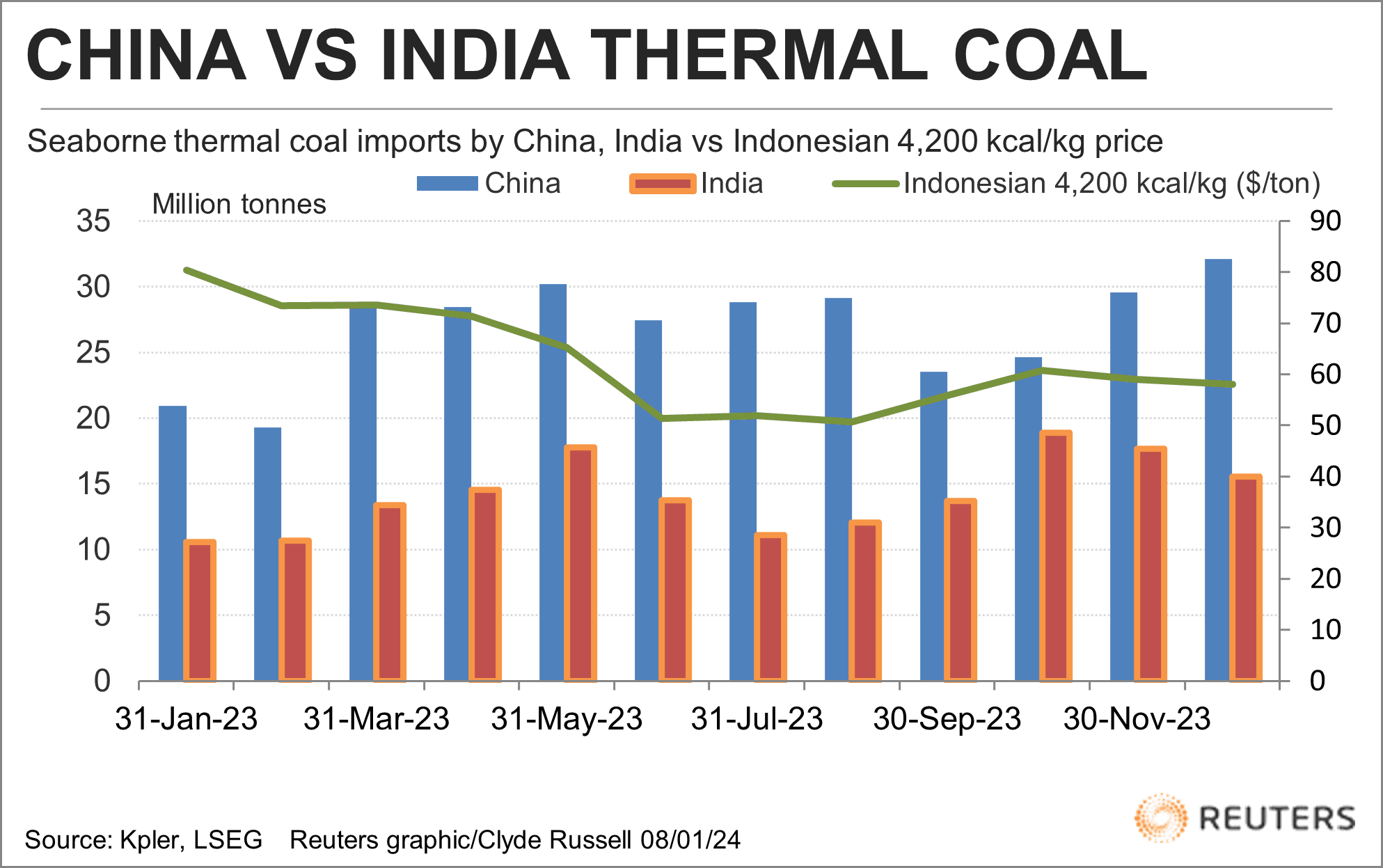
China played a pivotal role in driving this surge, with seaborne thermal coal imports reaching an astonishing 32.08 million tons in December. This figure, also a record high according to Kpler, demonstrated China's growing appetite for imported thermal coal in 2023. The increase in coal-fired power generation, driven by lower hydropower output and rising electricity demand, was a result of the country's modest recovery from the economic impact of Beijing's strict zero-COVID policy.
It is worth noting that China's domestic coal production also experienced a significant uptick, with November output reaching a daily record high of 13.8 million tons, surpassing the previous peak of 13.5 million tons set in March the previous year. Over the first 11 months of 2023, China, as the world's largest coal producer, consumer, and importer, witnessed a 2.9% increase in production, reaching 4.24 billion tons.
Competitive Imports
Despite the surge in domestic coal production, imported coal remained competitive in China, primarily due to lower prices for the main grades of Indonesian and Australian coal that constitute a significant portion of the country's imports. Indonesian coal, with an energy content of 4,200 kilocalories per kilogram (kcal/kg), saw prices drop to $57.82 per metric ton in the week ending January 7, hitting a two-month low and marking a 36% decrease compared to the start of 2023. Australian coal, with an energy content of 5,500 kcal/kg, also experienced a decline last week, falling to $93.23 per ton, a five-week low, and a 30.1% drop from the same week in 2023.
India's Influence
One of the reasons the strong demand for Indonesian thermal coal did not translate into higher prices is India, the second-largest coal importer, reducing its purchases. In December, India imported 15.53 million tons of seaborne thermal coal, a decrease from 17.65 million tons in November and the lowest volume since September. Additionally, India diversified its coal suppliers by increasing imports from South Africa, with the swing supplier to both the Atlantic and Indian basins seeing volumes rise to 2.78 million tons in December, up from 2.67 million in November. South Africa's share of India's imports in December reached 17.9%, a significant increase compared to the 9.6% share in July the same year.
Demand Dynamics
The pricing dynamics for lower energy coal grades are influenced by softer demand from Japan and South Korea, Asia's third- and fourth-largest importers, respectively. Japan's seaborne thermal coal imports increased in December to 10.64 million tons, up from 8.79 million in November. However, this figure still fell short of the 11.87 million tons imported in December 2022. South Korea imported 7.30 million tons in December, compared to 6.10 million in November, but below the 7.55 million recorded in December the previous year.
Japan and South Korea primarily procure coal priced against Australian 6,000 kcal/kg fuel. This grade reached $131.99 per ton on January 5, reflecting a decrease for three consecutive weeks. The peak for this grade during the current northern winter is significantly lower than the peaks of around $415 per ton observed during the winter of 2022-23. During that period, concerns over the loss of Russian coal and pipeline natural gas following Moscow's invasion of Ukraine had caused energy crisis worries in Europe.
Supply vs. Demand
In summary, the seaborne thermal coal market in Asia is characterized by a surge in supply, which has effectively offset strong demand from China. The outlook for the first quarter of 2024 hinges on whether China continues to prioritize imports or shifts towards greater reliance on domestic coal production and non-fossil fuel alternatives such as hydro, wind, and solar power.
Conclusion
Despite record-breaking imports of seaborne thermal coal in Asia, prices have remained subdued due to the ample supply from Indonesia and Australia. China's insatiable appetite for coal, driven by increased coal-fired power generation, has been a significant factor in this surge. However, India's reduced coal purchases and changing suppliers, along with softer demand from Japan and South Korea, have contributed to the stable pricing environment. The future of the thermal coal market in Asia will depend on whether China maintains its import-focused strategy or shifts towards greater reliance on domestic production and alternative energy sources.