
Robert Kiyosaki Sounds the Alarm - The Crash Is Now, Not Coming
As financial markets tremble, Rich Dad Poor Dad author Robert Kiyosaki doubles down on his warnings, urging a radical shift toward gold, silver, and Bitcoin to survive what he calls a premeditated global economic collapse.
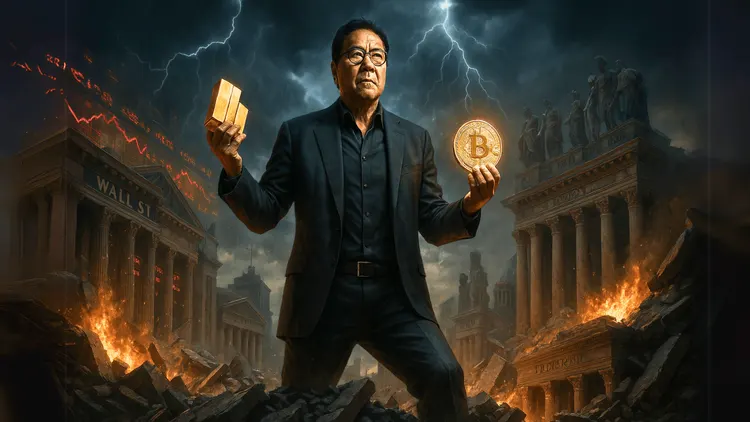
When Robert Kiyosaki speaks, millions of people listen. The best-selling author of Rich Dad Poor Dad has once again ignited global conversations after his April 13, 2025 post on X, where he declared with finality: “The crash has arrived.” For years, Kiyosaki has warned about the fragility of the global financial system. Now, with gold at record highs, silver demand booming, and Bitcoin charging past psychological barriers, he says the signals are undeniable. It’s not just a correction—it’s a reckoning.
Kiyosaki’s warning comes at a time of extraordinary global volatility. From the halls of Wall Street to the central banks of Europe and Asia, uncertainty is setting off alarms. Financial markets are teetering, governments are grappling with unsustainable debt, and inflation remains stubbornly persistent in major economies. Yet it’s not just economic metrics that concern him—it’s the entire foundation on which the modern monetary system rests. And in his eyes, that foundation is cracked beyond repair.
He puts the blame squarely on what he calls the “corrupt and crooked US dollar.” To him, fiat currencies—especially the greenback—have been weaponized and manipulated by a tight circle of unelected central bankers. He names names: the Federal Reserve, the European Central Bank, the Bank of Japan, the Bank of England, and the Bank for International Settlements. Together, Kiyosaki argues, they form a “sinister global banking cartel” that has manufactured a debt-fueled illusion of prosperity.
But illusions don’t last forever.
To support his claim that the financial crash has arrived, Kiyosaki points to the explosive rise in gold and Silver Prices. Gold recently soared to an all-time high, propelled not only by investor fear but by central banks themselves. China, Russia, India, and other emerging economies have been aggressively stockpiling bullion, steadily distancing themselves from dollar-dependence. Silver, long overlooked, is now catching fire. Its industrial applications—from solar panels to electric vehicles—are surging, even as retail investors race to secure it as a hedge against systemic risk.
Then there’s Bitcoin. Once dismissed as a fad, the world’s most famous cryptocurrency has surged back into the spotlight. Bitcoin has not only regained its momentum but has surpassed previous highs, trading as both a digital gold and a decentralized escape hatch from fiat collapse. In Kiyosaki’s view, Bitcoin is more than a trade—it’s a survival strategy.
“Please LISTEN to Gold, Silver, & Bitcoin. What are they telling you?” Kiyosaki urged his followers. His call to action is clear: abandon traditional financial instruments before they implode. That includes stocks, bonds, ETFs, and mutual funds. In his eyes, these vehicles are loaded with risk, tied to an outdated system that’s nearing its breaking point. The new reality, he says, demands a new approach—one based on real assets, not paper promises.
And this isn’t the first time he’s raised the alarm.
In 2023, Kiyosaki coined the phrase “THE EVERYTHING BUBBLE,” warning that the confluence of overvalued real estate, stocks, government bonds, and derivatives could create a financial catastrophe more severe than the crash of 1929. His critics called him alarmist. But many of his predictions—rising inflation, supply chain fragility, government overreach, and geopolitical economic warfare—have played out almost word-for-word.
Kiyosaki’s harshest words, however, are reserved for the education system. He believes the financial illiteracy perpetuated by schools and universities is partly responsible for the crisis. “Go back to college, get another degree, get deeper in debt with more student loans and learn nothing about money… much less… learn nothing about the real world of money?” he scoffs. In his world, real education isn’t about textbooks—it’s about survival.
To that end, Kiyosaki advocates a personal financial revolution. He’s not just warning people—he’s urging them to take action. Start buying gold and silver, accumulate Bitcoin, and step outside the matrix of centralized control. In his words, those who listen may become “the new rich and the new leaders of the world.”
It’s a bold vision, but it’s catching on.
Gold dealers are reporting historic demand. Silver shortages are becoming more common in the retail market. And crypto platforms are seeing new users flood in at the fastest pace since the last Bitcoin bull run. In this new reality, diversification no longer means splitting between stocks and bonds. It means unplugging from the traditional system altogether.
What makes Kiyosaki’s message resonate so powerfully is his ability to frame finance in moral terms. He doesn’t see this crash as an accident—it’s a consequence. A consequence of decades of financial mismanagement, institutional arrogance, and public complacency. And for those who refuse to see what’s coming, he offers no sympathy.
That’s what makes his April 13th post feel like more than just another tweet. It’s a line in the sand. Even financial giants like BlackRock have started to sound alarms. In recent days, the world’s largest asset manager issued a rare warning about the trajectory of the U.S. economy, noting structural weaknesses, declining productivity, and elevated risk in the bond market. When BlackRock starts to echo Kiyosaki, you know something serious is brewing.
So what does the average person do?
Kiyosaki’s answer is straightforward: think for yourself. Don’t wait for the government or your financial advisor to save you. Don’t trust the headlines that say everything is fine. And above all, don’t keep your wealth in assets tied to a crumbling system.
Instead, he champions self-reliance. Physical gold and silver stored safely away from the banking system. Bitcoin stored in cold wallets, beyond the reach of surveillance and seizure. A mindset that prioritizes sovereignty over convenience. And a refusal to be lulled into complacency by promises of “soft landings” or “transitory inflation.”
To his supporters, he’s a prophet. To his critics, a doomsayer. But in an age where mainstream narratives are constantly shifting, and trust in institutions is rapidly eroding, Kiyosaki’s consistency is striking. He doesn’t pretend to have all the answers, but he believes the old answers no longer apply.
As the world watches markets sway and governments scramble to reassure the public, one thing is clear: Robert Kiyosaki isn’t backing down. If anything, he’s doubling down.
And whether you agree with him or not, it’s impossible to ignore the growing number of people who believe he might just be right.
Conclusion
Robert Kiyosaki’s stark warning that “the crash has arrived” may sound apocalyptic to some, but to others, it’s a clarion call to action. In a world of manipulated currencies, ballooning debt, and opaque central banking, his message is simple—trust hard assets, not hollow promises. Whether it’s gold in your hand, silver in your vault, or Bitcoin in your digital wallet, the future Kiyosaki envisions belongs to those who choose independence over dependence, action over fear, and truth over illusion.