
Navigating the Nickel Surge: The Rise of Tier-1 Junior Mining Companies
Geopolitical supply shocks and Indonesian quota cuts are transforming safe-haven exploration companies into the battery industry's most valuable strategic assets.
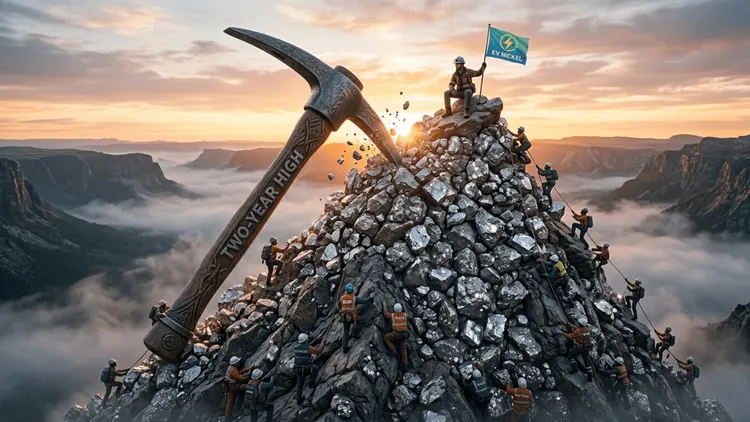
Base metal traders woke up this morning to a board bathed in green, with nickel leading the charge. Futures on the London Metal Exchange have surged roughly 10% since the onset of the Iran conflict, catapulting the battery metal to an intraday peak of $19,350 a ton, a level we have not sniffed since the summer of 2024. While the headline number is flashy, the real story is playing out in the trenches of the junior mining sector, where exploration companies are suddenly finding themselves holding the winning tickets in a high-stakes geopolitical lottery.
The current price action is a textbook example of a supply shock meeting inelastic demand. Indonesia, the undisputed heavyweight champion of global nickel production, has aggressively slashed its mining quotas in a calculated effort to prop up industrial metal prices. This artificial bottleneck is strangling the supply of mixed-hydroxide precipitate (MHP), a critical intermediate product for electric vehicle batteries. Combine that with a global sulfur shortage sparked by the ongoing geopolitical turmoil in the Middle East, sulfur being a non-negotiable reagent for both Indonesian MHP processing and African copper leaching, and you have a recipe for a full-blown supply chain panic.
This geopolitical chaos has birthed a massive jurisdictional premium, and junior explorers sitting on Tier-1 assets in North America and Australia are the immediate beneficiaries. Automakers and battery manufacturers are terrified of overseas export controls and vulnerable shipping routes like the Strait of Hormuz. They want secure, conflict-free, Class 1 nickel. As a result, exploration outfits operating in safe havens are seeing their valuations decouple from the broader market lethargy. For instance, Canada Nickel Company (TSXV:CNC), with its massive Crawford sulphide project in Ontario, and FPX Nickel (TSXV:FPX), advancing the Baptiste deposit in British Columbia, are positioned perfectly to capitalize on this Western desperation for homegrown battery metals.
The downstream panic is also reigniting the mergers and acquisitions pipeline. Major producers like BHP Group (ASX:BHP) and Vale S.A. (NYSE:VALE) have spent the better part of the last decade chronically underinvesting in greenfield exploration. Now that the supply deficit is knocking at the door and spot prices are comfortably floating above the $19,000 mark, these behemoths are evaluating their options. They need to secure future resources, and it is often vastly cheaper and faster to buy out successful juniors like Magna Mining (TSXV:NICU) or Talon Metals (TSX:TLO) than it is to build an exploration arm from scratch. For retail investors, this creates a highly lucrative dynamic: the ultimate goal for these junior companies isn't necessarily to pour concrete and build a mine, but to de-risk a massive deposit just enough to trigger a buyout from a desperate major.
It is also impossible to ignore the environmental mandates reshaping the space. The automotive giants are demanding low-carbon supply chains, meaning "dirty nickel" processing methods are falling out of favor. Junior explorers are smartly pivoting to geological formations that naturally sequester carbon or can be plugged directly into renewable hydroelectric grids, making their potential product a premium commodity in an increasingly eco-conscious market.
The junior mining market is historically a graveyard of broken dreams and empty drill holes. But in an era defined by Indonesian export games, sulfur shortages, and a frantic scramble for clean energy metals, the narrative has flipped. For the explorers holding the right ground in the right postal code, the 2026 nickel squeeze isn't just a pricing anomaly; it is an incredibly rare window of opportunity.
Source: Bloomberg News, "Nickel Rises to Two-Year High as Supplies From Indonesia Tighten" (April 27, 2026).