
Lutnick Signals Washington Could Tap Lockheed, Northrop Next
After the Intel stake, Lutnick signals defense contractors may be next in Washington’s new era of economic statecraft.
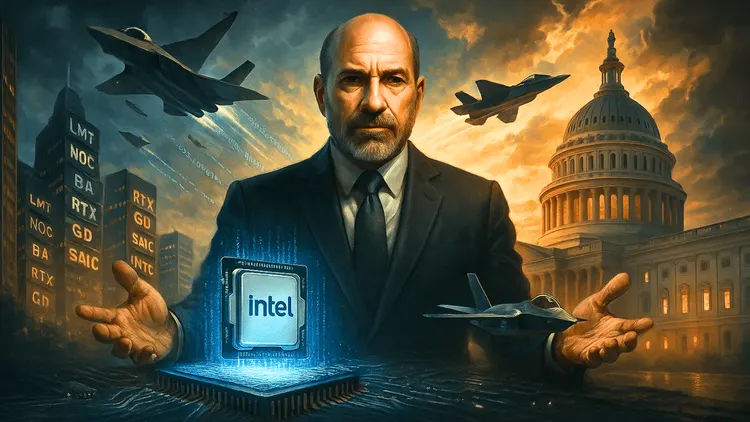
US Commerce Secretary Howard Lutnick has placed the defense sector squarely in Washington’s sights after a groundbreaking deal that saw the government take nearly a 10 percent stake in Intel Corp. (Nasdaq: INTC). The $8.9 billion move stunned Wall Street, signaling that the Trump administration is prepared to use equity stakes as a tool of statecraft. Lutnick’s comments this week made clear that semiconductors may only be the beginning.
Lockheed Martin and the Economics of War
Pressed on whether defense contractors might face similar arrangements, Lutnick singled out Lockheed Martin Corp. (NYSE: LMT), which generates nearly three quarters of its sales from the US government. Describing the aerospace giant as “basically an arm of the US government,” he asked pointedly, “What’s the economics of that?” Lockheed’s role in supplying advanced weapons systems such as the F-35 and F-22 has long made it central to America’s military posture. Lutnick’s remarks underscored a new willingness to explore financial leverage alongside procurement policy.
The Market Reacts
Defense stocks surged immediately after the interview. Lockheed Martin (NYSE: LMT) shares advanced as much as 1.7 percent, while Northrop Grumman Corp. (NYSE: NOC) added 1.2 percent. The rally reflected investor belief that government partnerships, even unconventional ones, could boost balance sheets in a sector already benefiting from historic levels of defense spending.
The Intel Precedent
The Intel stake was financed with previously allocated funds from the Chips and Science Act and the Secure Enclave program, bringing total federal support to more than $11 billion. The government has no board seat and no direct control, but the symbolism was unmistakable: Washington is no longer content to merely subsidize critical industries, it wants equity in return. President Trump’s second term has embraced this aggressive blend of nationalism and capitalism, upending traditional boundaries between state and market.
Financing America’s Arsenal
Lutnick left open the question of how far this strategy will extend, pointing to munitions financing as a central debate for the administration. “There’s a lot of talking that needs to be had about how do we finance our munitions acquisitions,” he said. The implication was clear: if taxpayers are underwriting America’s arsenal, taxpayers might also deserve a slice of the upside.
Strategic Leverage Beyond Defense
The Commerce Secretary also invoked US universities, supply chains, and rare earths as areas where federal funding essentially builds private enterprise from the ground up. With China dominating global rare earth magnets, Lutnick suggested that government equity stakes could serve as a tool to safeguard supply chains while securing taxpayer benefits.
A New Bargain Between State and Market
For Lutnick, the Intel deal is a template for a broader bargain. If companies rely heavily on taxpayer support, the government should not be a “pushover.” Instead, it should demand a share of the profits. This thinking echoes earlier debates over public stakes in banks during the 2008 crisis, but today’s context is different: the focus is on long-term strategic industries central to national security and technological supremacy.
Conclusion
Lutnick’s remarks reflect a profound shift in US industrial policy. Defense contractors such as Lockheed Martin (NYSE: LMT), Northrop Grumman (NYSE: NOC), Boeing Co. (NYSE: BA), RTX Corp. (NYSE: RTX), General Dynamics Corp. (NYSE: GD), and Science Applications International Corp. (NYSE: SAIC) now face the prospect of deeper financial entanglement with Washington. What began with Intel (Nasdaq: INTC) may extend into the heart of America’s defense-industrial complex. Investors are already taking note, and the line between private profit and public investment is becoming increasingly blurred.
The question now is not whether the government will act again, but where it will strike next.