
"We Have the Lowest Amount of Antimony Since WWII" - US Antimony CEO Sounds Alarm
How U.S. Antimony Corp. is navigating geopolitical risks, depleted stockpiles, and government urgency to secure America’s critical mineral future.
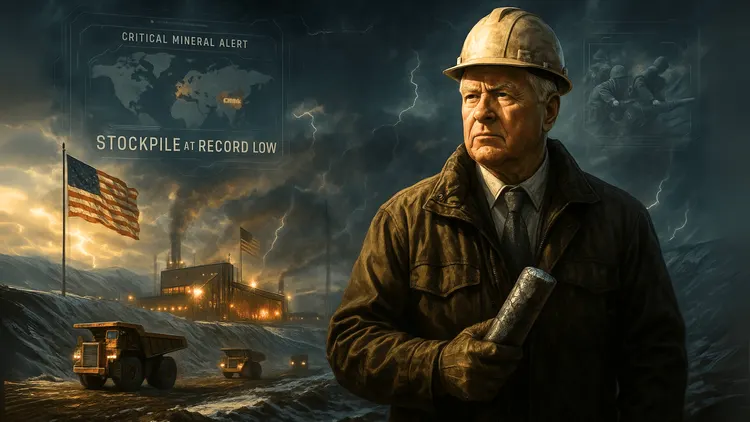
In an era where supply chains have become geopolitical flashpoints, antimony has emerged as one of the most strategically sensitive metals in the United States’ defense and industrial portfolio. Gary Evans, Chairman and CEO of United States Antimony Corp., says Washington isn’t just watching — it’s pushing. In a candid discussion with Bloomberg, Evans revealed that the federal government wants the company to expand operations, with urgency fueled by China’s stranglehold on the global antimony market.
Washington’s Newfound Focus on Antimony
Antimony isn’t a household name, but in the corridors of the Pentagon, it’s top-tier priority. The Department of Defense ranks it as the number one critical mineral, vital for munitions, missile guidance systems, night vision optics, and other advanced military technologies. The problem is stark: the U.S. produces none of it domestically, while China controls 65% of global reserves and 85% of downstream processing.
With the U.S. military dependent on foreign sources, the Biden and Trump administrations alike have sounded alarms. Under the current administration, Evans says responsiveness from Washington has been swift, with weekend government turnaround times on requests — a rarity in federal operations — signaling how high this issue sits on the national agenda.
The Alaska and Montana Connection
United States Antimony Corp. is not starting from scratch. The company already operates the only two active antimony smelters in North America — one in Montana, one in Mexico. But mining is where the shortfall lies. Evans disclosed that the company has been securing leases in Alaska and Montana, including nearly 30,000 acres in Alaska alone, with plans to restart production from properties mined two decades ago.
Permitting remains the bottleneck. Applications filed in Alaska in May are still awaiting approval, a delay Evans attributes to an entrenched bureaucratic culture where federal agencies, environmental groups, and other stakeholders can stall mining projects for years. Despite these hurdles, the company anticipates moving its first truckloads of Alaskan antimony to Montana within the next month.
A Strategic Mineral Under Siege
The stakes escalated in September when China abruptly banned all antimony exports, cutting off the U.S. military’s supply overnight. Since then, U.S. Antimony has been in high-level talks with the Pentagon and the Defense Logistics Agency. Evans says the government’s antimony stockpile has fallen to its lowest level since World War II — a dangerous position given America’s simultaneous military commitments to Ukraine and Israel.
China’s export ban isn’t the only obstacle. Earlier this year, Chinese customs seized a shipment of Australian-origin antimony bound for the company’s Mexican smelter, holding it for 90 days without explanation. The incident forced intervention from the State Department and the White House. The shipment was eventually returned to Australia before being re-routed to Mexico, underscoring the fragility of supply chains.
Government Support Without Direct Investment — For Now
While parallels are being drawn to MP Materials’ $400 million Department of Defense investment in rare earths, Evans says U.S. Antimony’s current negotiations are different. The company has a $450 million market cap and access to capital, but what it needs most is strategic backing and streamlined logistics. However, Evans leaves the door open for future government equity participation, particularly if the company builds additional smelters or expands into other critical minerals such as tungsten and cobalt.
The Path to Antimony Independence
Evans believes the United States can achieve complete antimony self-sufficiency within three to five years, sourcing entirely from the U.S., Canada, and Mexico. Canada, he notes, is a “very pro-mining” jurisdiction and is already being treated by the Department of Defense as a domestic source. Mexico poses more uncertainty under a new, mining-skeptical president, though U.S. Antimony’s existing operations there are grandfathered in.
The bigger challenge is aligning permitting processes with strategic needs. Even with supportive rhetoric from Washington, delays in environmental and bureaucratic reviews threaten to undermine the country’s ability to meet its defense requirements on time.
An Urgent National Security Imperative
The message from U.S. Antimony’s leadership is clear: the antimony shortage is not theoretical — it is real, present, and pressing. With the lowest government reserves in decades, ongoing geopolitical tensions, and a Chinese export ban unlikely to be lifted in our lifetimes, Evans frames the situation as a race against time.
The U.S., he insists, has the resources and capability to secure its own supply, but only if policy follows priority. If the current momentum in Washington holds, the next few years could see the U.S. reclaim control over one of its most strategically important minerals.
Conclusion
Antimony may not yet be a household term, but in the world of defense readiness and industrial resilience, it is as critical as oil or steel once were. The combination of Chinese export bans, depleted stockpiles, and rising military demand has thrust this obscure metal into the center of national security planning. U.S. Antimony Corp. stands at the nexus of government urgency and market necessity, with expansion plans that could redefine America’s mineral independence over the next half decade.