
What If Canada Never Sold Its Gold? The $144 Billion Question at $4,400 per Ounce.
Unveiling the Billion-Dollar Bet: How Canada Cashed Out on Gold and What It Means Today
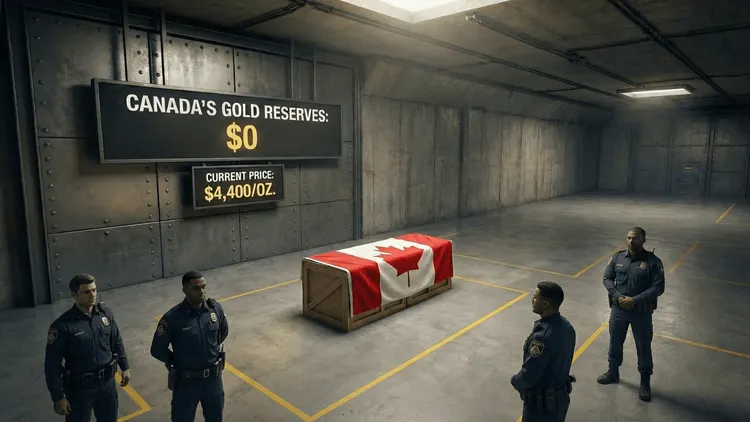
Picture this: a country blessed with vast mineral wealth, a top global gold producer, yet its central bank vaults echo with emptiness where bullion once gleamed. That's Canada in 2026, the lone G7 outlier holding zero official gold reserves after a decades-long divestment spree that now sparks heated debate amid skyrocketing precious metal prices. As gold futures flirt with $4,385 per troy ounce on this crisp January 2 morning, one can't help but wonder if Ottawa's bold bet against the yellow metal was a stroke of fiscal genius or a glittering folly that's cost billions.
The saga begins in the mid-20th century, when Canada's gold holdings hit their zenith at 1,023 tonnes in 1965, valued at a modest $1.15 billion under the era's fixed exchange rates. Fast-forward to the post-Bretton Woods world, where the U.S. ditched the gold standard in 1971, and the rationale for hoarding non-yielding assets began to crumble. By the late 1970s, the Bank of Canada embarked on a systematic sell-off, adopting a formal policy in 1980 to liquidate reserves in favor of more liquid, interest-earning alternatives. The drawdown accelerated: holdings halved to about 500 tonnes by 1985, plummeted to 46 tonnes by 2000, and trickled to mere ounces by the early 2010s. The final curtain fell in 2016, when the last coins were auctioned off, leaving Canada's official stash at zilch.
Defenders of the move, including past Bank of Canada officials, have long championed it as savvy stewardship. Gold, they argue, is a relic, an "antique instrument" that generates no income while demanding pricey storage and security. In a nation deeply intertwined with the U.S. economy through trade and currency ties, swapping bullion for U.S. dollars, Treasuries, and other bonds made perfect sense, providing yields and liquidity for potential crises. After all, Canada hasn't dipped into its reserves for currency intervention since 1998, and the portfolio has grown steadily through interest and prudent management. It's a philosophy that prioritizes practicality over the allure of shiny bars, treating reserves as tools for stability rather than speculative bets.
Yet, as gold's value has erupted, climbing over 65% in the past year alone amid inflation fears, geopolitical jitters, and a dash of de-dollarization drama, the opportunity cost stings like a missed lottery ticket. If those 1,023 tonnes still sat in Canadian coffers, they'd command roughly $144 billion at today's spot price, eclipsing the nation's entire foreign exchange reserves of about $128 billion as of late December 2025. Early sales in the 1980s caught peaks around $400 to $800 per ounce, but even reinvesting those proceeds at average bond yields of 4-5% annually pales against gold's long-term surge, which has outpaced many fixed-income returns in this turbulent era. The 2016 finale, executed when prices hovered near $1,200-$1,300, now looks particularly prescient in reverse, missing a near quadrupling in value.
Meanwhile, the rest of the world is on a gold-buying binge, with central banks snapping up over 1,000 tonnes annually for the last three years as a hedge against uncertainty. From the U.S. to Germany, G7 peers maintain hefty allocations, viewing gold as a timeless diversifier in an age of ballooning debts and volatile fiat currencies. Canada's solitary stance raises eyebrows among analysts, who question if it leaves the loonie more exposed to global shocks without that metallic buffer. As a leading gold miner, pumping out 31% more in recent years, the irony is thick: the nation extracts fortunes from the ground but lets none linger in its own ledgers.
In the end, Ottawa's gold purge may have been a rational play in a bygone low-volatility world, but today's glittering highs paint it as a historic head-scratcher. With no signs of a policy U-turn from the Bank of Canada, the debate simmers on: was ditching the gold a prudent pivot or a billion-dollar blunder? As prices push boundaries, the answer tilts ever more toward the latter, a cautionary tale for reserve managers everywhere.