
U.S. Deploys Pentagon AI to Control Germanium, Gallium, Antimony, and Tungsten Pricing
How a Pentagon algorithm and a proposed 50-nation tariff alliance aim to bypass traditional commodity markets and secure America's heavy metal supply chain.
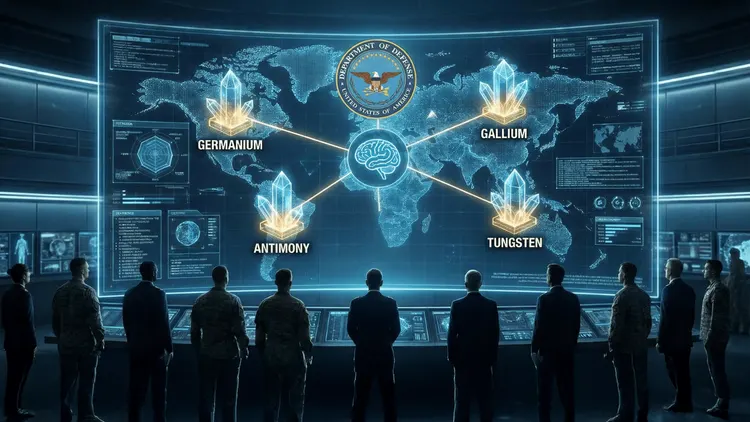
Forget everything you know about how global commodities are priced. The Trump administration is bringing military-grade artificial intelligence to the metals market, effectively telling traditional supply-and-demand mechanics to take a back seat. According to recent February 2026 reports, the White House is preparing to deploy a Pentagon-developed AI system to establish reference prices for a highly strategic basket of critical minerals: germanium, gallium, antimony, and tungsten.
The engine behind this ambitious overhaul is the Department of Defense’s OPEN program, which stands for Open Price Exploration for National Security. Launched by the Defense Advanced Research Projects Agency (DARPA) in 2023, the OPEN AI model isn't interested in the current market price of a metal. Instead, it calculates what a mineral should cost by factoring in the realities of labor, processing, and raw inputs. The objective is to entirely strip out the market-distorting effects of foreign dumping, specifically from China, which has historically produced these critical materials at a massive loss to bankrupt Western competitors.
To pull off this algorithmic feat, the administration is bringing in serious data muscle. Financial intelligence heavyweight S&P Global (NYSE: SPGI) and Finnish data firm Rovjok are actively supplying the data pipelines and technical assistance required to train and maintain the AI pricing framework.
This technological pivot is born out of financial necessity. Previously, the administration had entertained the idea of providing direct, taxpayer-funded price floors to individual U.S. mining companies to keep them afloat. However, a lack of congressional funding quickly derailed that strategy. Enter Vice President JD Vance, who recently outlined a bold alternative: a proposed international metals trading alliance comprising the United States and over 50 partner nations.
Within this proposed trading bloc, the AI-generated reference prices will act as the structural backbone. Rather than handing out subsidies, the coalition intends to enforce these fair-market prices using flexible, adjustable tariffs. If a non-allied nation attempts to flood the market with artificially cheap antimony or tungsten, the tariff wall will automatically adjust to protect the bloc's internal pricing integrity.
The choice of germanium, gallium, antimony, and tungsten for the program's maiden voyage is highly calculated. These four minerals are notoriously thinly traded, making accurate price discovery incredibly difficult even on a good day. More importantly, they are the irreplaceable building blocks of modern national security. Gallium and germanium are the lifeblood of advanced semiconductors, fiber optics, and next-generation missile defense radars. Antimony and tungsten are critical for armor-piercing ammunition, night vision technology, and hardening the steel required for military assets.
Naturally, the strategy is not without its skeptics. Automakers and defense contractors who rely heavily on these minerals are understandably nervous about whether this AI-enforced trade bloc will permanently inflate their raw material costs. Furthermore, the administration still faces the monumental diplomatic task of convincing dozens of allied nations to actually sign on the dotted line and adopt this unified pricing framework.
Ultimately, the goal is to give Western mining operations the financial certainty they desperately need to break ground on new projects. By utilizing artificial intelligence to outsmart suspected market manipulation, the United States is betting that a unified, data-driven trade alliance can successfully break foreign chokeholds on the supply chains of tomorrow.
Sources: Information for this article was synthesized from February 2026 exclusive reporting by Reuters and Fastmarkets regarding the Department of Defense's OPEN AI program, public policy proposals from Vice President JD Vance regarding the 50-nation critical minerals trading bloc, and verified data partnership confirmations involving S&P Global (NYSE: SPGI) and Rovjok.