
How Can Investors Benefit from Citigroup's Buy-the-Dip Advice?
Seizing the Opportunity: Citigroup Advises Buying Global Stocks on the Dip
 Gabriel ThomasOctober 4, 2026
In the world of finance, timing is often the key to success. Investors are constantly seeking opportunities to maximize their returns while minimizing risks. Today, we delve into the insights provided by Citigroup Inc. strategists, who are suggesting that the current market conditions are ripe for seizing a golden opportunity – buying the dip in global stocks as interest rates approach their peak.
Understanding the Citigroup Inc. Perspective
Citigroup Inc., a renowned financial institution, has a team of strategists led by Beata Manthey. According to their analysis, there is a compelling case to be made for entering the global equities market after a recent pullback, which had pushed stocks perilously close to entering correction territory. Their forecast? A substantial 15% surge in the MSCI All-Country World Local Index by mid-2024. This optimistic outlook is based on their perception of "more balanced macroeconomic risks."
The Strategy: Focusing on Cyclical Stocks
The Citigroup strategists are leaning towards sectors closely tied to the economic cycle – aptly named "cyclical stocks." Their rationale rests on several factors, including their anticipation of a peak in interest rates, a mild deceleration in economic growth, and a gradual easing of inflationary pressures.
Beata Manthey elaborated on their approach, stating, "Until recently, our year-end targets implied down markets and increased volatility. After the last selloff, we see a more attractive entry point. We would buy dips, as advised by our Bear Market Checklist." This checklist comprises various metrics, including stock valuations, the yield curve, investor sentiment, and profitability, helping investors gauge the opportune moments to enter the market.
The Impact of Rising US Bond Yields
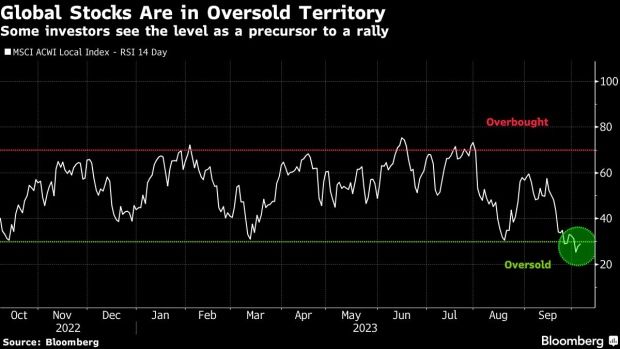
Recent weeks have seen a surge in US bond yields, causing considerable turbulence in financial markets. Concerns are mounting among investors that central banks may maintain a hawkish stance for an extended period. The MSCI all-country index felt the reverberations, plunging by as much as 9% this week from its peak on July 31. This downturn brought it tantalizingly close to the 10% threshold that defines a technical correction, before rebounding somewhat.
Among the casualties of the rising yields are US technology stocks. Higher interest rates translate to a greater discount on the future profitability of growth stocks, particularly those with lofty valuations. Despite the expectation that interest rates will remain elevated for an extended period, Beata Manthey argues that growth stocks are now oversold. As a result, she has upgraded her rating on global technology stocks to overweight.
Navigating Regional Preferences
Beata Manthey has a track record of insightful market analysis. Earlier this year, she correctly predicted that European stocks would outperform their US counterparts due to lower valuations and subdued fund flows. While she briefly shifted her optimism to the US market in March, her current stance favors European equities once more.
However, it's worth noting that her perspective on UK stocks has dimmed recently. She has downgraded UK stocks to "underweight" in her latest note. Her reasoning includes the FTSE 100 index's defensive orientation and its exposure to the energy sector, which she anticipates will face challenges as oil prices potentially retreat.
Alternative Viewpoints
While Citigroup Inc. strategists are optimistic about the current market environment, it's essential to acknowledge alternative viewpoints. Bank of America Corp. strategist Michael Hartnett, for instance, has voiced concerns about overselling in both stocks and bonds. In contrast to Citigroup's perspective, he anticipates a more challenging economic landing as a consequence of sustained high-interest rates.
In conclusion, Citigroup Inc. strategists believe that the time is ripe to buy global equities after a recent dip, citing more balanced macroeconomic risks and an attractive entry point. However, investors should carefully consider their own risk tolerance and financial goals when making investment decisions, and it's always wise to consult with financial experts for personalized advice.